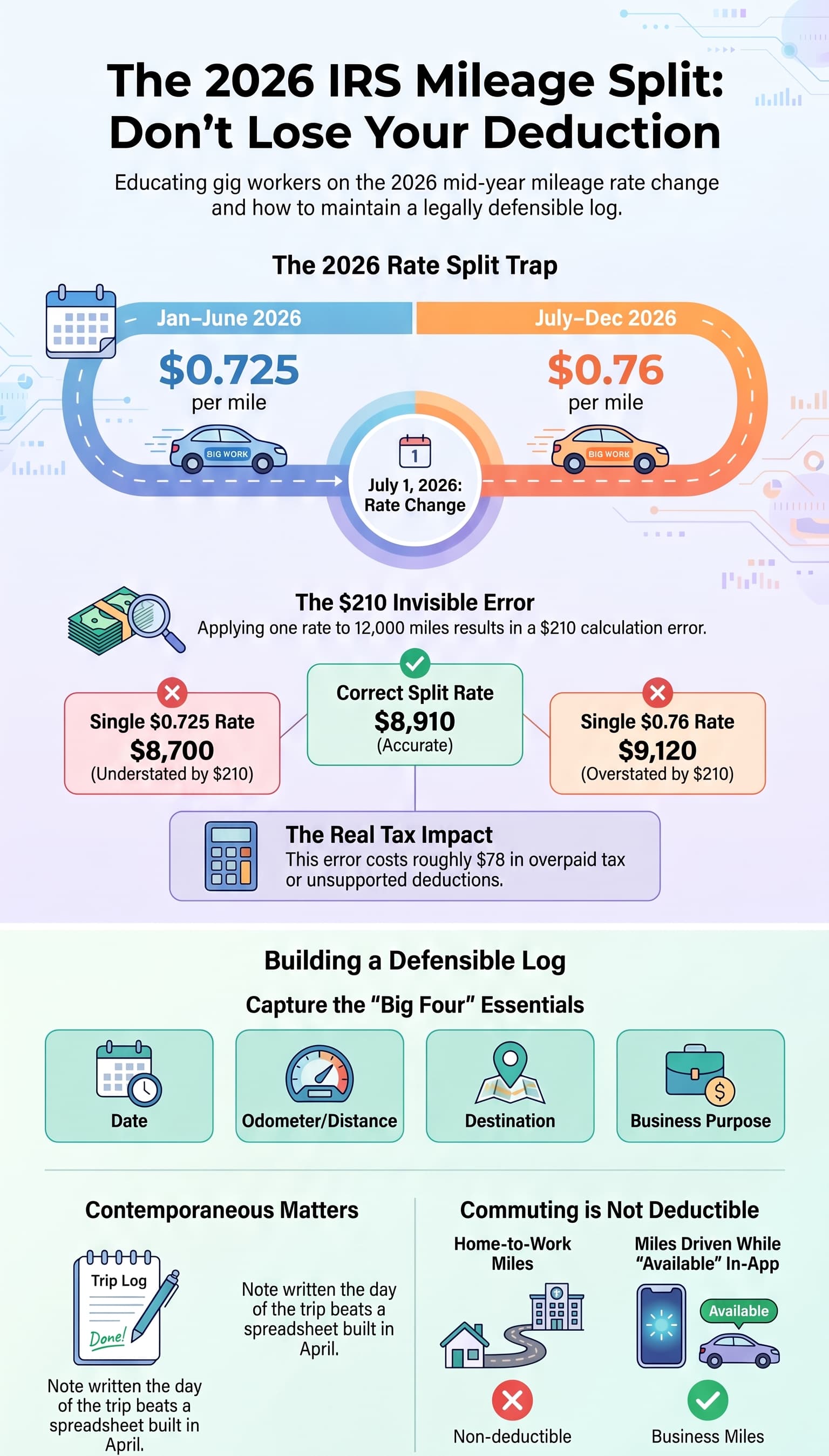
The IRS mileage rate changed in the middle of 2026. Miles driven through June 30 deduct at $0.725; miles from July 1 onward deduct at $0.76. If you apply one rate to the whole year — which is what almost every mileage app and spreadsheet template does — a 12,000-mile year comes out $210 wrong, and the error is invisible because the arithmetic is internally consistent.
What the split actually costs
Take a driver covering 1,000 business miles a month, evenly across the year:
| Period | Miles | Rate | Deduction |
|---|---|---|---|
| January – June | 6,000 | $0.725 | $4,350 |
| July – December | 6,000 | $0.76 | $4,560 |
| Correct total | 12,000 | $8,910 |
Now the two ways people get it wrong:
- One rate all year at $0.725: 12,000 × $0.725 = $8,700. Understated by $210 — you pay tax on $210 you did not have to.
- One rate all year at $0.76: 12,000 × $0.76 = $9,120. Overstated by $210 — a deduction you cannot support.
At a combined 15.3% self-employment rate plus a 22% marginal bracket, that $210 is roughly $78 in either direction. Small — until you notice that the same mistake repeats every year a rate changes, and that the overstated version is the one that has to be defended if anyone asks.
Why the deduction gets lost even when the miles were driven
The mileage deduction is not usually lost to bad math. It is lost because there is no record, and the IRS is explicit that expenses get forgotten when they are not written down as they happen. Reconstructing a year of driving from memory in April produces a number nobody can stand behind, including you.
What a defensible log contains, per trip:
- The date. This is what makes the mid-year rate split possible at all — without dates, there is no way to separate first-half miles from second-half miles, and the whole year collapses onto one rate.
- Starting and ending odometer readings, or the trip distance.
- Where you went.
- The business purpose — "delivery shift, downtown zone" is enough; "work" is not.
Contemporaneous matters more than beautiful. A note written the day of the trip carries weight that a tidy spreadsheet built in April does not.
Commuting is not business mileage
The most expensive misunderstanding in this area: driving from home to your first work location and home from your last one is commuting, and commuting is never deductible — no matter that you are self-employed, and no matter that the drive is long.
For gig drivers the line lands in a specific place. Miles driven while the app is on and you are available for work, and miles between drop-offs, are business miles. The drive from your house to the neighbourhood where you start, and home again at the end, generally are not. Log them separately from the start; separating them a year later is guesswork.
Standard mileage or actual expenses — decide before the first trip
You have two methods, and the choice has a consequence people discover too late.
Standard mileage multiplies business miles by the IRS rate. Simple, and it needs only the log above.
Actual expenses deducts the business-use share of what the car really costs: fuel, insurance, repairs, depreciation, registration. It needs receipts for all of it, plus the mileage log anyway to establish the business-use percentage.
The trap: if you want the option of using the standard rate in later years for a car you own, you generally have to use it in the first year the car is placed in service. Choosing actual expenses first can close the door on switching back. Whichever you pick, keep the log — both methods require it.
What to write down for everything else
Mileage is one line of a Schedule C. The same discipline applies to the rest, and the reason is the same — records are what turn a claim into a deduction:
- Gross receipts, including income no 1099 reports. Every dollar counts as income whether a platform reports it or not.
- Purchases and supplies, with the receipt attached to the transaction.
- Equipment, where the $2,500 de minimis safe harbor lets you expense an item per invoice rather than depreciate it — but only if the invoice shows the per-item price.
- Home office square footage and the bills behind it.
The four dates this all feeds
Records are not for April. They are for the four times a year you have to pay: April 15, 2026, June 16, 2026, September 15, 2026, and January 15, 2027. Each of those is a moment when you need a current profit figure, and a current profit figure needs current records.
Skipping estimated payments has its own cost, and there is a safe harbor worth knowing: pay 100% of last year's total tax across the four instalments — 110% if your prior-year AGI exceeded $150,000 — and the underpayment penalty does not apply, even if this year turns out bigger. We work through the mechanics in the safe harbor rule explained.
Frequently Asked Questions
Do I need to log every single trip, or can I estimate?
Every trip. The rules expect records adequate to establish each element of the expense — the amount, the date, the place, and the business purpose. An estimate is not a record, and a mileage figure with nothing behind it is the first thing to fall in a review. The practical version is a note per trip, written the same day.
Does an app satisfy the requirement?
Yes, if it captures date, distance, destination and purpose, and you keep the data. Electronic records are acceptable and are held to the same standards as paper. Check one thing first: whether it applies both 2026 rates by date. Many apply one rate to the whole year, which is exactly the error this article opens with.
Which rate applies to a trip on June 30?
$0.725. The higher $0.76 rate applies to miles driven on or after July 1, 2026. The split is by date driven, not by when you were paid or when you record it — another reason each trip needs its own date rather than a monthly total.
If I drive for two platforms, do I keep separate logs?
One log is fine, and it is easier to keep. The miles deduct the same way regardless of which app was running. Note the platform per trip if you want to know which one is actually profitable per mile — but for the deduction itself, total business miles by date is what matters.
What if I have no log for the first half of the year?
Reconstruct what you can from evidence that already exists — platform trip histories, delivery records, calendar entries, bank records tied to specific jobs — and be conservative where the evidence runs out. Then start a real log today. A partial year documented properly is worth considerably more than a full year of round numbers.
Work Out What the Driving Actually Leaves You
Miles are only half the picture. What matters is what remains after fuel, wear, self-employment tax and the hours the driving actually takes.
The Gig Worker True Earnings Calculator takes your weekly earnings, hours and miles and returns the real hourly figure after vehicle costs and tax — using the same mid-year rate split described here, so the answer matches what your return will say.