One of the biggest fears for self-employed people is getting hit with an IRS underpayment penalty because their income was hard to predict. The Safe Harbor rule eliminates this risk entirely — if you meet the threshold, the IRS cannot charge you an underpayment penalty, even if you end up owing thousands more at tax time.
This guide explains exactly how the Safe Harbor rule works, which threshold applies to you, and how to calculate the right quarterly payment to stay protected. You can also use our Quarterly Tax Estimator to get your personalized Safe Harbor amounts automatically.
What Is the Safe Harbor Rule?
The IRS Safe Harbor rule is a provision that protects taxpayers from underpayment penalties as long as they've paid a minimum amount in estimated taxes throughout the year — regardless of what they actually end up owing.
In practical terms: if you pay the Safe Harbor amount across four quarterly installments, the IRS cannot charge you the underpayment penalty when you file — even if your actual tax liability turns out to be much higher than what you paid.
You'll still owe the difference between what you paid and what you actually owe when you file your annual return. Safe Harbor doesn't eliminate that balance due — it eliminates the penalty on top of it.
The Two Safe Harbor Thresholds
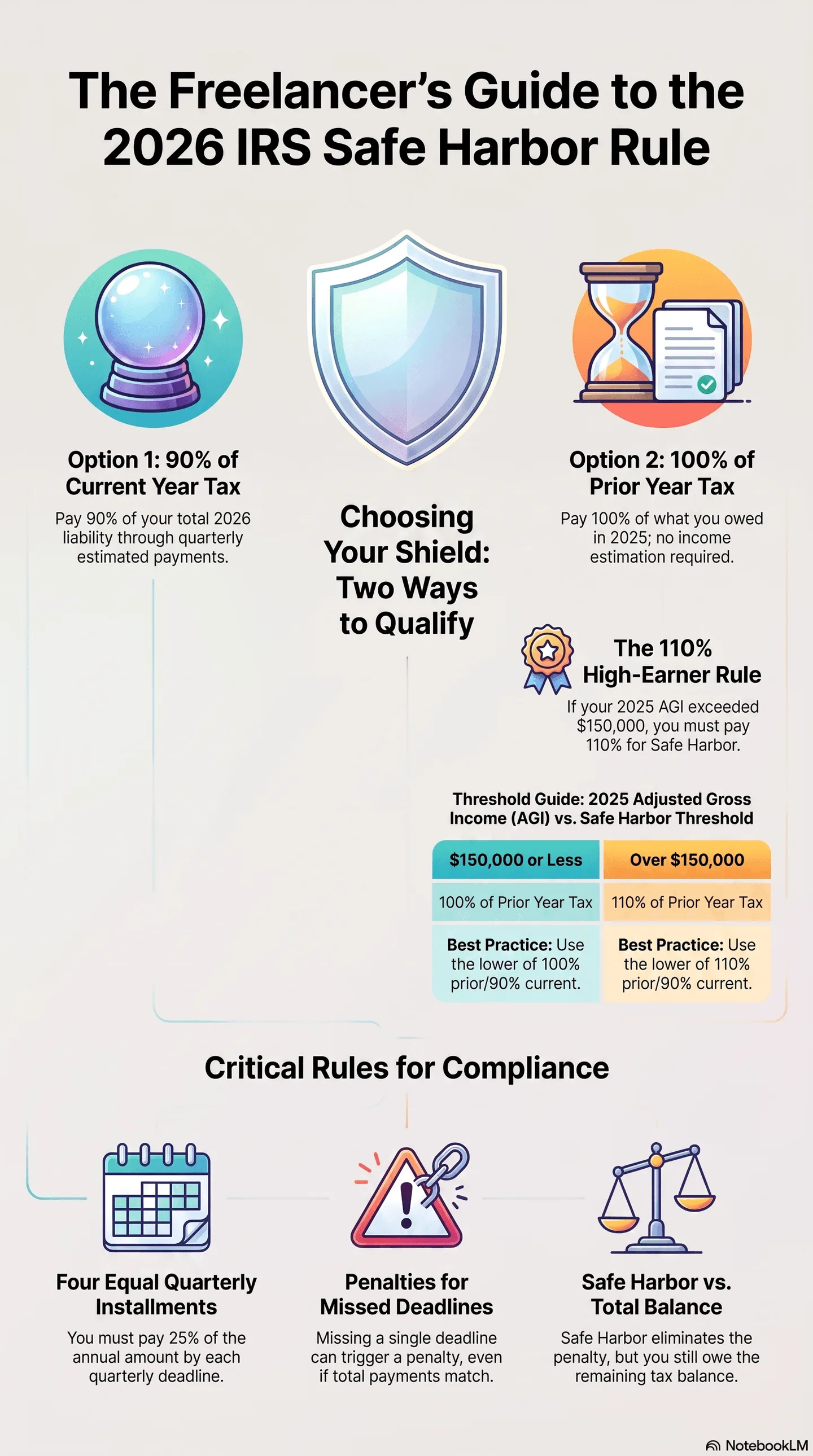
There are two ways to qualify for Safe Harbor in 2026. You only need to meet one of them:
Option 1: 90% of Current Year Tax Liability
Pay at least 90% of what you'll actually owe for the current year (2026) in estimated payments throughout the year. This requires accurately projecting your current year income — which is straightforward if your income is stable but difficult if it's volatile.
Option 2: 100% (or 110%) of Prior Year Tax Liability
Pay at least 100% of what you owed in the prior tax year (2025), spread across four equal quarterly payments. This is the simpler option for most freelancers — you already know exactly what you owed last year, so there's no estimation required.
The 110% rule: If your prior year adjusted gross income (AGI) exceeded $150,000, you must pay 110% of last year's tax liability (not 100%) to qualify for Safe Harbor. This affects higher-income freelancers and is a commonly missed detail.
| Prior Year AGI | Safe Harbor Threshold | Method |
|---|---|---|
| $150,000 or less | 100% of prior year tax OR 90% of current year tax | Use whichever is lower |
| Over $150,000 | 110% of prior year tax OR 90% of current year tax | Use whichever is lower |
A Step-by-Step Example
Scenario: A freelance consultant whose 2025 total federal tax was $18,000. AGI was $130,000 (below the $150,000 threshold). In 2026, income increases significantly to $200,000.
Safe Harbor calculation:
- Option 1 (90% of current year): 90% × estimated $45,000 = $40,500 — but this requires projecting 2026 income, which is hard
- Option 2 (100% of prior year): 100% × $18,000 = $18,000 — simple and certain
- Since $18,000 is lower, use Option 2: pay $4,500 per quarter
Result at year-end: They owe $45,000 total for 2026. They've paid $18,000 through quarterly estimates. They owe $27,000 when they file in April — but they owe zero underpayment penalty because they met the Safe Harbor threshold.
Without Safe Harbor, the penalty on $27,000 underpaid over the year would be roughly $1,500–$2,000. Safe Harbor eliminates this entirely.
Why Most Freelancers Should Use the Prior-Year Safe Harbor
The 90% current-year option sounds appealing — if your income drops, you'd pay less. But it requires accurate income projection, and if you estimate wrong, you lose Safe Harbor protection.
The prior-year option is simpler and completely predictable. You know exactly what you paid last year, divide by four, and pay that amount each quarter. No estimation required, no risk of getting it wrong.
The tradeoff: if your income drops significantly, you'll overpay estimated taxes and get a refund at filing. Most freelancers consider this an acceptable tradeoff for the certainty and simplicity.
When the 90% Current-Year Option Makes More Sense
There are situations where tracking your current-year liability makes more financial sense:
- Your first year of self-employment: You have no prior year self-employment tax to base the prior-year calculation on. You must estimate current-year liability.
- Your income dropped significantly: If you earned $150,000 last year but expect to earn $60,000 this year, the prior-year method would have you overpaying by thousands. Tracking actual income lets you pay much less each quarter.
- You have a CPA who tracks your income quarterly: If someone is actively monitoring your tax position, the 90% method can save cash flow while still avoiding penalties.
How to Apply Safe Harbor Across Four Quarters
Safe Harbor applies on an installment basis — each quarterly payment must be made by the corresponding deadline. It's not enough to make up underpaid quarters later in the year.
| Quarter | Deadline | Amount Due (Safe Harbor) |
|---|---|---|
| Q1 2026 | April 15, 2026 | 25% of annual Safe Harbor amount |
| Q2 2026 | June 15, 2026 | 25% of annual Safe Harbor amount |
| Q3 2026 | September 15, 2026 | 25% of annual Safe Harbor amount |
| Q4 2026 | January 15, 2027 | 25% of annual Safe Harbor amount |
Missing a quarterly deadline — even if you pay the same total amount later — can result in a penalty for that specific quarter. Each installment must be paid by its deadline to maintain full Safe Harbor protection.
Safe Harbor and State Taxes
Most states that have income tax have their own Safe Harbor rules for estimated payments, generally mirroring the federal structure (100% of prior year or 90% of current year). The thresholds and specifics vary by state.
For state estimated taxes, search "[your state] estimated tax safe harbor" for your state's specific rules. California, New York, and other high-income-tax states all have their own versions of this rule.
What Safe Harbor Doesn't Protect You From
Safe Harbor only protects against the underpayment penalty. It does not:
- Eliminate the balance due when you file your annual return
- Protect you from late payment penalties if you don't pay your balance by April 15
- Apply to state taxes automatically (each state has separate rules)
- Protect you if you make payments after the quarterly deadlines
Calculate Your Safe Harbor Amount
Our Quarterly Tax Estimator calculates your quarterly payment using both the current-year estimate method and the prior-year Safe Harbor method — and tells you which one results in a lower quarterly payment for your specific situation. It also generates a personalized 2026 payment calendar with all four deadlines.
Frequently Asked Questions
Does Safe Harbor apply to self-employment tax as well as income tax?
Yes. The Safe Harbor calculation covers your total federal tax liability, which includes both income tax and self-employment tax. When you look at your prior year tax return, the Safe Harbor base is your total tax on Line 24 of Form 1040 — which includes SE tax.
What if I miss a quarterly deadline by a few days?
The IRS calculates underpayment penalties on a daily basis, so a late payment still results in a penalty for the days it was late — even if it's only a few days. That said, a small late payment incurs only a small penalty. The key is to pay as close to the deadline as possible if you can't make it exactly on time.
Can I use Safe Harbor if I'm also receiving W-2 income?
Yes. If you have both W-2 and self-employment income, your Safe Harbor calculation includes your total prior-year tax liability (from all sources). Your W-2 withholding counts toward the Safe Harbor threshold — meaning if your employer withholds enough, you may not need any additional estimated payments even with significant freelance income.
What form do I use to report the Safe Harbor calculation?
You don't need to file anything special to claim Safe Harbor protection. If you owe a penalty, you report it on Form 2210 when you file your annual return. If you met Safe Harbor, you simply check the appropriate box on Form 2210 (or let your tax software handle it) and no penalty is assessed.
Is there a Safe Harbor for first-year self-employed people?
The prior-year Safe Harbor doesn't apply in your first year of self-employment (since you had no prior-year self-employment tax). For your first year, you use the 90% current-year method. Estimate your income conservatively and recalculate each quarter as your actual income becomes clearer. The IRS also has an annualized income installment method (Form 2210 Schedule AI) that can help first-year freelancers with variable income avoid penalties.