Most freelancers significantly underpay their taxes — not because they make mistakes on their returns, but because they miss deductions they were entitled to claim all year. Every dollar of deductible business expense reduces your taxable income, which reduces both your income tax and your self-employment tax.
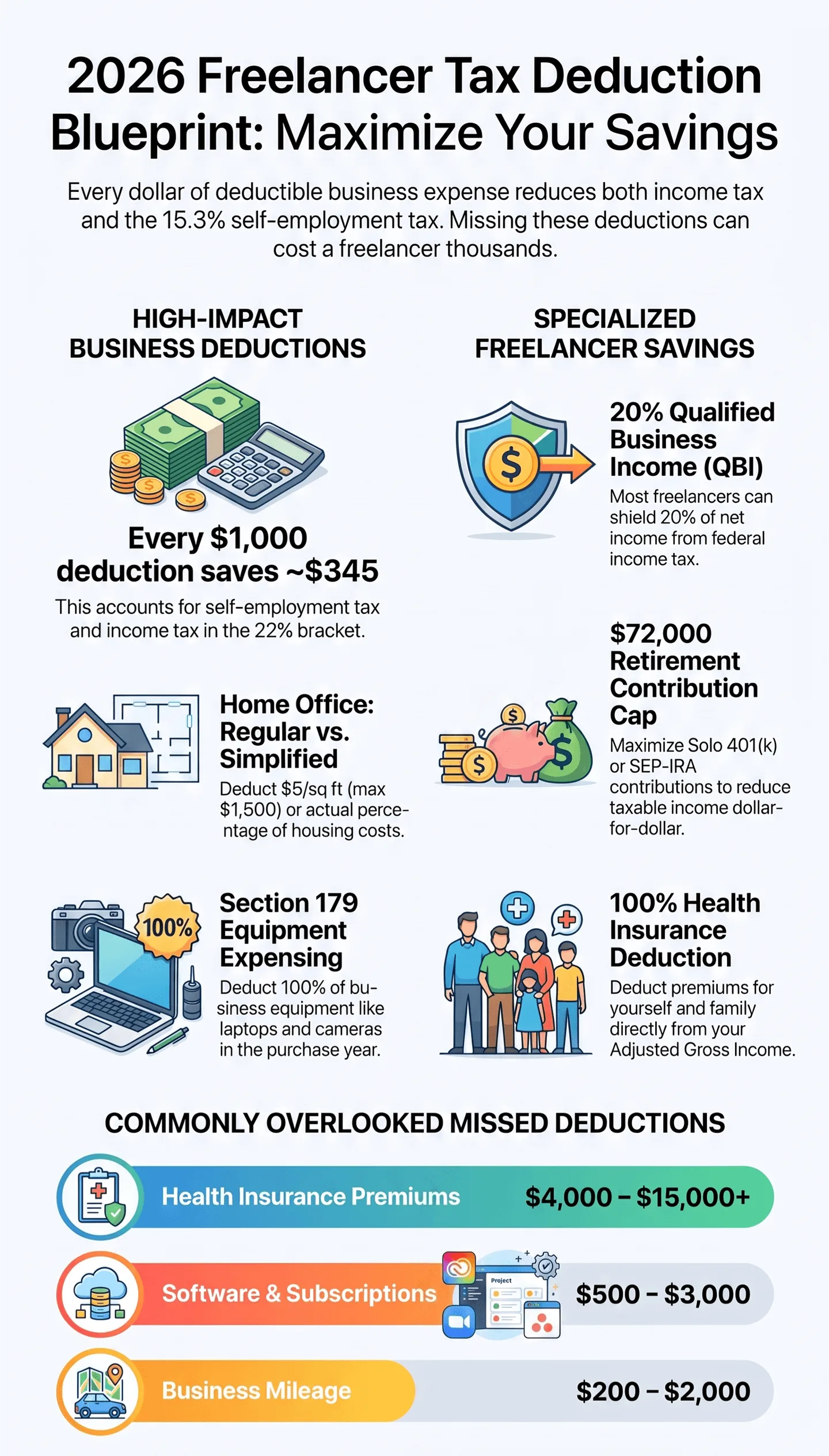
This checklist covers every major deduction category available to self-employed people in 2026. Use our Quarterly Tax Estimator to see how your deductions reduce your quarterly payment obligation.
How Self-Employed Deductions Work
As a self-employed person, you report income and expenses on Schedule C. Your net profit (income minus expenses) is what gets taxed — both for income tax and self-employment tax purposes. This means every $1,000 in legitimate business deductions saves you:
- $141 in self-employment tax. The 15.3% rate applies to 92.35% of your net profit, not the full amount — so each $1,000 of deduction saves $1,000 × 92.35% × 15.3%, not a flat $153.
- Plus income tax on most of that $1,000. Because half your SE tax is itself deductible, a $1,000 expense lowers your AGI by about $929 rather than the full $1,000 — worth roughly $204 at the 22% rate.
Combined, a $1,000 deduction saves a freelancer in the 22% bracket about $345 — or closer to $300 if you also claim the QBI deduction, since a smaller business profit means a smaller QBI deduction too. Missing $10,000 in deductions costs roughly $3,000–$3,450 in unnecessary tax.
The Complete Deductions Checklist
1. Home Office Deduction
If you use part of your home regularly and exclusively for business, you can deduct that portion of your housing costs.
Two methods:
- Simplified method: $5 per square foot, up to 300 square feet ($1,500 maximum). No depreciation calculation required.
- Regular method: Calculate the percentage of your home used for business (e.g., a 150 sq ft office in a 1,500 sq ft home = 10%), then deduct 10% of rent/mortgage interest, utilities, insurance, and repairs. Higher deduction but more documentation required.
Key rule: The space must be used regularly and exclusively for business. A dining table where you occasionally work doesn't qualify. A dedicated room or clearly defined office area does.
Estimated annual value: $1,500–$8,000+ depending on home size and location.
2. Equipment and Technology
Business equipment can be deducted in full in the year of purchase (Section 179 expensing) or depreciated over time. For most freelancers, Section 179 makes more sense.
Deductible items include:
- Computers, laptops, tablets, monitors
- Printers, scanners, external drives
- Cameras, microphones, lighting (for content creators)
- Smartphones (business-use percentage)
- Office furniture (desk, chair, filing cabinet)
Mixed-use rule: If you use a device for both business and personal purposes, deduct only the business-use percentage. Keep a log if the split is audited.
3. Software and Subscriptions
Software used for your business is fully deductible as a business expense:
- Design tools (Adobe Creative Cloud, Figma, Canva Pro)
- Project management (Asana, Notion, Monday)
- Communication (Slack, Zoom Pro)
- Accounting (QuickBooks, Wave, FreshBooks)
- Cloud storage (Dropbox, Google Workspace)
- Website hosting and domain registration
- Email marketing tools
- AI tools used for business (Claude Pro, ChatGPT Plus, etc.)
- Stock photo and asset subscriptions
Track these monthly. Subscriptions are easy to forget, especially annual ones paid early in the year.
4. Phone and Internet
Deduct the business-use percentage of your monthly phone and internet bills. If you use your phone 60% for business, deduct 60% of the bill. Most freelancers deduct 50–80% of phone and internet costs.
Documentation tip: The IRS accepts a reasonable estimate of business vs. personal use. You don't need to track every call — a written statement of your typical usage percentage is generally sufficient.
5. Professional Services
Fees paid to professionals for business purposes are fully deductible:
- CPA and tax preparation fees
- Bookkeeper fees
- Business attorney fees
- Consultant fees
- Virtual assistant costs
- Freelancer payments (subcontractors you hire)
Note on subcontractors: If you pay a subcontractor $600 or more in a calendar year, you must issue them a Form 1099-NEC. Failure to do so doesn't eliminate your deduction, but it can create IRS complications.
6. Business Insurance
Premiums for business-related insurance are deductible:
- Professional liability insurance (E&O insurance)
- General liability insurance
- Business property insurance
Health insurance is handled separately (see below).
7. Health Insurance Premiums
Self-employed individuals can deduct 100% of health insurance premiums paid for themselves, their spouse, and dependents — as an adjustment to income, not just a Schedule C deduction. This means the deduction reduces your AGI directly, which also reduces your income tax (though not SE tax).
Eligibility: You must not be eligible for employer-sponsored health insurance through a spouse's plan. If your spouse has coverage available to you through their employer, even if you don't take it, you may not qualify for this deduction.
Estimated annual value: $4,000–$15,000+ depending on your plan.
8. Retirement Contributions
Contributions to self-employed retirement accounts reduce your taxable income dollar-for-dollar:
- SEP-IRA: Roughly 20% of net self-employment income if you're a sole proprietor, capped at $72,000 in 2026. The rule is written as 25% of compensation, but for the self-employed "compensation" means net earnings after the SE tax adjustment and after the contribution itself — which works out to about 20% of net profit. Simple to set up, and contributions can be made up to your filing deadline including extensions.
- Solo 401(k): Up to $24,500 in employee deferrals for 2026, plus the same ~20% employer contribution, capped at $72,000 combined. The employee deferral is a flat dollar amount regardless of income, which is why a Solo 401(k) beats a SEP-IRA at nearly every income level — most dramatically at lower ones. More administration, though no annual filing until the balance passes $250,000.
- SIMPLE IRA: Less common for solo self-employed; primarily useful if you have employees.
Maxing out a Solo 401(k) at higher income levels can reduce your taxable income by $50,000–$70,000 — one of the most powerful tax reduction strategies available to the self-employed.
9. Education and Professional Development
Education that maintains or improves skills required in your current work is deductible:
- Online courses and training programs
- Books, publications, and industry journals
- Conferences and professional events (registration fees, travel)
- Professional memberships and association dues
- Certifications relevant to your work
Not deductible: Education to qualify for a new career (even if related to your industry). The IRS draws the line at "maintaining existing skills" vs. "qualifying for new work."
10. Business Travel
Travel for business purposes is deductible:
- Airfare, train, and other transportation
- Hotels and lodging
- Meals while traveling (50% deductible)
- Ground transportation (taxi, rideshare, rental car)
- Baggage fees, parking, tolls
Local transportation: Driving for business purposes (to client meetings, the post office, supply stores) is deductible at the 2026 IRS standard mileage rate. Keep a mileage log with dates, destinations, and business purposes.
Important: Commuting from home to a regular workplace is not deductible. But if your home is your principal place of business (which it is for most freelancers), travel from home to client sites is deductible.
11. Business Meals
Meals with clients, prospects, or business partners where business is discussed are 50% deductible. Keep records of who attended, what was discussed, and the business purpose. The days of deducting 100% of entertainment expenses are gone — the Tax Cuts and Jobs Act eliminated the entertainment deduction, but business meals remain at 50%.
12. Marketing and Advertising
Costs to promote your business are fully deductible:
- Website design and development
- Paid advertising (Google Ads, Facebook/Meta Ads, LinkedIn)
- Social media management tools
- Business cards, brochures, promotional materials
- Email marketing services
- Photography for business use (headshots, portfolio)
13. Bank Fees and Financial Costs
- Business bank account fees
- Payment processing fees (Stripe, PayPal, Square)
- Wire transfer fees
- Business credit card annual fees (proportional to business use)
14. QBI Deduction (Section 199A) — The Big One
This isn't a Schedule C deduction but a separate deduction on your personal return: 20% of qualified business income for most self-employed filers below the phase-out threshold ($203,000 for single filers, $406,000 for married filing jointly in 2026).
If you earn $80,000 in net business income and qualify, this deduction shields $16,000 from federal income tax — saving roughly $3,520 at the 22% rate. This is automatically included in our Quarterly Tax Estimator.
Deductions Freelancers Commonly Miss
| Missed Deduction | Estimated Annual Value |
|---|---|
| Half of SE tax deduction | $1,000–$5,000 |
| Home office (simplified method) | $500–$1,500 |
| Business portion of phone/internet | $600–$1,800 |
| Software subscriptions | $500–$3,000 |
| Professional development | $300–$2,000 |
| Business mileage | $200–$2,000 |
| Health insurance premiums | $4,000–$15,000 |
| Retirement contributions | Up to $70,000 |
How to Document Your Deductions
The IRS requires that business expenses be "ordinary and necessary" for your trade or business. Documentation requirements:
- Keep receipts for all business purchases — digital copies are fine
- Categorize monthly — don't try to reconstruct a year of expenses in April
- Use a dedicated business account — running all business expenses through one account makes documentation dramatically easier
- Record business purpose for meals and travel — who, what, why
- Keep records for 3 years from your filing date — 6 years if you omit more than 25% of your gross income, which is the extended assessment window under IRC §6501(e)
How Deductions Affect Your Quarterly Payments
Every dollar of legitimate business expense reduces the net profit that's subject to both income tax and self-employment tax. If you're currently setting aside 30% of gross revenue for taxes but have $15,000 in deductible expenses you haven't been tracking, you're overpaying estimated taxes by roughly $5,500 per year.
Use our Quarterly Tax Estimator to calculate your actual tax obligation based on your real net income after expenses — not your gross revenue.
Frequently Asked Questions
Can I deduct expenses from before I officially formed my LLC?
Yes — startup costs incurred before your business officially opened can be deducted, up to $5,000 in the first year (with the remainder amortized over 15 years). Costs include market research, training, legal fees, and equipment purchased in preparation for opening.
What's the difference between a deduction and a credit?
A deduction reduces your taxable income; a credit directly reduces your tax bill dollar-for-dollar. A $1,000 deduction saves you $220 if you're in the 22% bracket. A $1,000 credit saves you $1,000 regardless of your bracket. Credits are more valuable, but most self-employed tax benefits come in the form of deductions.
Can I deduct a home office if I also work at client sites?
Yes — your home office doesn't need to be your only place of work. It just needs to be your principal place of business (where you do your administrative work, billing, planning, etc.) and used regularly and exclusively for business. Most freelancers who work primarily from home qualify even if they occasionally work at client offices.
Do I need to track every single receipt?
For most expenses, yes — keep receipts. For expenses under $75 (except lodging), the IRS doesn't technically require a receipt, but a bank statement showing the charge provides adequate documentation. The practical advice: photograph every receipt at the moment of purchase rather than filing it away to deal with later. A phone photo taken in the shop is worth more than an hour spent hunting through a drawer next April, and it captures the one thing a bank statement can't — what the purchase actually was.