If you're self-employed, you pay a tax that most W-2 employees never think about: self-employment tax. It funds Social Security and Medicare, it's separate from income tax, and at 15.3%, it can be larger than your entire income tax bill at moderate income levels. Here's exactly how it works in 2026.
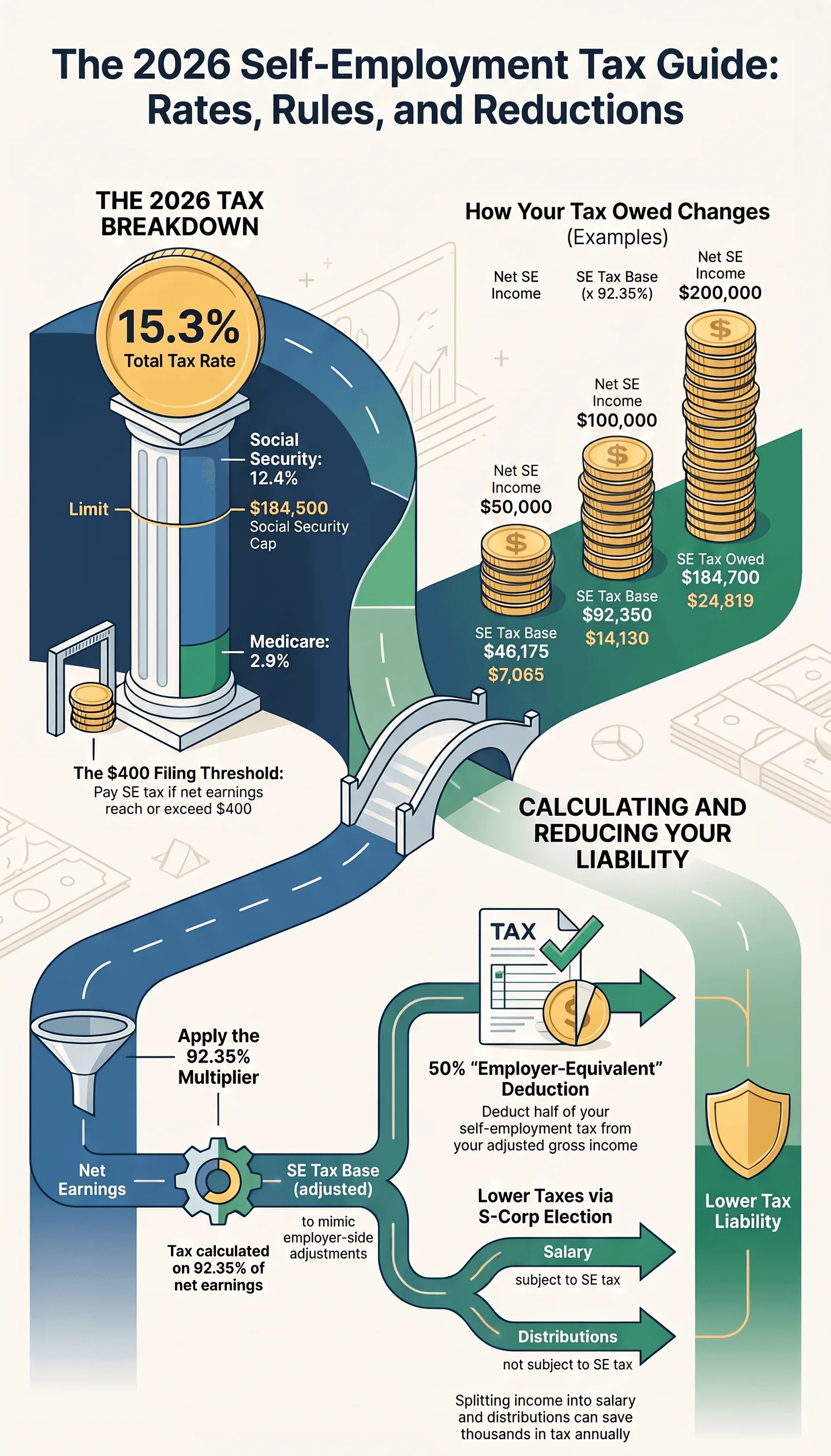
The 2026 Self-Employment Tax Rate
The self-employment tax rate for 2026 is 15.3%, broken down as:
- 12.4% for Social Security — applies to the first $184,500 of net self-employment income (the 2026 Social Security wage base, up from $176,100 in 2025)
- 2.9% for Medicare — applies to all net self-employment income with no cap
- 0.9% Additional Medicare Tax — applies to net earnings above $200,000 (single) or $250,000 (married filing jointly)
Source: IRS.gov, Schedule SE instructions
How SE Tax Is Actually Calculated
SE tax is not calculated on 100% of your net income — it's calculated on 92.35% of net self-employment earnings. This adjustment accounts for the employer-equivalent portion you're paying (an employee's employer pays 7.65% of the employee's wages into FICA; the 92.35% multiplier gives self-employed workers a comparable adjustment).
The exact formula:
- Calculate net self-employment income (gross revenue minus business expenses)
- Multiply by 92.35%
- Apply the SE tax rate to that amount
SE Tax at Different Income Levels (2026)
| Net SE Income | SE Tax Base (×92.35%) | SE Tax Owed | Effective SE Rate |
|---|---|---|---|
| $30,000 | $27,705 | $4,239 | 14.1% |
| $50,000 | $46,175 | $7,065 | 14.1% |
| $80,000 | $73,880 | $11,304 | 14.1% |
| $100,000 | $92,350 | $14,130 | 14.1% |
| $150,000 | $138,525 | $20,094* | 13.4%* |
| $200,000 | $184,700 | $24,819* | 12.4%* |
*SS tax capped at $184,500 base; Medicare continues at 2.9% above that. Rate appears to fall because SS portion stops.
What SE Tax Funds
SE tax funds the same programs as employer and employee payroll taxes:
- Social Security: Retirement benefits, disability insurance, survivor benefits. Your SE tax contributions build your Social Security earnings record, which determines your eventual retirement benefit.
- Medicare: Hospital insurance (Part A) and related coverage for people 65 and older, and qualifying disabled individuals.
An important implication: the salary you pay yourself as an S-Corp owner affects your eventual Social Security benefit. S-Corp owners who set a very low salary to minimize payroll tax may receive lower retirement benefits. This is worth factoring into your long-term strategy.
The SE Tax Deduction (Automatic Offset)
The IRS allows you to deduct 50% of your SE tax from your adjusted gross income — the "employer-equivalent" deduction. This is automatic and appears on Schedule 1 of your Form 1040.
At $100,000 net income with $14,130 in SE tax:
- SE tax deduction: $14,130 × 50% = $7,065
- At 22% income tax rate, this saves: $7,065 × 22% = $1,554 in income tax
This deduction doesn't reduce SE tax itself — it reduces the income tax you pay on the same income. It's a partial offset, not an elimination.
SE Tax vs Income Tax: The Key Differences
| Self-Employment Tax | Federal Income Tax | |
|---|---|---|
| Rate structure | Flat 15.3% (then 2.9% above SS cap) | Progressive brackets 10%–37% |
| Calculated on | 92.35% of net SE income | Taxable income after deductions |
| Reduces via deductions? | Only through reducing net profit | Many deduction types apply |
| Caps? | SS portion caps at $184,500 base | No cap |
| Reported on | Schedule SE | Form 1040 with brackets |
How to Calculate Your Quarterly SE Tax Payment
Your quarterly estimated tax payments must cover both SE tax and income tax. A simplified calculation:
- Estimate annual net SE income (gross revenue minus business expenses)
- Calculate SE tax: Net income × 92.35% × 15.3%
- Calculate income tax: Apply your tax bracket to (net income − SE deduction − standard deduction − QBI deduction)
- Add SE tax + income tax = annual liability
- Divide by 4 = quarterly payment
Or skip the math entirely: use our Quarterly Tax Estimator, which does all of this automatically including the QBI deduction and Additional Medicare Tax, and gives you a personalized 2026 payment calendar.
Top Ways to Reduce SE Tax in 2026
- S-Corp election: Split income into salary + distributions; only salary is subject to payroll/SE tax. Saves $3,000–$10,000+/year at $80,000+ net income.
- Business expense deductions: Every dollar of legitimate expense reduces net income and therefore the SE tax base.
- Solo 401(k) employer contributions: Employer-side contributions reduce net SE income. (Employee elective deferrals do not reduce SE tax.)
For a full breakdown of all SE tax reduction strategies, see our guide: How to Reduce Self-Employment Tax in 2026.
Frequently Asked Questions
At what income level do I start owing SE tax?
You owe SE tax if your net self-employment earnings are $400 or more in a year. This is a very low threshold — nearly any freelance income triggers it. Even a small amount of contract work requires you to file Schedule SE and pay the tax.
Do I pay SE tax on gross income or net income?
Net income — that is, gross revenue minus all legitimate business expenses. This is why tracking and deducting business expenses is so important: it reduces your SE tax directly, not just your income tax. A $1,000 business deduction saves $153 in SE tax at the 15.3% rate.
Is SE tax the same as payroll tax?
They fund the same programs (Social Security and Medicare) at the same rates, but SE tax is what self-employed people pay via Schedule SE, while payroll tax is what W-2 employees and their employers pay via employer withholding. The combined rate is the same (15.3%), but W-2 employees only pay half (7.65%) while their employer pays the other half — self-employed people pay both halves.
Does the Social Security wage base change every year?
Yes — the Social Security Administration adjusts the wage base annually based on changes in average wages. In 2025, it was $176,100. In 2026, it increased to $184,500. This means the income subject to the 12.4% Social Security portion increases each year. The 2.9% Medicare portion has no cap and applies to all net self-employment income.
Can I stop paying SE tax after I start collecting Social Security?
No. SE tax is owed on self-employment income regardless of your age or whether you're already collecting Social Security or Medicare benefits. Retirees who continue to do freelance work must continue paying SE tax on that income. The credits to your Social Security earnings record may have diminishing returns at that point, but the tax obligation remains.