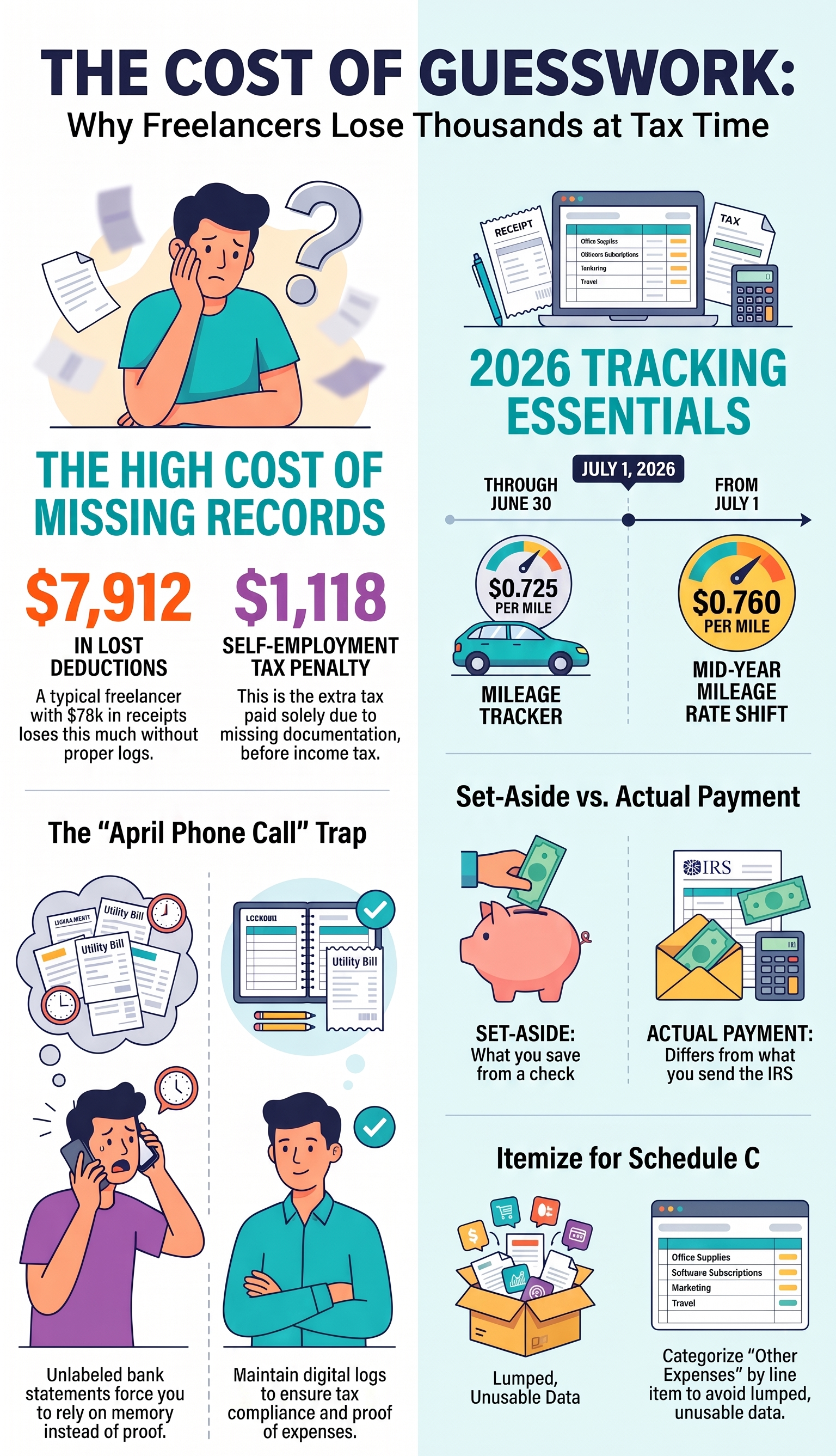
You know the moment. Your preparer is on the phone, reading down your bank statement, asking what a $3,400 charge to a payment processor actually was. You don't remember. It was ten months ago, it was probably split across three projects, and the receipt — if there ever was one — is gone. Multiply that phone call by every unlabeled line on the statement, and April stops being about your taxes and starts being about your memory.
That call is the whole reason this kit exists.
Who this is for
Freelancers, consultants, and anyone filing a Schedule C who gets paid by more than one client and drives, buys equipment, or works from home doing it. If your income shows up as a single 1099-NEC from one employer-like client, you probably don't need this. If it shows up as a dozen deposits from a dozen sources, and your "bookkeeping" is a bank account and a hope, this was built for exactly that gap.
What actually costs you money — with real numbers
The deductions you cannot rebuild in April. A freelancer with $78,000 of receipts who arrives at their preparer with bank statements but no mileage log, no home-office measurements, and no receipt for a laptop loses about $7,912 of deductions — roughly $1,118 in self-employment tax alone, before any income tax. The expenses were all real. The records were not there. This isn't a hypothetical; it's the arithmetic of what a typical mix of vehicle, equipment, and home-office deductions is worth when nobody tracked it.
The 2026 mileage rate changed mid-year. $0.725 a mile through June 30, $0.76 from July 1. Almost every mileage template on the market applies one rate to the whole year — wrong for whichever half you drove more in. A workbook that doesn't read the date on each trip is quietly costing you money in one direction or the other.
Not knowing what to hold back. Self-employment tax is 15.3% on top of income tax, and nobody withholds it for you. Most freelancers either panic-save too much or get blindsided every January 15. There's a real difference between "what to set aside from this payment" and "what to actually send at the next deadline" — they're not the same calculation, and conflating them is how people either starve their checking account or miss a payment.
The itemized-line problem. Schedule C line 27a ("other expenses") arrives from most templates as one lump number. Your preparer then has to call and ask what's in it — which is the exact phone call this whole thing started with.
What's in the workbook
- Dashboard — the year to date in seven figures and two charts, so you can see where you actually stand without opening a calculator
- Income, Expenses, and Mileage logs, 200 rows each — built for entering as you go, not reconstructing in April
- Schedule C Organizer — your records sorted into the form's actual lines, itemized, not lumped
- Tax set-aside — a reserve estimate, a safe-harbor planner, and a payment tracker, kept as three separate answers instead of one confusing number
- Rates 2026 — every figure used in the workbook, each with the IRS page it came from, so you're never taking a number on faith
- For your preparer — a page telling them what to print and in what order, so the phone call doesn't happen
Why this one and not a free template you already found
Every figure in it comes from the same constants file the fifteen free calculators on this site read, so the mileage rate, the SE tax math, and the quarterly deadlines are one source, not typed into a cell once and left to go stale. It doesn't just total your numbers — it tells you what share of each payment to set aside and which vehicle method is worth more. And every release goes through a structural check, a set of tax-regression tests, and a full recalculation of every formula before anyone downloads it — the last pass caught two real defects before a single copy shipped.
It does not cover inventory and cost of goods sold, the home-office deduction, depreciation schedules, the QBI deduction, payroll, partnerships or S corporations, or state and local tax. It's an organizing and planning tool, not a substitute for a preparer — it's built to make the conversation with one shorter, not to replace it.
Where to start
If you want to see the logic behind it first, the Quarterly Tax Estimator runs the same set-aside math the kit's Tax set-aside sheet does — try it on one quarter before you commit to tracking a whole year.
The kit itself is free while it's in beta: every formula has been machine-evaluated and every tax figure regression tested, but the layout and print setup have been checked in code, not yet by someone with Excel open. Get the Self-Employed Tax Kit →
Frequently Asked Questions
Do I need this if I only have one client?
Probably not, if that client pays you like an employee would and you have no other deductions to track. The kit earns its keep once you have multiple income sources, vehicle use, or equipment purchases to organize — a single simple 1099 usually doesn't need a system this detailed.
Does it file anything or calculate my actual tax return?
No. It organizes your records into the shape Schedule C and your quarterly payments need, and estimates what to set aside. It doesn't file, and it isn't tax advice — the Rates sheet exists so you or your preparer can verify every figure against the source rather than trust the workbook blindly.
What if I already use bookkeeping software?
Software categorizes transactions; it generally doesn't tell you the mileage rate that applied to a specific trip's date, or split your set-aside from your actual quarterly payment. Many people run both — software for the books, this for the tax-specific planning software doesn't do.