A freelancer who sets a $75/hour rate and bills 30 hours a week isn't making $75 an hour. They're making that on the hours a client actually pays for — and everything else it takes to run the business happens on unpaid time.
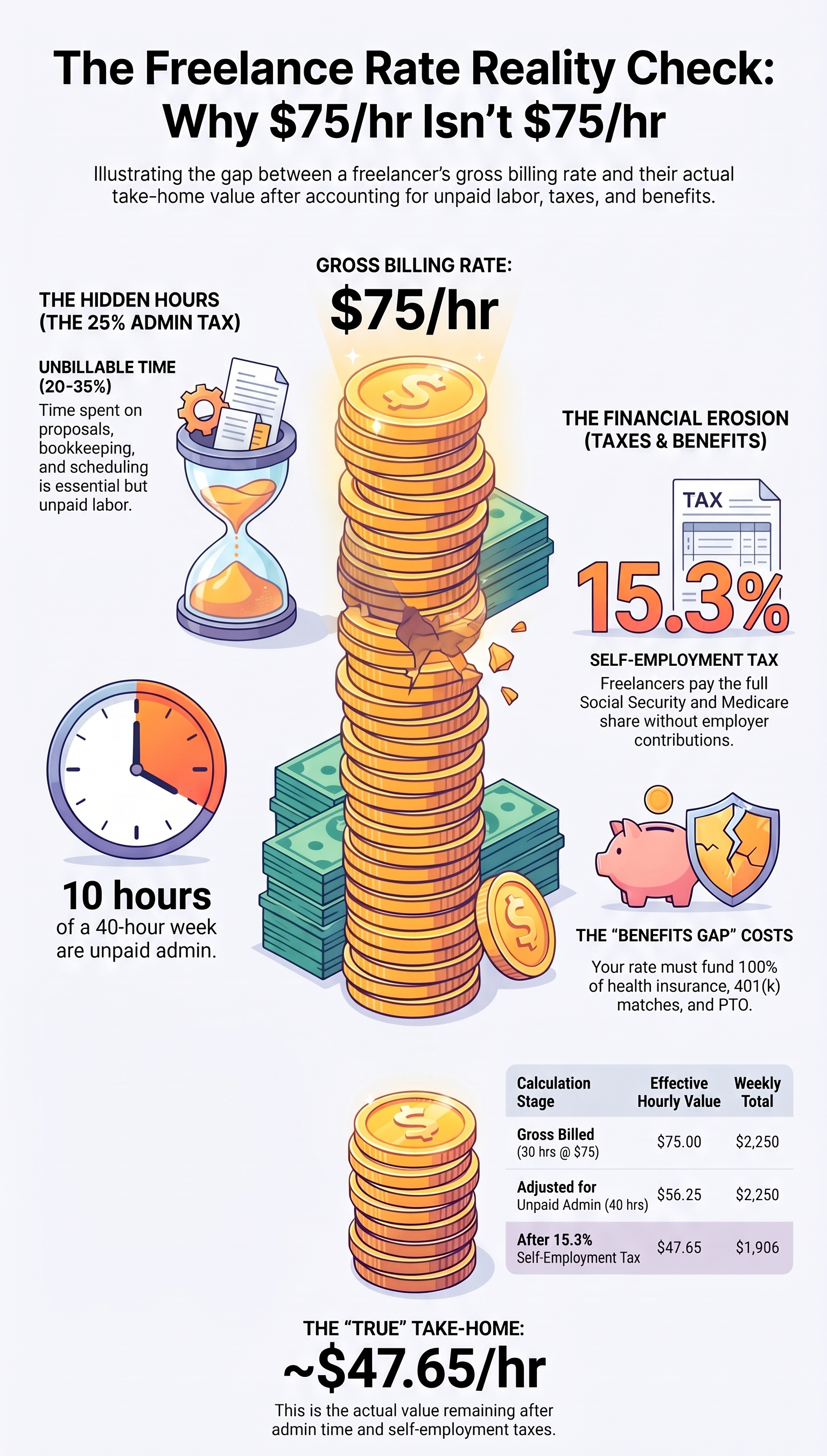
The hours that don't show up on an invoice
Client work is the visible part. Underneath it, every freelancer is also doing, unpaid: sending proposals that don't convert, invoicing and chasing late payments, bookkeeping, scheduling, and the ordinary admin of running a one-person business. Freelancer surveys consistently put this at 20–35% of total working hours — meaning someone who thinks of themselves as working 40 hours a week might be billing 28–30 of them, with the rest going to the business rather than to clients.
That alone changes what a rate is actually worth: a $75/hour rate at 30 billable hours out of a 40-hour week is $56.25 an hour averaged across the time actually worked — before a single dollar of tax comes out.
Then the taxes that a salary already had withheld
An employee's paycheck already has Social Security, Medicare, and income tax withheld — invisible, but real. A freelancer's invoice has none of that withheld, which makes the gross number feel bigger than it is. Self-employment tax alone is 15.3% (Social Security and Medicare combined) on top of ordinary income tax, and it starts from the first dollar of profit past a small threshold — there's no employer quietly paying half of it the way there is at a W-2 job.
And the benefits an employer isn't providing anymore
Health insurance, a 401(k) match, paid time off, disability coverage — a W-2 salary usually comes with some mix of these funded partly by the employer. A freelance rate has to fund all of it alone, plus cover time off with zero income (no vacation days that still get paid), or it's not actually equivalent to the salary it's being compared against.
What this means for a specific number
Take that same $75/hour freelancer, 30 billable hours out of 40 worked, in a state with no income tax:
| Gross billed (30 hrs × $75) | $2,250/week |
| Averaged across all 40 hours worked | $56.25/hour |
| After ~15.3% self-employment tax | ~$47.65/hour |
| After funding health insurance and no paid time off out of pocket | Lower still, and highly individual |
The headline rate and the number that actually lands are two different numbers, and the gap between them is exactly what a salary comparison misses if it just compares the invoice rate to an hourly-equivalent salary.
Where to run your own numbers
The True Hourly Rate Calculator takes your actual rate, hours worked versus hours billed, and business expenses, and returns what you're really making per hour — the number worth comparing against a salary offer, not the one on the invoice. If the next question is what to actually set aside from each payment once you know the real number, the Quarterly Tax Estimator picks up from there.
Frequently Asked Questions
How much should I raise my rate to account for unpaid hours?
It depends on your actual billable ratio, which varies a lot by how much of your own marketing, admin, and bookkeeping you do versus delegate. The calculator works backward from your real target take-home to a rate, rather than applying one multiplier to everyone.
Does this apply the same way to a part-time side hustle?
The unpaid-hours effect is smaller if you already have a W-2 job (less admin overhead since you're not running the whole business full-time), but the self-employment tax and expense math still apply to whatever you earn from the side work itself.
Is 30 billable hours out of 40 normal, or unusually low?
It varies by how established the freelancer is and how much of the business (sales, admin) they do themselves versus outsource. It's common enough that assuming 40 billable hours in a rate calculation is the more unusual assumption, not the safe one.