A tax preparer can only work from what you hand them. Everything you cannot document becomes income you pay tax on — not because the expense was not real, but because there is nothing to show it was. The four items freelancers most often arrive without are a mileage log, home-office measurements, receipts for equipment bought early in the year, and a record of income no 1099 ever reported.
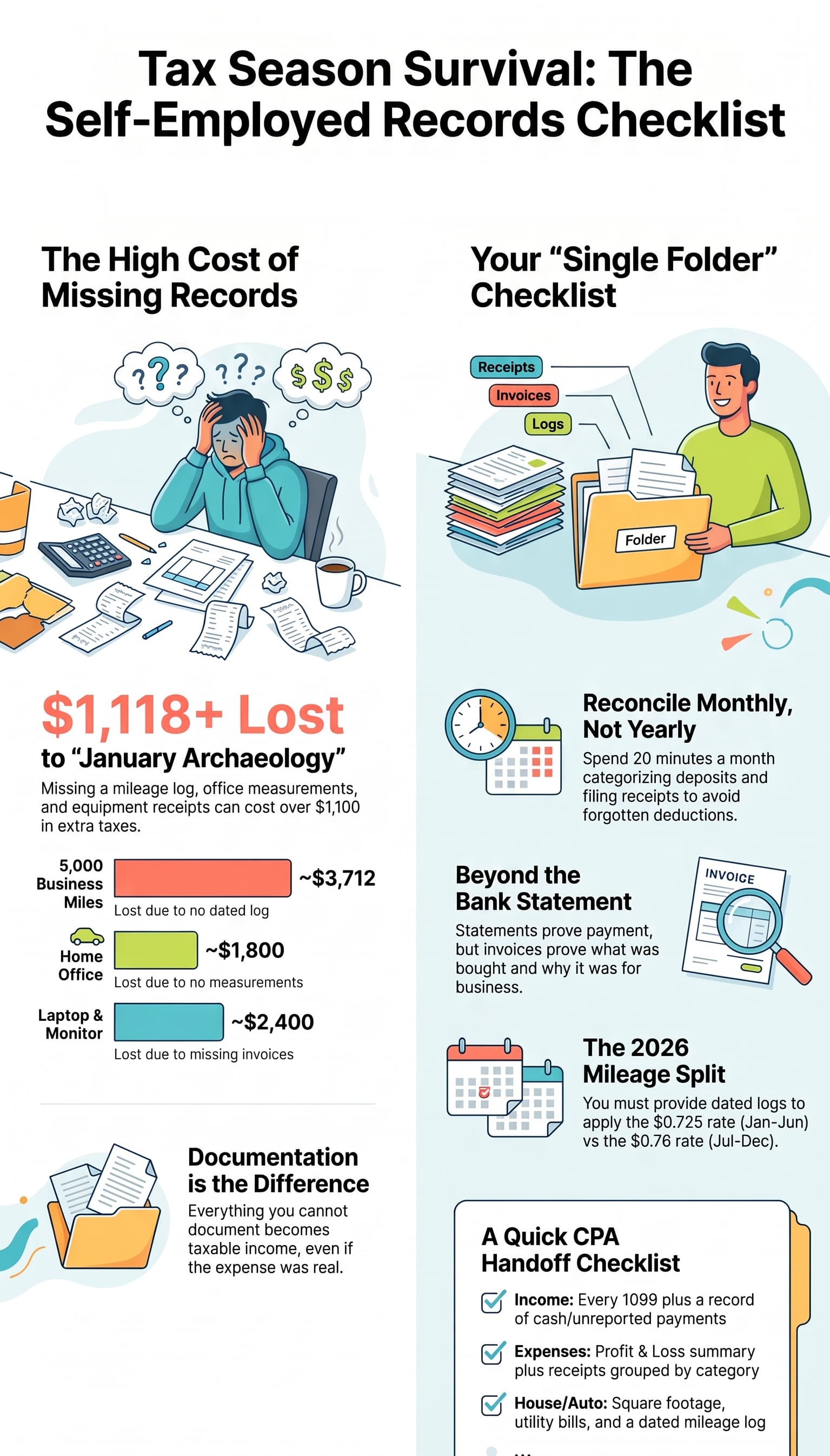
The list, in the order a Schedule C is built
Income — all of it, reported or not. Every 1099-NEC and 1099-K you received, plus income that generated no form at all. Direct client payments, cash, small platform payouts under a reporting threshold: all of it is taxable income regardless of whether anyone sent paperwork. A preparer who only sees the 1099s builds a return that is wrong in the direction the IRS notices, because it has copies of those same forms.
Expenses, with the receipt attached to the transaction. A bank line reading "$847 — office supply store" is a payment, not a deduction. What makes it a deduction is knowing what was bought and why it was for the business. Capture the purpose at the time; nobody reconstructs it in January.
Equipment, with the per-item invoice price. The $2,500 de minimis safe harbor lets you expense an item rather than depreciate it over years — but the threshold is applied per invoice line, so the invoice itself is what makes it available. A $3,900 receipt covering three separate $1,300 items is fine if the invoice shows the split, and a problem if it does not.
Vehicle: a dated mileage log. Dates matter more than usual in 2026, because the rate changed mid-year — $0.725 through June 30, $0.76 from July 1. Monthly totals cannot be split across that boundary; individual dated trips can.
Home office: the measurements and the bills. Square footage of the space and of the home, plus rent or mortgage interest, utilities, and insurance. The space has to be used regularly and exclusively for the business, which is the test that disqualifies most kitchen tables.
What you already paid. The dates and amounts of your estimated payments. This is the single most common item missing from a January handoff, and its absence produces a return that overstates what you still owe.
Retirement contributions, and the deadlines attached. How much went into a SEP-IRA or Solo 401(k), and when. Some deadlines fall before year end rather than at filing.
A worked example of what the gaps cost
A freelancer with $78,000 of gross receipts arrives with bank statements and 1099s, but no mileage log, no home-office measurements, and no receipts for a laptop and monitor bought in March.
| Deduction | Amount | Why it is lost |
|---|---|---|
| Mileage, 5,000 business miles | ~$3,712 | No dated log |
| Home office | ~$1,800 | Square footage never measured |
| Laptop and monitor | ~$2,400 | Receipts gone, purchase not identifiable in the statement |
| Total lost | ~$7,912 |
Self-employment tax alone on that amount — 15.3% applied to 92.35% of it — is about $1,118, before any income tax. The expenses were all real. The records were not there.
The mileage figure above uses the split rate: 2,500 miles at $0.725 plus 2,500 at $0.76.
Do it monthly, not in January
The IRS's own guidance makes the point plainly: expenses get forgotten when they are not recorded as they occur. A monthly habit costs about twenty minutes:
- Reconcile the business account — every deposit categorised as income, every payment categorised as an expense.
- File receipts against transactions while you still remember what they were.
- Update the mileage log with the trips actually taken.
- Note anything unusual now, while the explanation is fresh.
Twelve of those is a finished year. Doing it once in January is not the same task — it is archaeology, and the deductions that cannot be dug up are the ones you pay for.
The four dates that make this urgent
Records are not only for filing. They are for the four payment dates: April 15, 2026, June 15, 2026, September 15, 2026, and January 15, 2027. Each needs a current profit figure, and a current profit figure needs current books.
If your income swings, the safe harbor is the cheapest insurance available: pay 100% of last year's total tax across the four instalments — 110% if your prior-year AGI was above $150,000 — and no underpayment penalty applies even if this year is much bigger. The mechanics are in the safe harbor rule explained, and how to pay quarterly taxes covers the payment side.
What to hand over, and in what form
Your preparer wants one folder, not a year of loose parts:
- A profit and loss summary for the year, by category
- The income backup: every 1099, plus your own record of unreported income
- Expense backup, grouped by category
- The mileage log
- Home-office measurements and the bills behind them
- Estimated payment dates and amounts
- Last year's return, if they did not prepare it
Add a short note listing anything unusual — a new asset, a business structure change, a year with unusually low income. The questions a preparer has to ask are the expensive part of their time.
Frequently Asked Questions
How long do I need to keep all this?
Three years from the filing date covers the ordinary case, but several situations extend it — six years where income was substantially understated, and longer for records establishing the basis of property you still own. Property records in particular need to survive until years after you sell, because that is when the basis matters. Electronic copies are acceptable.
Do I need receipts if everything went through the business bank account?
The statement proves a payment was made. It does not prove what was bought or that it was for the business, and those are the two things a deduction rests on. For most small expenses the statement plus a contemporaneous note is workable; for equipment, travel and anything unusual, keep the actual receipt.
What if income arrived with no 1099 at all?
It is still income and still reportable. Thresholds govern when a payer must send a form, not whether you owe tax. Keep your own record of it — invoices, a payment log, deposits identified as business income — because your books are the only place that income exists.
Can I just hand over my bank statements?
You can, and preparers charge for the hours it takes to turn them into categorised books, usually while asking you questions you can no longer answer. It is the most expensive way to buy the same result, and it produces a weaker return because the unidentifiable transactions get left out.
Does a bookkeeping app remove the need for any of this?
It removes the arithmetic, not the substantiation. An app categorises transactions; it does not hold your mileage purposes, your home-office measurements, or the receipts behind a purchase. Those still need collecting, and the app is only as accurate as the categorising you check.
Know What You Owe Before January
A checklist is only useful if it produces a number you can act on. The point of keeping current books is knowing, at each quarterly date, what to set aside.
The Quarterly Tax Estimator turns your income and expenses so far into what to pay at the next deadline — including the self-employment portion, which is the part most people forget to reserve for.