When you're self-employed, no employer withholds taxes from your paycheck. That means you're responsible for paying the IRS four times a year — and if you miss a payment or underpay, you'll owe penalties on top of what you already owe. This guide covers exactly how quarterly taxes work, how much to pay, and when to pay it.
Want to skip the manual math? Use our free Quarterly Tax Estimator to calculate your exact payment amount and get a personalized 2026 payment calendar.
Who Has to Pay Quarterly Estimated Taxes?
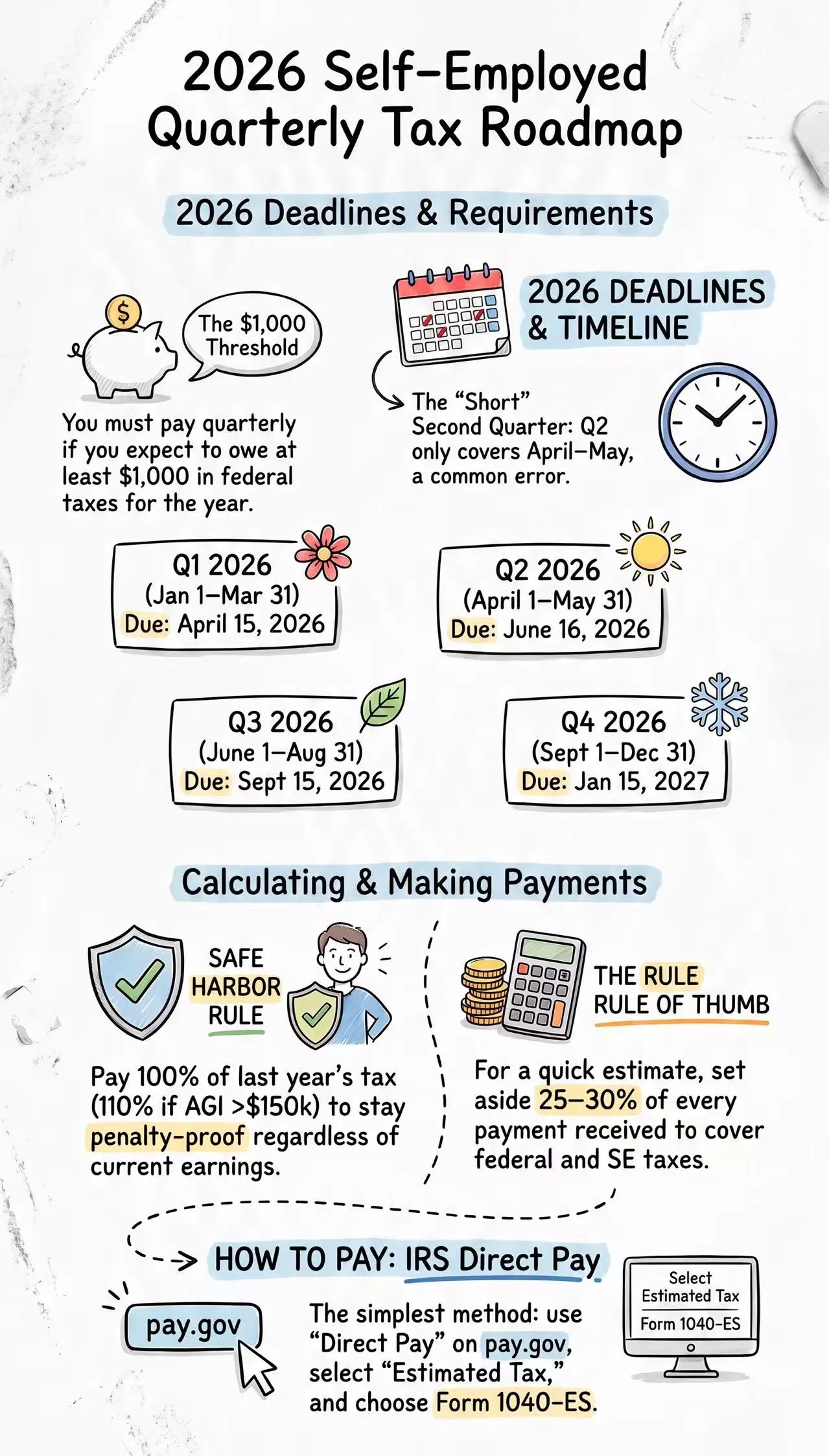
You're required to make quarterly estimated tax payments if you expect to owe at least $1,000 in federal taxes for the year after subtracting withholding and credits. This applies to:
- Freelancers and independent contractors (1099 income)
- Sole proprietors and single-member LLC owners
- S-Corp owners taking distributions beyond their W-2 salary
- Anyone with significant side hustle income alongside a W-2 job
- Landlords with rental income
If you have a W-2 job and your employer withholds enough to cover your total tax liability (including on side income), you may not need to make separate quarterly payments. The test: if you'll owe more than $1,000 after accounting for withholding, quarterly payments are required.
2026 Quarterly Tax Payment Deadlines
| Quarter | Income Period | Payment Deadline |
|---|---|---|
| Q1 2026 | January 1 – March 31 | April 15, 2026 |
| Q2 2026 | April 1 – May 31 | June 15, 2026 |
| Q3 2026 | June 1 – August 31 | September 15, 2026 |
| Q4 2026 | September 1 – December 31 | January 15, 2027 |
Note that Q2 covers only two months (April–May), not three. This is a common source of confusion — the IRS quarters don't follow calendar quarters exactly.
What Taxes Are You Paying?
Your quarterly payment covers three types of tax:
Self-employment (SE) tax
As a self-employed person, you pay both the employee and employer portions of Social Security and Medicare. That's 15.3% on the first $184,500 of net self-employment income in 2026, then 2.9% above that. You can deduct half of this SE tax when calculating your income tax.
Additional Medicare Tax (0.9%)
If your combined earnings exceed $200,000 (single) or $250,000 (married filing jointly), an additional 0.9% Medicare tax applies on the amount above the threshold. This is often missed in simplified calculators.
Federal income tax
Based on your taxable income after deductions — including the SE tax deduction, the QBI deduction (see below), and your standard or itemized deduction.
QBI deduction (Section 199A) — the one most people miss
Most self-employed filers qualify for a 20% deduction on qualified business income under Section 199A. This is one of the largest deductions available to freelancers and is frequently left out of simplified tax calculators — causing people to significantly overestimate what they owe. Our [Quarterly Tax Estimator] includes this deduction automatically.
State income tax
Most states require quarterly estimated state tax payments as well, on a similar (though sometimes slightly different) schedule. Nine states have no income tax at all: Texas, Florida, Nevada, Washington, Wyoming, South Dakota, Alaska, New Hampshire, and Tennessee.
How to Calculate Your Quarterly Payment
There are two methods. Most self-employed people use Method 2.
Method 1: Estimate your actual current-year tax
Project your annual income and expenses, calculate what you'll owe for the full year, divide by four. This is the most accurate method but requires a reliable income forecast — which many freelancers don't have.
Method 2: Use the Safe Harbor rule (simpler and penalty-proof)
Pay at least 100% of last year's total tax liability across four equal payments (110% if your prior-year AGI exceeded $150,000). As long as you hit this threshold, the IRS cannot charge underpayment penalties — even if you end up owing more when you file your return.
Example: If you owed $12,000 in total federal tax last year, paying $3,000 per quarter this year ($12,000 ÷ 4) protects you from penalties regardless of what you actually earn this year.
Safe Harbor Summary:
- Prior-year AGI ≤ $150,000: Pay 100% of last year's tax liability
- Prior-year AGI > $150,000: Pay 110% of last year's tax liability
- Alternative: Pay 90% of current-year's estimated liability
- Use whichever amount is smaller
A Simple Rule of Thumb
If you don't want to run detailed calculations, the most widely used rule of thumb for freelancers in the 22% federal bracket is: set aside 25–30% of every payment you receive.
This approximation covers both SE tax and federal income tax for most middle-income freelancers. It's not precise, but it prevents the most common problem — spending money that belongs to the IRS before April arrives.
For a precise number based on your actual income, filing status, state, and deductions, use the Quarterly Tax Estimator.
How to Actually Make the Payment
The IRS provides several ways to pay estimated taxes. The simplest:
IRS Direct Pay (pay.gov)
Free, no registration required, instant confirmation. Go to pay.gov, select "Make a Payment," choose "Estimated Tax," then "1040-ES." Takes about five minutes. This is the method most freelancers use.
EFTPS (Electronic Federal Tax Payment System)
Free, requires registration (takes a few days to activate). Best if you want to schedule all four payments in advance at the start of the year. Many self-employed people set up EFTPS once and use it every year.
IRS2Go Mobile App
The IRS's official app allows Direct Pay payments from your phone.
Check with Form 1040-ES
Old-fashioned but still valid. Download Form 1040-ES from IRS.gov, include a check, and mail it. Not recommended given how easy online payment is.
What Happens If You Miss a Payment?
Missing a quarterly deadline doesn't trigger an immediate penalty notice. Instead, the IRS calculates underpayment penalties when you file your annual return — charged at the federal short-term interest rate plus 3% (currently around 7–8% annually) on the amount you underpaid, for each day it was late.
On a $3,000 underpayment for one quarter, that's roughly $60–$80 in penalties. Not catastrophic, but avoidable. The penalty calculation is done per quarter, so paying late on Q1 still results in a Q1 penalty even if you make a larger payment in Q2.
State Quarterly Taxes
Most states that have income tax also require quarterly estimated payments, typically on a similar schedule. You pay federal and state quarterly taxes separately through each government's own payment system.
States without income tax (TX, FL, NV, WA, WY, SD, AK, NH, TN) have no quarterly state tax requirement.
For states with income tax, search "[your state] estimated tax payment" to find your state's payment portal. California uses FTB.ca.gov; New York uses tax.ny.gov; most other states have similar dedicated portals.
Quarterly Tax and S-Corp: How It Changes
If you've elected S-Corp status, your quarterly tax situation changes in two ways:
- Payroll taxes on your salary are withheld through payroll (Gusto or similar) and deposited quarterly — this replaces part of your estimated tax payment
- Remaining income tax on distributions still requires estimated quarterly payments
Most payroll software handles the payroll tax deposits automatically. You still need to make estimated payments for any additional income tax due on distributions.
Get Your 2026 Payment Calendar
Our Quarterly Tax Estimator calculates your exact payment amount for each quarter, generates a personalized 2026 payment calendar with all four deadlines, and flags penalty risk if you've missed or underpaid earlier quarters. It also includes a one-click iCal export so you can add all four deadlines directly to Google Calendar or Outlook.
Frequently Asked Questions
Do I have to pay quarterly if I'm new to freelancing this year?
If you expect to owe more than $1,000 in federal tax this year, yes. For your first year, you can't use the prior-year Safe Harbor (since you had no self-employment income last year), so you'll need to estimate your current-year liability. A rough estimate is fine — the IRS won't penalize you for reasonable estimation errors in your first year if you make a good-faith effort.
Can I pay all four quarters at once?
You can make a lump-sum payment by January 15 of the following year, but you'll still owe underpayment penalties for Q1, Q2, and Q3 — calculated from each deadline date. Paying quarterly as you go is the only way to avoid penalties entirely.
What if my income varies a lot from month to month?
Use the annualized income installment method (IRS Form 2210, Schedule AI). This lets you pay different amounts each quarter based on actual income earned in that period, rather than equal quarterly payments. It's more complex to calculate but avoids overpaying early quarters when income is slow.
Is there a minimum quarterly payment amount?
No minimum — even small payments help. But the practical threshold is $1,000 in expected annual tax liability. Below that, the IRS doesn't require quarterly payments, though making them is still