Jake is 23 and started freelancing as a web developer right after graduating, about a year and a half ago. He'd always assumed that paying self-employment tax meant he was "covered" by Social Security the same way anyone with a job is. When he actually checked, he discovered he hadn't been self-employed long enough to qualify for SSDI at all — not a smaller benefit than he expected, but potentially zero.
Paying SE Tax Isn't the Same as Being Eligible
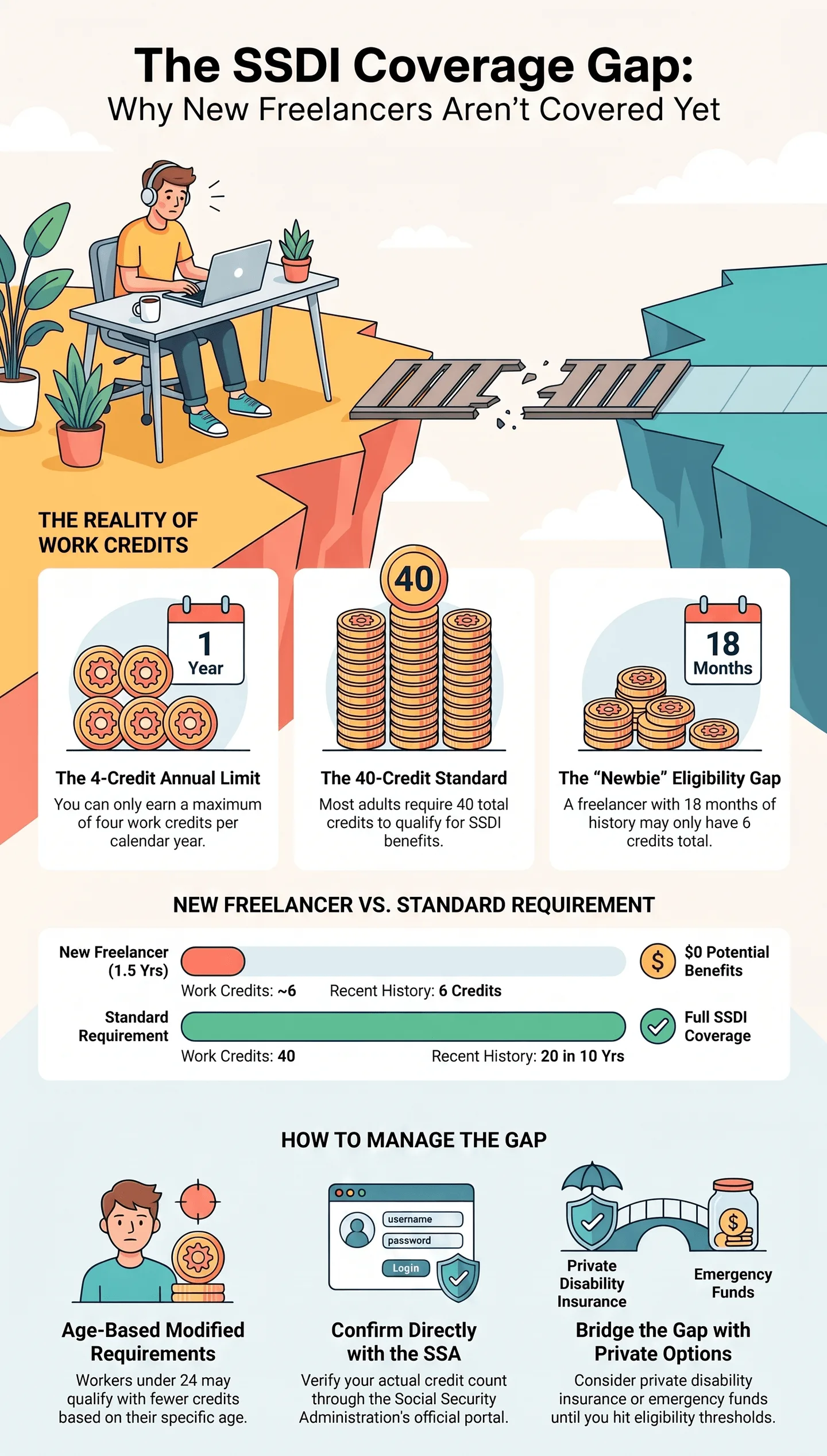
Self-employment tax funds Social Security and Medicare, and every self-employed person paying it is building toward eligibility — but building toward isn't the same as having arrived. SSDI eligibility requires accumulating a minimum number of work credits, and for most adults, that means 40 total credits, with at least 20 earned in the 10 years immediately before a disability begins.
At 18 months into self-employment, even earning enough to hit the maximum four credits a year, Jake has accumulated roughly 6 credits — well short of what most adults need. Younger workers do qualify under a modified, lower credit requirement than the standard 40, since they've had less time in the workforce, but the exact threshold depends on age and is worth confirming directly with the Social Security Administration rather than assumed.
What This Means in Practice
If Jake became unable to work today, he likely would not qualify for SSDI at all, regardless of how his benefit amount would otherwise be calculated. This is a meaningfully different problem than the one facing an established freelancer with a modest income — it's not "my benefit is smaller than the average," it's "I may have no benefit to rely on yet."
The Full Math
- Months self-employed: approximately 18
- Approximate work credits earned: around 6 (at 4 credits/year pace)
- Standard credits typically required: 40 total, 20 in the last 10 years
- Modified requirement for younger workers: lower, but age-dependent — confirm directly via SSA
- Estimated SSDI benefit if a claim were filed today: effectively $0 — credit requirement not yet met
Why This Gets Missed
Freelancers who transition from a W-2 job often carry over an assumption that Social Security coverage is continuous and automatic, the way it feels when a paycheck already has taxes withheld. Someone starting self-employment straight out of school, with no prior W-2 work history at all, has an even starker version of this gap — there's no accumulated credit history to fall back on, only what's been earned since starting out on their own.
What This Isn't
This isn't a reason to panic or to assume self-employment was a mistake — the credit requirement is standard and applies to anyone regardless of employment type, and Jake will close this gap simply by continuing to earn and pay SE tax over the next few years. It's a reason to know where you actually stand rather than assume coverage exists, particularly in the first few years of self-employment when the gap is largest.
Check Your Own Number
Whether you're newer to self-employment or have years of history, the honest first question is whether you'd qualify for SSDI at all today — not just how much it would pay. Our Disability Insurance Calculator helps you think through both questions rather than just the benefit estimate.
Frequently Asked Questions
How many work credits do I need to qualify for SSDI? Most adults need 40 total credits, with at least 20 earned in the 10 years before becoming disabled. Younger workers qualify under a reduced, age-based requirement, since they've had less time to accumulate credits — check the exact figure for your age directly with the Social Security Administration.
How many credits can I earn per year? Up to four credits per year, regardless of how much you earn beyond the threshold amount for each credit ($1,810 per credit in 2026).
If I'm not eligible for SSDI yet, is private disability insurance my only option? It's one option worth considering, particularly in the early years of self-employment when the SSDI gap is largest. Some newer freelancers instead prioritize building an emergency fund until their SSDI eligibility and estimated benefit are more established.
Does prior W-2 work count toward my SSDI credits? Yes — work credits accumulate across both W-2 employment and self-employment, based on total covered earnings over your working life, not just your current self-employment income.