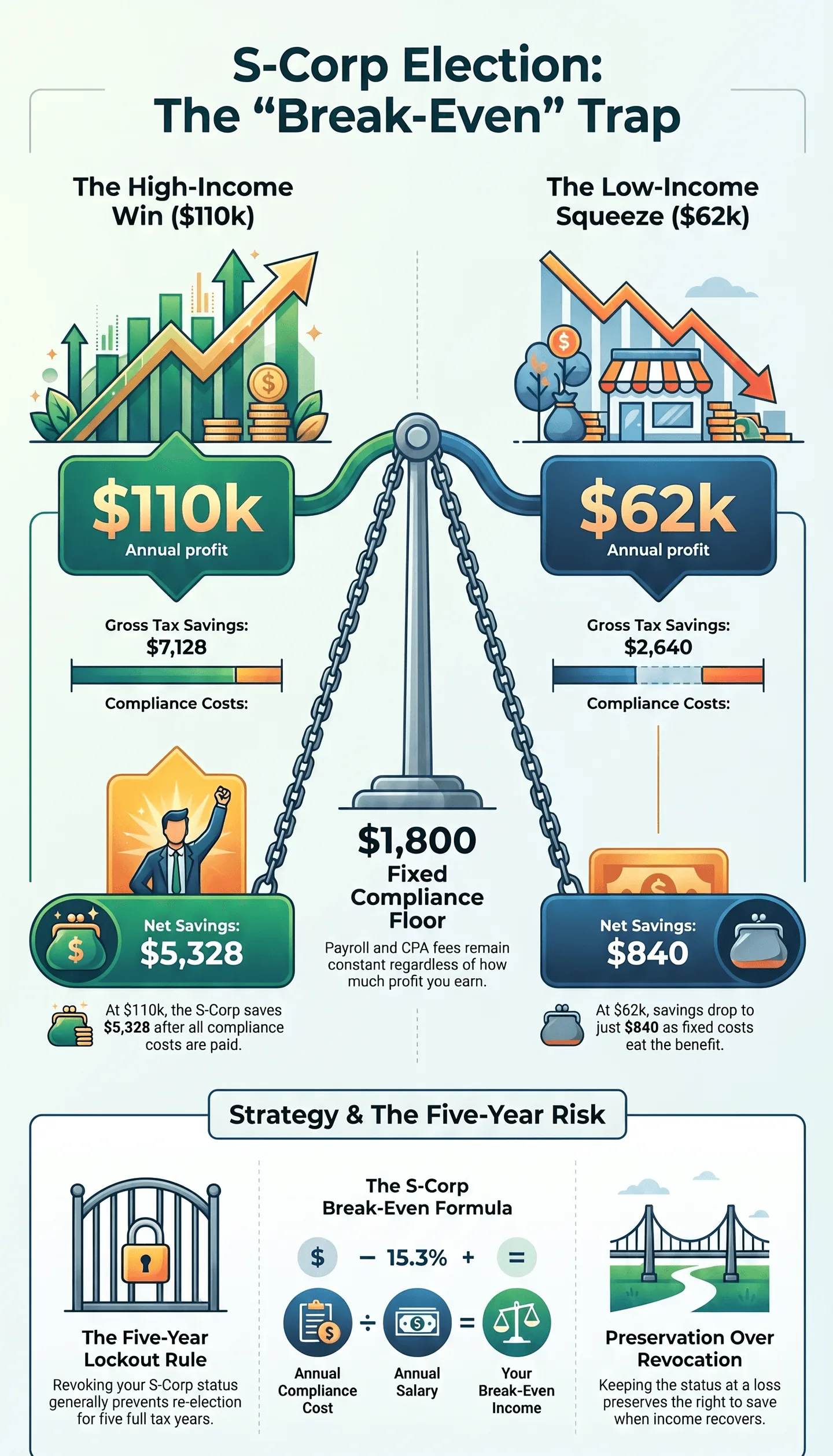
Marcus's S-Corp election saved him $5,328 in its first year. After his income fell from $110,000 to $62,000, the same election nets him $840 — for the same payroll runs, the same 1120-S, and the same CPA bill. Revoking it is possible, but it locks him out of re-electing for five tax years, which makes "wait and see" the more valuable option than the arithmetic alone suggests.
Year One: The Election Working as Advertised
Marcus is a freelance UX designer. In his first S-Corp year he netted $110,000 and paid himself a $55,000 W-2 salary — a 50% split, comfortably inside the range the IRS treats as defensible.
As a plain LLC, self-employment tax applies to 92.35% of net profit:
- $110,000 × 92.35% = $101,585 of net earnings
- × 15.3% = $15,543 in self-employment tax
As an S-Corp, payroll taxes apply only to the salary:
- $55,000 × 15.3% = $8,415 in payroll tax
- Gross savings: $15,543 − $8,415 = $7,128
Against that, the annual cost of being an S-Corp:
| Compliance item | Cost |
|---|---|
| Payroll software | $600 |
| CPA premium for Form 1120-S | $1,200 |
| State S-Corp cost (no state income tax) | $0 |
| Total | $1,800 |
Net savings: $7,128 − $1,800 = $5,328. A clear, unambiguous win. This is the case the internet describes when it tells freelancers to elect S-Corp status.
Year Three: Same Structure, Different Math
Two clients left. Marcus's net income dropped to $62,000, and he reduced his salary to $40,000 to keep some distribution room.
- SE tax as an LLC: $62,000 × 92.35% × 15.3% = $8,760
- Payroll tax as an S-Corp: $40,000 × 15.3% = $6,120
- Gross savings: $2,640
- Less compliance: −$1,800
- Net savings: $840
Nothing broke. No rule changed. The election simply lost most of its value, because the savings scale with the gap between profit and salary while the costs stay flat. Marcus's gap fell from $55,000 to $22,000, and the $1,800 of fixed compliance went from a rounding error to two-thirds of the benefit.
There is a second problem hiding in that salary cut. At $40,000 on $62,000 of profit, his salary is 65% of net income. That is at the very top of the defensible range — push it lower to protect the savings and he moves into territory the IRS challenges. The lower your income, the less room you have to engineer the split, which is precisely why the election gets weaker as income falls.
The Break-Even Nobody Calculates Before Electing
The threshold is not a rule of thumb, it is arithmetic. The election breaks even when gross payroll-tax savings equal compliance costs:
Break-even income = (annual compliance cost ÷ 15.3%) + your salary
For Marcus at a $40,000 salary and $1,800 of compliance: $1,800 ÷ 0.153 = $11,765, plus $40,000 = $51,765. Below roughly $52,000 of net income, his S-Corp actively costs him money.
At $62,000, he is $10,000 past break-even and keeping $840. That is real, but it is $840 for running payroll every month, filing a separate business return, and carrying the risk of a late-filing penalty on Form 1120-S — which accrues per shareholder for every month the return is late, and can erase a year of savings on a single missed deadline.
This is the number to know before electing, not after. The general guidance that S-Corp status "makes sense above $80,000" exists because it builds in room for exactly this: income falls, and a structure chosen at the edge becomes a liability. Our S-Corp readiness checklist covers the non-financial side of that decision, and LLC vs S-Corp works the savings math across income levels.
What Revoking Costs — and Why It Is Not Symmetric
Marcus can revoke. The mechanics are straightforward: a written revocation statement to the IRS with consent from shareholders holding more than 50% of the shares. File it by the 15th day of the third month of the tax year and it is retroactive to the start of that year; file later and it takes effect the following year, or on a prospective date you specify.
The part that matters is what happens afterward. Once the election terminates, the corporation generally cannot elect S-Corp status again for five tax years without IRS consent (IRC §1362(g)). Consent is discretionary and not something to count on.
So the real comparison is not "$840 versus $0." It is:
- Keep the election: $840 a year, plus the option to benefit immediately if income recovers.
- Revoke: save the $1,800 of compliance and the administrative burden, and give up the election until roughly 2031 — including any year in that window when income climbs back over $100,000.
If Marcus expects his income to recover within a year or two, revoking to save $840 of hassle costs him the far larger savings waiting on the other side of the recovery. If he expects to stay at this level or lower, or he is winding the business down, revoking is the cleaner call.
The Middle Option Most People Miss
There is a third path: keep the election and stop optimizing around it. Marcus can raise his salary toward $50,000, which shrinks the tax savings to almost nothing but eliminates the reasonable-salary risk entirely, keeps the entity intact, and preserves the ability to swing the split back the moment income returns.
He pays roughly $1,800 a year for that optionality. Whether that is worth it is a judgment call about his pipeline, not a tax question — and framing it that way is more honest than pretending there is a formula.
One caveat on all of the figures above: Marcus is in a state with no income tax. In California, the 1.5% S-Corp franchise tax with an $800 minimum would add roughly $930 to his annual cost at $62,000 of income, which pushes his $840 of net savings below zero. In New York, additional state-level filings do something similar. State treatment can flip this decision on its own.
Frequently Asked Questions
Can I just stop running payroll instead of formally revoking?
No, and this is the expensive version of the mistake. As long as the S election is in effect, the IRS expects reasonable compensation reported on a W-2. Taking distributions with no salary invites reclassification of those distributions as wages, with back payroll taxes, interest, and penalties on top. If you want out, revoke properly; if you stay in, run payroll.
Does revoking an S-Corp election dissolve my LLC?
No. The S election is a federal tax classification, not a legal structure. Revoking it returns a single-member LLC to default treatment — taxed on Schedule C, with self-employment tax on net profit — while the LLC itself continues to exist, keeps its EIN in most cases, and keeps whatever liability protection it provided. Your operating agreement, bank accounts, and contracts are unaffected.
What if my income was low for one bad year but I expect it to recover?
That is the strongest argument for doing nothing. The five-year lockout is the asymmetry in this decision: staying in costs you the compliance bill for a year or two, while revoking can cost you several years of much larger savings if income comes back. Model your realistic income for the next three years before you file anything.
How much does an S-Corp actually cost to run each year?
Budget $1,800 to $4,500 depending on your CPA and state. The components are payroll processing (roughly $600 a year), the CPA premium for preparing Form 1120-S on top of your personal return ($800–$1,800 is typical), and any state-level S-Corp tax or filing. California's $800 minimum franchise tax and 1.5% S-Corp tax are the most common state surprise.
Is there an income level where the S-Corp election is always wrong?
Below your personal break-even, yes — and you can compute it: annual compliance cost ÷ 15.3%, plus your planned salary. For most solo operators that lands somewhere between $50,000 and $65,000 of net income. Above it the election pays, but thinly until roughly $80,000, which is why that figure gets quoted as the practical threshold rather than the mathematical one.
Check Where You Actually Stand
The election is not a permanent decision, but the exit has a five-year price tag, which makes it worth re-checking rather than assuming last year's answer still holds.
The S-Corp Readiness Assessment scores your current situation across income, structure, bookkeeping, CPA support, and payroll readiness — and shows what staying in or stepping out is worth at your numbers, including what a year of waiting costs when the election is the right call.