Most guides about S-Corp focus on the tax savings math. Fewer talk about what it actually takes to operate as an S-Corp — and what happens when you elect it before you're ready. This checklist covers the five dimensions of S-Corp readiness that determine whether you should file Form 2553 now, or wait until you've built the right foundation.
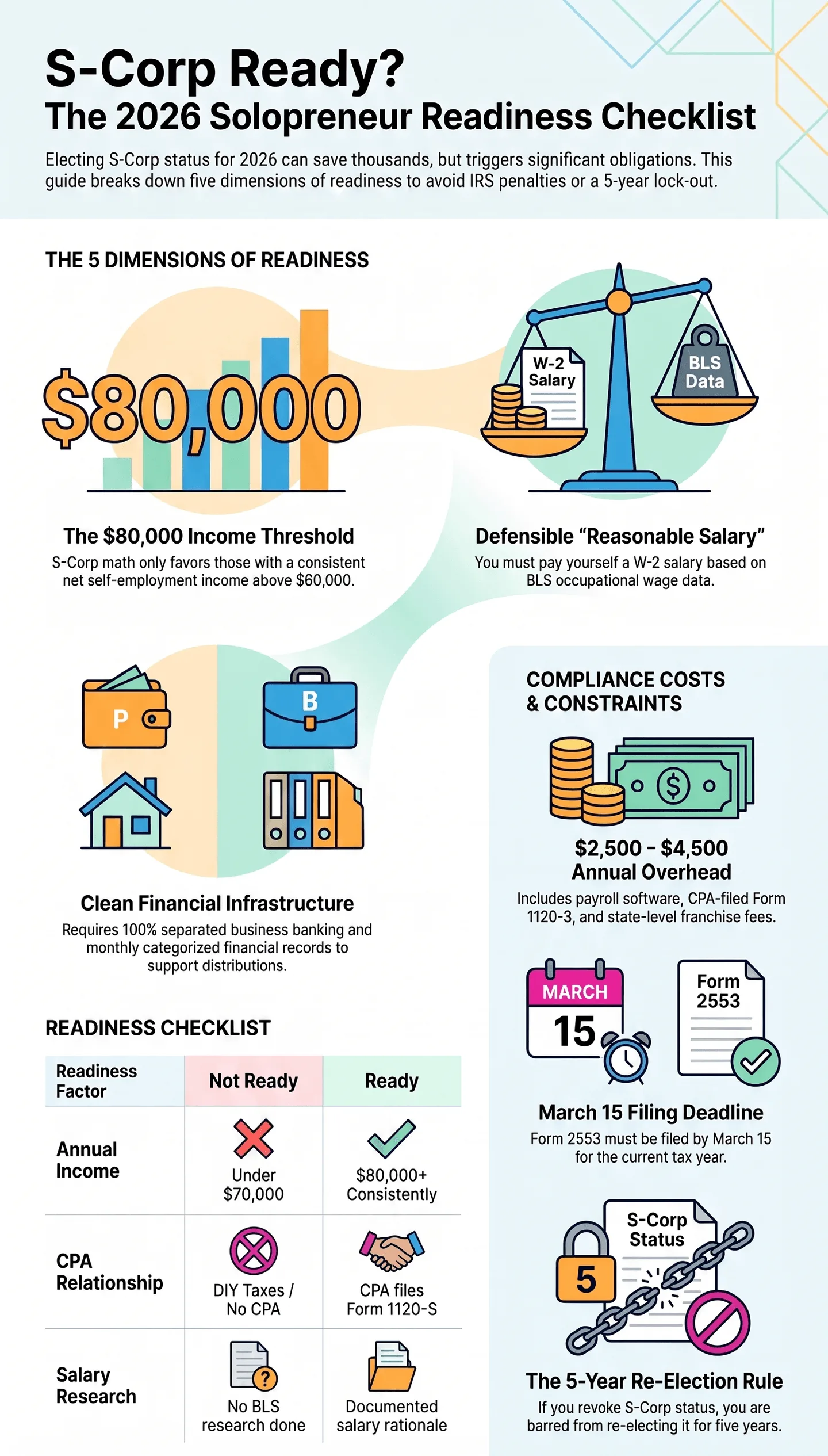
Take our free S-Corp Readiness Assessment to get a scored evaluation across all five dimensions — with a personalized action plan based on where you are right now.
Why "I Can Save Money with S-Corp" Isn't Enough
S-Corp election is attractive for one reason: it can save you thousands per year in self-employment taxes. But electing S-Corp triggers a set of ongoing obligations that many solopreneurs aren't prepared for:
- You must pay yourself a reasonable W-2 salary and run actual payroll
- You must file a separate business tax return (Form 1120-S) in addition to your personal return
- You must make quarterly payroll tax deposits with the IRS
- Your financial records must be clean enough to support the salary/distribution split
Electing S-Corp before you've addressed these requirements doesn't just create paperwork headaches — it can expose you to IRS penalties, audit risk, and the cost of unwinding a structure you weren't ready for.
There's also a significant constraint most people don't know about: if you revoke S-Corp election, you cannot re-elect S-Corp status for five years without IRS approval. Getting it right the first time matters.
The 5 Dimensions of S-Corp Readiness
Dimension 1: Income Threshold
S-Corp election only makes financial sense when your net self-employment income is high enough that the SE tax savings exceed the annual compliance costs.
The 2026 compliance cost breakdown:
- Payroll software (Gusto, Rippling): ~$600/year
- S-Corp tax return (Form 1120-S, filed by CPA): $800–$2,000/year
- State-level S-Corp fees: $0 most states; $800+ in California
Total ongoing overhead: typically $2,500–$4,500/year.
The general break-even: net self-employment income of $70,000–$80,000/year. Below that, compliance costs typically exceed the SE tax savings. Above $80,000, the math becomes increasingly favorable.
Use our LLC vs S-Corp Calculator to find your exact break-even point based on your income, salary split, and state.
Readiness check: Is your net self-employment income consistently (not occasionally) above $80,000?
Dimension 2: Reasonable Salary Defensibility
The IRS requires S-Corp owner-employees to pay themselves a "reasonable salary" before taking distributions. This salary must reflect what you'd pay a third-party employee to do the same work — not what feels comfortable to minimize taxes.
Setting your salary too low is the single most common S-Corp audit trigger. The IRS actively scrutinizes S-Corp returns where owner compensation appears artificially suppressed, and they win most Tax Court cases on this issue. Back taxes, interest, and penalties can wipe out years of savings.
What makes a salary "defensible":
- You've researched Bureau of Labor Statistics (BLS) occupational wage data for your role and region
- You've documented your research and reasoning in writing
- Your salary falls within a reasonable range for comparable positions
- You update this documentation annually as your role and income evolve
A practical starting framework: most CPAs recommend 40–60% of net profit as an initial salary range, cross-referenced against BLS data. But the documentation of your reasoning matters as much as the number itself — if you're ever audited, your paper trail is your defense.
Readiness check: Have you researched comparable salaries using BLS data or industry surveys, and can you document why your proposed salary is reasonable?
Dimension 3: Business Structure Readiness
S-Corp election requires an existing LLC (or corporation) in good standing. Beyond the entity itself, your business structure needs to be solid enough to support the split between salary and distributions:
- Dedicated business bank account: Personal and business finances must be completely separated. Commingled funds undermine the LLC's liability protection and create compliance problems when running S-Corp payroll.
- Clean financial records: Your income and expenses need to be categorized and organized — not just at year-end, but on an ongoing monthly basis. S-Corp compliance requires knowing your net profit accurately throughout the year to run appropriate payroll.
- EIN: You need an Employer Identification Number to run payroll. If you don't have one, it's free and takes five minutes at IRS.gov.
Readiness check: Do you have a dedicated business bank account, organized monthly financial records, and an EIN?
Dimension 4: Compliance Infrastructure
S-Corp operation requires infrastructure that most sole proprietors and default LLC owners don't have in place:
Payroll software
You must run your own W-2 payroll as an S-Corp owner. This means setting up payroll software, running payroll on a regular schedule (typically monthly or bi-weekly), and making quarterly payroll tax deposits (Form 941) with the IRS. Gusto and Rippling are the most commonly used options for small S-Corps — both start around $40–$50/month and handle the quarterly deposits automatically.
A CPA with S-Corp experience
S-Corp requires Form 1120-S — a separate business tax return that most standard tax preparers and consumer software (TurboTax, H&R Block) cannot handle. You need a CPA who explicitly serves S-Corp clients. When interviewing candidates, ask: "Do you file Form 1120-S for clients?" and "How many S-Corp clients do you currently serve?" A confident, specific answer is what you're looking for.
Readiness check: Have you selected payroll software and confirmed that your CPA (or a prospective CPA) files Form 1120-S?
Dimension 5: State-Level Considerations
Federal S-Corp benefits are consistent across states, but state-level treatment varies and can materially change your decision:
- No-income-tax states (TX, FL, NV, WA, WY): Cleanest scenario. S-Corp savings are purely federal. No state S-Corp complexity.
- Most states: Generally follow federal S-Corp treatment with modest state fees. The federal break-even analysis applies directly.
- California: Charges a 1.5% franchise tax on S-Corp net income, with an $800/year minimum. At lower incomes, this can significantly reduce or eliminate the net benefit. California S-Corp filers should get a state-specific CPA review before electing.
- New York: Has its own S-Corp tax treatment with additional filings. NY-licensed CPA review is strongly recommended before electing.
Readiness check: Have you accounted for your state's specific S-Corp treatment in your cost-benefit analysis?
The S-Corp Readiness Checklist
| Readiness Factor | Not Ready | Ready |
|---|---|---|
| Net annual income | Under $70,000 | $80,000+ consistently |
| Business structure | No LLC yet / newly formed | Established LLC, 12+ months, good standing |
| Business bank account | Mixed with personal funds | Dedicated, fully separated |
| Financial records | Disorganized or inconsistent | Clean, categorized monthly |
| CPA relationship | DIY taxes / no CPA | CPA who files Form 1120-S confirmed |
| Payroll setup | No payroll system in place | Software selected or already active |
| Salary research | No BLS research done | Documented, defensible salary rationale |
| State situation | CA/NY without CPA review | State-specific advice obtained |
How to File Form 2553
Once you've confirmed readiness across all five dimensions, the actual election process is straightforward:
- Download Form 2553 from IRS.gov — it's free
- Complete Section A — basic information about your LLC
- Complete Section B — tax year and shareholder consent (for a single-member LLC, this is just you)
- File with the IRS — by mail or fax to the applicable IRS Service Center for your state (addresses on the form instructions)
- Wait for confirmation — the IRS typically sends written confirmation within 60 days
Deadline: For the election to apply to the current tax year, Form 2553 must be filed by March 15. For new LLCs, the deadline is 2 months and 15 days from formation. Missing the current-year deadline doesn't necessarily mean waiting until next year — the IRS frequently grants late election relief for businesses with reasonable cause.
S-Corp Is a Strategy, Not a One-Time Decision
One thing most guides don't mention: S-Corp election requires annual reassessment. As your income grows, your optimal salary split changes. If you expand from one service line to multiple, or move to a different state, the tax implications shift. A structure that was optimal at $90,000 net income may need adjustment at $150,000.
Most CPAs recommend reviewing your S-Corp salary split and overall structure annually — and running a fresh assessment whenever your income changes by more than $20,000 or your business situation materially changes.
Take the Free Assessment
Not sure where you stand across these five dimensions? Our S-Corp Readiness Assessment evaluates your readiness across all five dimensions and gives you a scored result — from "Not Yet Ready" to "Election-Ready" — with a personalized action timeline and a list of specific blockers to address before filing.
Frequently Asked Questions
Can I elect S-Corp if I just formed my LLC this year?
Yes. For a newly formed LLC, you can elect S-Corp status within 2 months and 15 days of formation and have it apply for the full year. The March 15 deadline applies to existing LLCs wanting current-year election. New LLCs have more flexibility on timing.
What if I elect S-Corp and then decide to revoke it?
You can revoke S-Corp election, but the five-year re-election restriction is a real constraint. Before electing, make sure you're confident the structure makes sense for your foreseeable situation — not just your current year. An unplanned revocation followed by years of being locked out of S-Corp can cost more than the original election saved.
Do I need to change my LLC name or structure to elect S-Corp?
No. S-Corp election is a tax designation only — it doesn't change your LLC's legal name, structure, EIN, or state registration. Your LLC remains an LLC under state law; only your federal tax treatment changes. Clients, contracts, and bank accounts stay the same.
How do I find out if my current CPA can handle an S-Corp return?
Ask directly: "Do you currently file Form 1120-S for any clients?" If the answer is yes, ask how many S-Corp clients they serve and what they charge for the return. If the answer is no or vague, you need a different CPA for S-Corp — this is not a return that generalist preparers handle well.
What's the difference between this assessment and the LLC vs S-Corp Calculator?
The LLC vs S-Corp Calculator answers "how much would I save?" — it's a financial math tool. The S-Corp Readiness Assessment answers "am I prepared to do this?" — it evaluates operational, structural, and compliance readiness. Use both: confirm the savings justify it with the calculator, then confirm you're ready for the obligations with the assessment.