James left his corporate job in September to freelance full-time as a UX consultant. By October he had his first clients. By December, he's looking at roughly $12,000 in net self-employment income for the year — a real but modest amount for three months of getting a new business off the ground. He assumed a retirement account wasn't worth thinking about yet at this income level. It's actually the most time-sensitive decision on his plate.
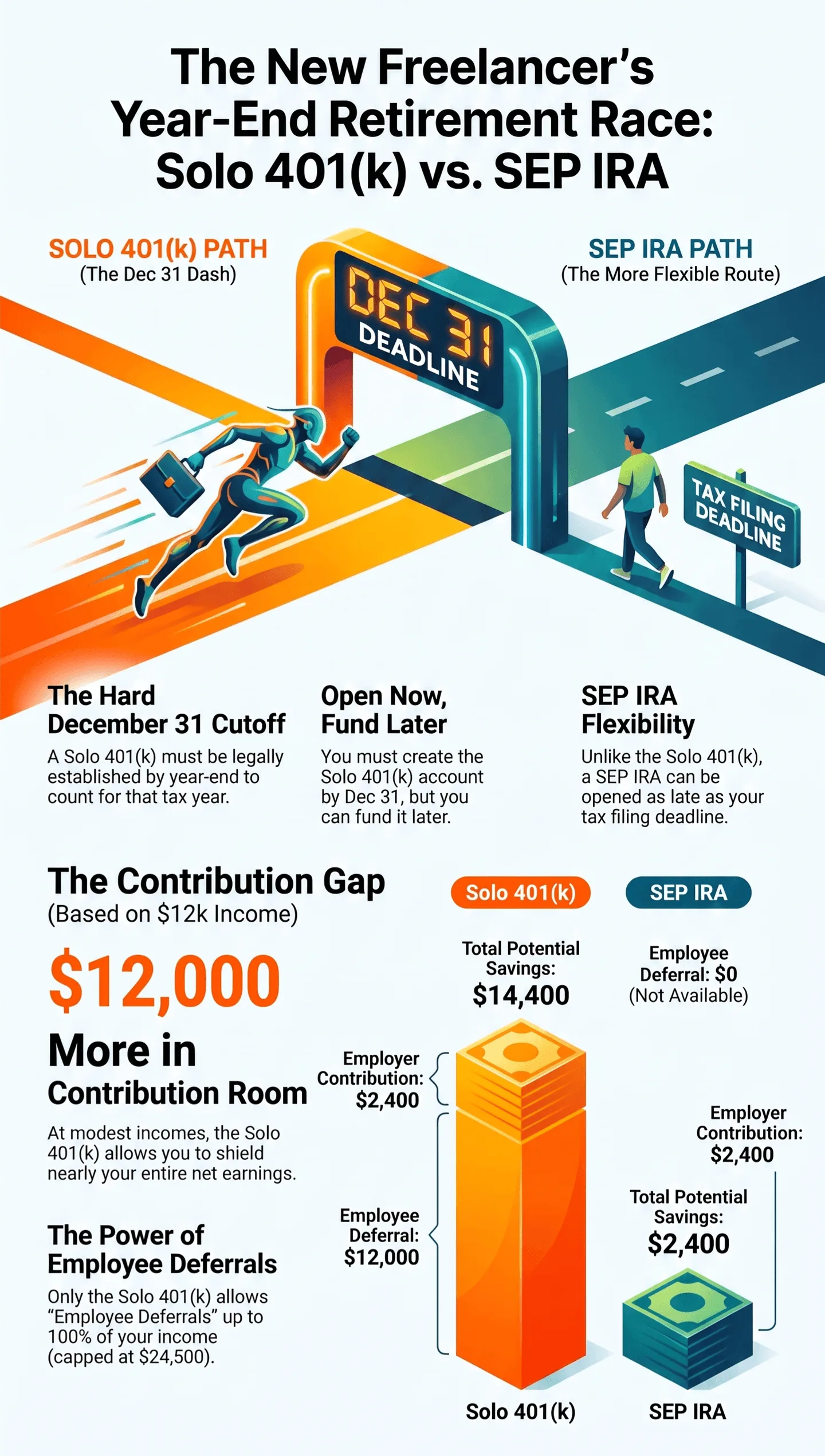
The Deadline That Doesn't Care How New You Are
A Solo 401(k) has to be legally established by December 31 of the tax year for that year's contributions to count — this applies exactly the same whether you've been freelancing for ten years or ten weeks. There's no partial-year exception, no prorated deadline, no grace period tied to how long you've been in business. If James wants this year's income to be eligible for a Solo 401(k) contribution, the account needs to exist before the calendar turns over, even though he can actually fund it later, up to his tax filing deadline.
A SEP IRA doesn't have this same year-end cutoff — it can be opened and funded as late as the extended tax filing deadline the following year. This is exactly the kind of situation where defaulting to "the simpler option because I'll figure out retirement accounts later" quietly forecloses the better option, simply by running out the clock.
What James's Numbers Actually Look Like
Here's the detail that changes the math for someone at James's income level and timeline: the Solo 401(k) employee deferral (up to $24,500) is capped by your actual net self-employment income — you can't defer more than you actually earned. At $12,000 in net income, James's employee deferral is limited to $12,000, not the full $24,500 that a higher earner could claim.
SEP IRA: $12,000 × 20% = $2,400 maximum
Solo 401(k):
- Employee deferral: capped at $12,000 (his full net income, since it's below the $24,500 limit)
- Employer contribution: $12,000 × 20% = $2,400
- Total: $14,400
The Gap, Even at a Modest Income
| SEP IRA | Solo 401(k) | |
|---|---|---|
| Employee deferral | Not available | $12,000 |
| Employer contribution | $2,400 | $2,400 |
| Total | $2,400 | $14,400 |
Difference: $12,000 — and proportionally, this is actually the largest relative gap of any income level, precisely because the employee deferral bucket (which the SEP IRA doesn't have at all) can absorb nearly his entire net income when that income is modest. At higher incomes, the employee deferral is a meaningful piece of a larger total; at James's income level this year, it's most of the whole picture.
Is It Worth Setting Up an Account for Only $14,400?
This is a fair question for a three-month partial year, and the honest answer depends on what James expects next year to look like. If this freelance business is a one-time experiment that might not continue, the administrative effort of opening and maintaining a Solo 401(k) for $14,400 in contribution room might not be worth it relative to a simpler SEP IRA or no retirement contribution at all this year.
But if James is planning to freelance full-time going forward — which his situation suggests, having left his corporate job intentionally — opening the Solo 401(k) now means the account already exists for next year, when his full-year income will likely support a much larger contribution. There's no need to re-establish the account annually once it's open; the December 31 deadline only matters for the first year you want contributions to apply.
What This Looks Like Next Year
If James's freelance income normalizes to something like $70,000 for a full year, his Solo 401(k) room would jump to roughly $38,500 (employee deferral of $24,500 plus $14,000 employer contribution) — a very different number than this year's $14,400, but only accessible without missing a year if the account is already open.
The Practical Takeaway for a Late-Starting Year
Opening a Solo 401(k) before December 31, even for a small first-year contribution, accomplishes two things: it captures whatever contribution room this partial year actually supports, and it means James doesn't have to remember to deal with account setup under time pressure next December, when his income and the stakes will likely be higher.
Check Your Own Numbers
If you started freelancing partway through this year, your numbers will look different from someone with a full year of income — see exactly what your specific partial-year contribution room looks like with our Solo 401(k) vs SEP IRA Calculator, and don't let "my income is still small" be the reason you miss the December 31 window entirely.