Self-employment tax is 15.3% on the first $184,500 of net self-employment income in 2026, then 2.9% above that. On $100,000 of net profit, that's $14,130 — before you pay a single dollar of income tax. Unlike income tax, SE tax has no brackets and very few deductions. But there are legitimate strategies to reduce what you owe. This guide covers all seven of them, ranked by impact.
Use our Quarterly Tax Estimator to see how these strategies affect your quarterly payment obligation in real numbers.
Understanding Self-Employment Tax First
SE tax exists because self-employed people pay both the employee and employer portions of Social Security and Medicare. As a W-2 employee, you pay 7.65% and your employer pays 7.65%. As a freelancer, you pay the full 15.3%.
The exact 2026 breakdown:
- Social Security: 12.4% on the first $184,500 of net self-employment income
- Medicare: 2.9% on all net self-employment income (no cap)
- Additional Medicare Tax: 0.9% on earnings above $200,000 (single) / $250,000 (married filing jointly)
One partial offset already built in: SE tax is calculated on 92.35% of your net earnings, not 100%. This adjustment accounts for the employer-equivalent portion. So on $100,000 net income, SE tax applies to $92,350 — saving you about $1,177 compared to a flat 15.3% calculation.
Strategy 1: Elect S-Corp Status (Biggest Impact for Higher Earners)
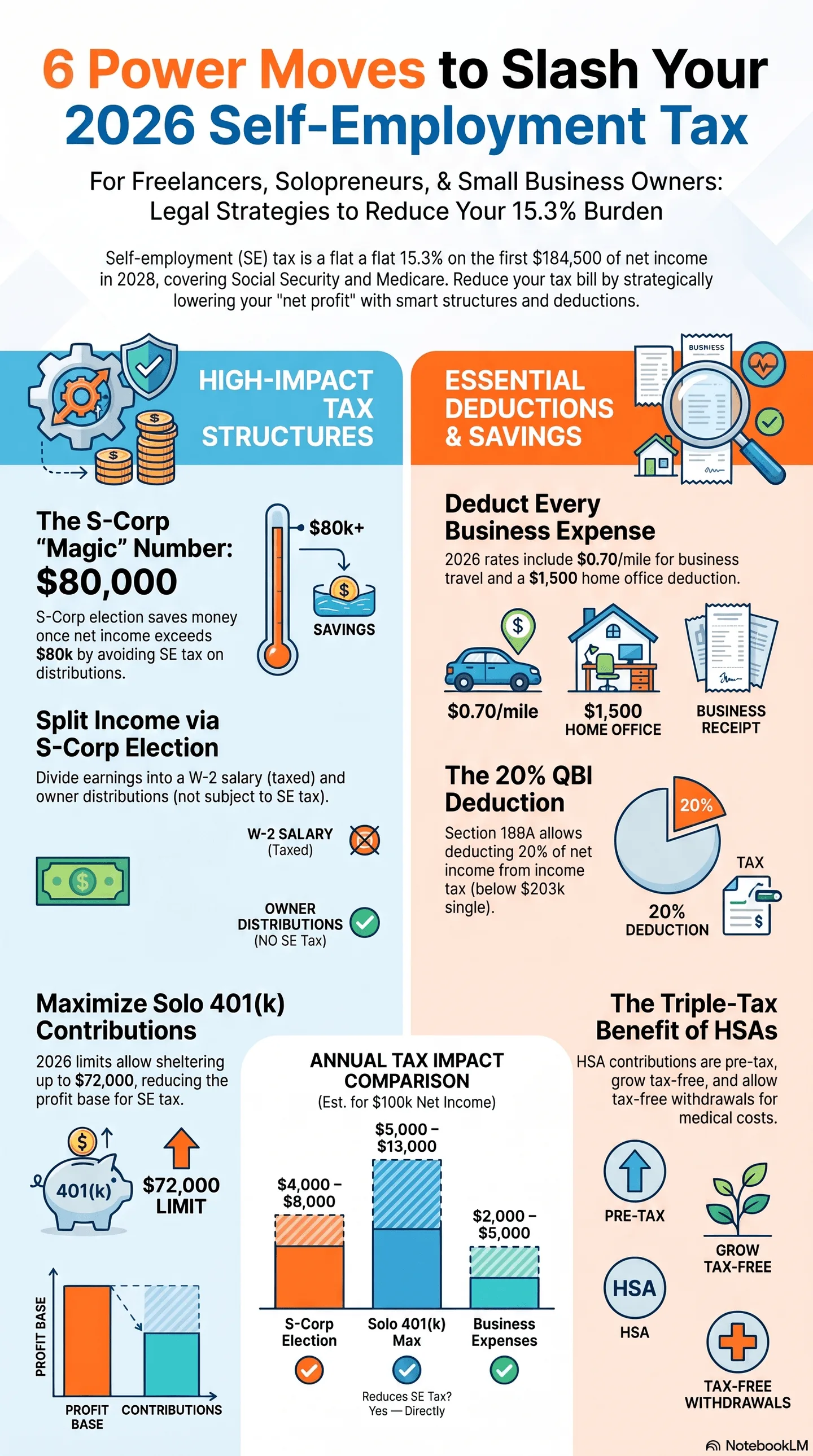
S-Corp election is the single most powerful SE tax reduction strategy available to high-income freelancers. It works by splitting your income into a W-2 salary (subject to payroll taxes) and owner distributions (not subject to SE or payroll tax).
Example at $120,000 net income:
- LLC default: Pay SE tax on all $120,000 → ~$16,956 in SE tax
- S-Corp with $65,000 salary: Pay payroll tax on $65,000 only → ~$9,185 in payroll tax
- Gross savings: ~$7,771/year
- After compliance costs ($2,500–$4,000): net savings $3,771–$5,271
The break-even point: S-Corp makes financial sense once your net income consistently exceeds $80,000. Below that, the compliance costs (payroll software + CPA fees) typically exceed the savings.
Use our LLC vs S-Corp Calculator to find your exact break-even with your specific numbers.
Strategy 2: Maximize Retirement Contributions
Every dollar contributed to a Solo 401(k) or SEP-IRA reduces your net self-employment income — which reduces both your income tax and your SE tax.
2026 contribution limits (from IRS):
- Solo 401(k) employee contribution: Up to $24,500 (plus $8,000 catch-up if age 50+)
- Solo 401(k) employer contribution: Up to 25% of W-2 wages (S-Corp) or ~20% of net self-employment income (sole proprietor)
- Solo 401(k) combined total: Up to $72,000 in 2026 ($80,000 with catch-up)
- SEP-IRA: Up to 25% of compensation, maximum $72,000
At $100,000 net income, maxing out a Solo 401(k) could shelter $36,000–$42,000 from taxes. At a 22% income tax rate plus SE tax, that's roughly $10,000–$13,000 in combined tax savings.
Solo 401(k) vs SEP-IRA for lower incomes: Solo 401(k) wins at incomes below $175,000. At $60,000 net income, a Solo 401(k) allows contributions up to $36,000; a SEP-IRA only allows $12,000. The employee deferral feature of the Solo 401(k) is the difference.
Strategy 3: Deduct All Legitimate Business Expenses
SE tax is calculated on your net profit — not your gross revenue. Every legitimate business expense reduces net profit and therefore reduces SE tax directly.
Most-missed deductions:
- Home office (simplified method: up to $1,500/year; actual method: higher but requires documentation)
- Software subscriptions (Adobe, Figma, Slack, Zoom, QuickBooks, AI tools)
- Business portion of phone and internet (50–80% for most freelancers)
- Health insurance premiums (100% deductible above-the-line)
- Professional development (courses, books, conferences)
- Business mileage at $0.70/mile (2026 IRS rate)
- Equipment and technology (Section 179 allows full first-year expensing, limit raised to $2.5 million in 2026 under OBBBA)
On $100,000 gross with $15,000 in legitimate expenses, your SE tax base drops from $100,000 to $85,000 — saving roughly $2,295 in SE tax alone.
Strategy 4: Claim the QBI Deduction (Section 199A)
The Qualified Business Income deduction allows most self-employed filers to deduct 20% of their net business income from their taxable income. This doesn't directly reduce SE tax, but it reduces the income tax you pay on the same income — and the two are calculated on the same base.
2026 phase-out thresholds:
- Full 20% deduction available below $203,000 (single) / $406,000 (married)
- Partial deduction in the phase-out range above these amounts
- Some service businesses (law, accounting, health, consulting) face additional limitations above the phase-out threshold
Under the OBBBA (2025), the QBI deduction was made permanent and a new $400 minimum deduction was added for anyone with QBI exceeding $1,000. This effectively ensures even very low-income freelancers get some benefit.
On $80,000 net income, the 20% QBI deduction shields $16,000 from income tax — saving approximately $3,520 at the 22% bracket.
Strategy 5: Deduct the Employer-Equivalent SE Tax
This is an automatic deduction most freelancers don't think about because it happens on your Form 1040 without any special action. You can deduct 50% of your SE tax from your adjusted gross income — the "employer-equivalent" portion.
On $100,000 net income with $14,130 in SE tax, you deduct $7,065 from your AGI. At the 22% income tax rate, that's a $1,554 income tax reduction. It doesn't reduce SE tax itself, but reduces the income tax you pay on SE income.
Strategy 6: Deduct Self-Employed Health Insurance Premiums
If you pay for your own health insurance (not covered by a spouse's employer plan), 100% of the premiums are deductible from your adjusted gross income. This is an above-the-line deduction — meaning it reduces your AGI even if you take the standard deduction.
At $700/month in premiums, that's $8,400/year deducted from AGI. At a 22% income tax rate, that's $1,848 in tax savings — plus the SE tax reduction on the same amount.
This deduction includes health, dental, and qualifying long-term care insurance premiums for you, your spouse, and dependents.
Strategy 7: Use a Health Savings Account (HSA)
If you have a high-deductible health plan (HDHP), you can contribute to an HSA and deduct contributions from your taxable income. 2026 HSA limits:
- Individual coverage: $4,400
- Family coverage: $8,750
- Age 55+ catch-up: Additional $1,000
HSA contributions are pre-tax, grow tax-free, and withdrawals for qualified medical expenses are tax-free — a triple tax benefit. For a freelancer paying for their own health coverage, this is one of the best tax-advantaged accounts available.
How Much Can You Actually Save?
| Strategy | Reduces SE Tax? | Reduces Income Tax? | Estimated Annual Impact at $100k |
|---|---|---|---|
| S-Corp election | Yes — directly | Indirectly | $4,000–$8,000 |
| Solo 401(k) max contribution | Yes — reduces net profit | Yes | $5,000–$13,000 |
| All business expenses claimed | Yes — reduces net profit | Yes | $2,000–$5,000 |
| QBI deduction (Section 199A) | No | Yes | $2,500–$4,000 |
| SE tax deduction (automatic) | No | Yes | $1,500–$2,000 |
| Health insurance deduction | No | Yes | $1,000–$2,500 |
| HSA contributions | No | Yes | $1,000–$2,000 |
A freelancer earning $100,000 who implements all seven strategies — including S-Corp election and maxing out a Solo 401(k) — can realistically reduce their combined tax burden by $15,000–$25,000 per year compared to doing nothing.
Start With Your Quarterly Payments
Every tax reduction strategy affects your quarterly estimated payments. Use our Quarterly Tax Estimator to calculate how much your deductions reduce what you owe each quarter — and adjust your payments accordingly.
Frequently Asked Questions
Is SE tax the same as income tax?
No — they are separate taxes calculated on the same base (net self-employment income), but at different rates and with different rules. SE tax funds Social Security and Medicare at 15.3%. Income tax funds general federal operations and is calculated using progressive brackets (10%–37%). You owe both, which is why the combined effective tax rate for freelancers often reaches 30–40% at moderate income levels.
Can I avoid SE tax entirely?
No legal strategy completely eliminates SE tax — the IRS requires it from anyone with $400 or more in net self-employment income. What you can do is significantly reduce the base on which it's calculated (through deductions and retirement contributions) and reduce the portion subject to SE tax (through S-Corp election). A $100,000 freelancer who uses all available strategies might reduce their effective SE tax burden by 30–50%.
Do LLC members pay SE tax?
Yes. By default, a single-member LLC is a disregarded entity — all net income flows to Schedule C and is subject to SE tax. Multi-member LLC members who actively participate in the business also pay SE tax on their distributive share. The only way to reduce SE tax through an LLC is to elect S-Corp tax treatment, which then requires running W-2 payroll.
What happens if I underpay SE tax through the year?
Underpaying estimated tax triggers an underpayment penalty — currently around 7–8% annually on the underpaid amount. The Safe Harbor rule protects you from this penalty if you pay at least 100% of last year's tax liability (110% if prior-year AGI exceeded $150,000) in four equal quarterly in