Sarah works full-time as a marketing manager, making $65,000 a year. On weekends, she runs a small Etsy shop selling hand-lettered stationery — nothing huge, but it cleared $18,000 in net profit this year, enough that she started wondering what she actually owes on it come tax season.
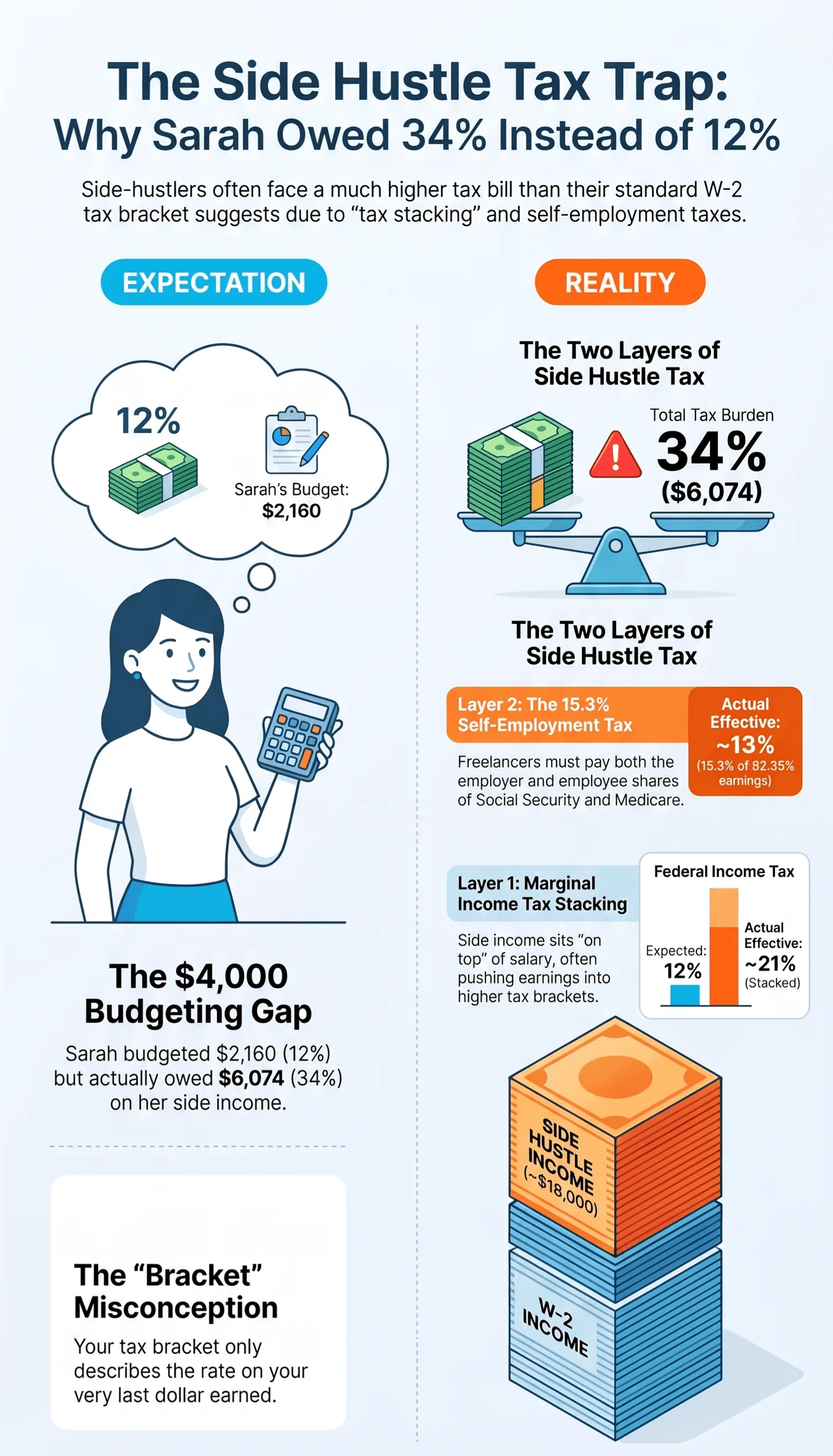
Her assumption going in: since her day job puts her in what she'd heard called "the 12% bracket," her side income would get taxed at roughly the same rate. It's actually closer to three times that, once everything is calculated correctly — and the gap comes from two separate places most people only understand one of.
Where Sarah's W-2 Income Actually Sits
After the standard deduction ($16,100 for a single filer in 2026), Sarah's W-2 taxable income comes to $48,900 — which does mean her last W-2 dollar is taxed at the 12% marginal rate. This is the number she'd heard referenced as "her bracket," and it's technically accurate for her salary alone.
Why Her Side Income Doesn't Get the Same 12% Treatment
Here's the mechanic that catches people off guard: her $18,000 in Etsy income doesn't get evaluated in isolation. It stacks directly on top of her W-2 income for tax purposes, pushing her total taxable income from $48,900 to $66,900. That crosses directly through the 22% bracket threshold ($50,400) partway through — meaning a meaningful chunk of her side income is taxed at 22%, not 12%.
Working through the actual bracket math: Sarah's income tax on her side income alone comes to roughly $3,530 — an effective 21% on that $18,000, nearly double the 12% she expected, purely from the income tax side of the equation.
The Part That Makes It Worse: Self-Employment Tax
Income tax stacking is only half of what applies to Sarah's Etsy income. As self-employment income, it also owes the 15.3% self-employment tax (12.4% Social Security + 2.9% Medicare, calculated on 92.35% of net earnings) — a tax her W-2 salary doesn't carry in the same way, since her employer already covers half of the equivalent payroll tax on her wages.
SE tax on Sarah's $18,000: roughly $2,543
The Full Picture
| Amount | |
|---|---|
| Income tax on side income (stacked at marginal rate) | ~$3,530 |
| Self-employment tax | ~$2,543 |
| Total tax on the $18,000 | ~$6,074 |
| Effective rate on side income | ~34% |
Sarah expected to owe roughly 12% on her Etsy earnings — closer to $2,160. The real number, once both layers are accounted for, is closer to $6,074, a difference of nearly $4,000 she hadn't budgeted for.
Why This Isn't a Sign Something Went Wrong
This isn't a penalty or a mistake in how Sarah ran her shop — it's simply how the tax system treats a second stream of self-employment income layered on top of existing W-2 wages. The confusion comes entirely from the informal way people talk about "my tax bracket" as if it's one flat number that applies to everything they earn, when it actually only describes the rate on their last dollar of income, in the order that income is calculated.
What This Means for Sarah's Quarterly Payments
If Sarah has been setting aside a flat 15-20% of her Etsy income for taxes — a common rule of thumb — she's underfunded relative to her actual roughly 34% obligation. This is exactly the kind of gap that shows up as an unpleasant surprise (and potentially an underpayment penalty) at filing time if quarterly estimated payments were based on the lower, incorrect assumption.
Check Your Own Stacking Math
Sarah's situation is common for anyone whose side income is large enough to meaningfully add to their existing W-2 income — the stacking effect only gets more pronounced the more your combined income crosses bracket thresholds. Run your actual W-2 income and side income through our Side Hustle Tax Calculator to see your real combined rate, rather than assuming your side income is taxed the same way your paycheck is.
Frequently Asked Questions
If Sarah's day job put her in a higher bracket, would the stacking effect be even worse? Yes — the stacking effect is proportionally larger the closer your W-2 income already sits to a bracket threshold, or the higher your existing bracket is. Someone with a $140,000 W-2 salary layering side income on top would see a similar mechanic play out at higher bracket levels, often pushing side income into the 32% or 35% federal bracket before self-employment tax is even added.
Does the self-employment tax ever go away once income is high enough? The Medicare portion (2.9%) applies to all self-employment income with no cap. The Social Security portion (12.4%) only applies up to the annual wage base ($184,500 for 2026) — but this cap is shared across W-2 wages and self-employment income combined, so someone with substantial W-2 income might already be near or past that cap before their side income is even calculated, which can actually reduce their effective SE tax rate on the side income specifically.