If you sell on Etsy on weeknights and drive for a rideshare app on weekends, you're not alone — a lot of side hustlers run more than one unrelated activity at once. The tax filing mechanics for this are more specific than most guides make clear, and getting the structure wrong is a common source of confusion at filing time.
The Core Rule: Separate Businesses, Separate Schedule Cs
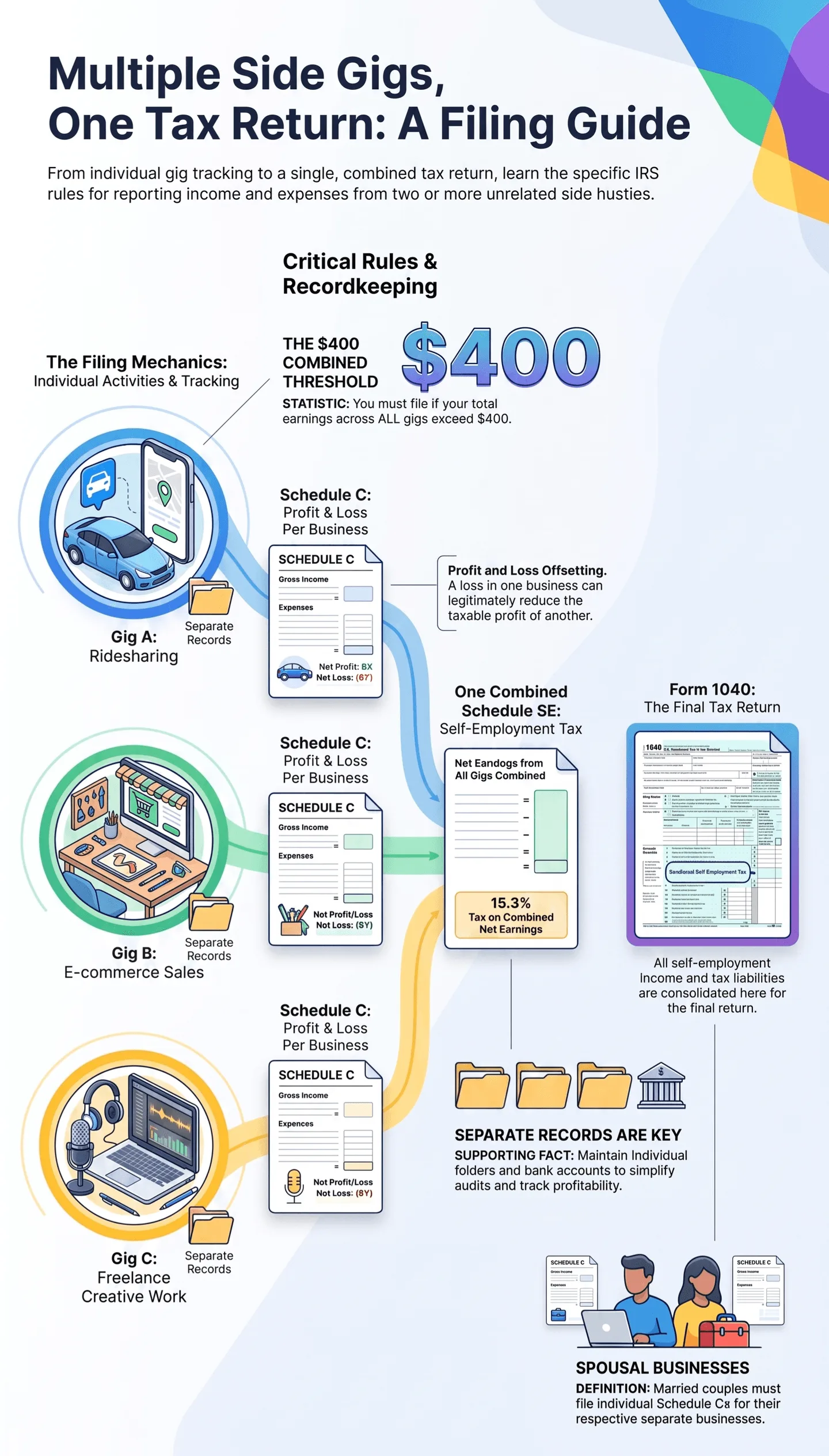
If your side hustles are genuinely different lines of work — say, freelance graphic design and driving for a delivery app — the IRS generally expects you to report them on separate Schedule C forms, one per business. This isn't optional bookkeeping preference; it's how the form is structured to work, and it keeps your income and expense tracking clean for each activity.
The exception is when your activities are similar enough to be considered the same line of business. If you sell handmade cake toppers on Etsy and also run a broader cake-baking business, those overlapping activities can typically go on one combined Schedule C, since they're part of the same general business. But an Etsy craft shop and a rideshare gig are different enough in nature that most tax guidance recommends keeping them on separate forms.
But Only One Schedule SE for Self-Employment Tax
Here's the part that surprises people: even with multiple Schedule C forms, you generally only need one Schedule SE to calculate your total self-employment tax. Schedule SE doesn't calculate tax per business — it calculates tax on your combined net self-employment earnings across all your Schedule C activities. Each Schedule C's net profit or loss flows into the same combined calculation.
This means if one side hustle shows a profit and another shows a loss, the loss from one legitimately offsets the gain from the other for self-employment tax purposes — as long as both are genuine, non-hobby business activities. What you cannot do is deliberately merge two separate activities into one Schedule C specifically to obscure or manufacture a loss; the IRS is explicit that combining activities for this purpose isn't allowed, and doing so likely wouldn't change your total tax liability anyway since the SE tax calculation combines the net results regardless.
The $400 Threshold Applies to Your Combined Total, Not Each Gig Separately
This is a detail that trips up a lot of side hustlers with more than one small gig: the $400 self-employment tax filing threshold applies to your total self-employment income across all activities combined, not to each individual side hustle.
If you earned $300 from selling items online and another $1,000 driving for a rideshare platform, your combined self-employment income is $1,300 — well over the $400 threshold — even though neither activity alone crossed that line. You'd owe self-employment tax on the full combined amount. This is the same underlying rule covered in our related article on the $400 side hustle rule, applied specifically to the "I have several small side gigs" scenario.
Keeping Records Separate (Even Though the Tax Owed Is Combined)
Even though your self-employment tax calculation combines everything, your day-to-day recordkeeping should stay separate by activity. Mixing receipts and expenses from your Etsy shop with mileage logs from your rideshare driving makes it much harder to substantiate deductions for either business individually if the IRS ever asks — and it increases your risk of missing legitimate deductions specific to each activity (craft supplies for one, vehicle expenses for the other).
A practical system: separate folders or bookkeeping categories per gig, ideally with a dedicated bank account per meaningful side business once it grows past occasional small income. This isn't just about audit protection — clean per-business records make it much easier to see which of your side hustles is actually profitable and worth your continued time.
What Flows Where on Your Tax Return
For anyone doing this by hand or trying to understand what their tax software is doing:
- Each business's income and expenses go on its own Schedule C, resulting in a net profit or loss per business
- All Schedule C net results combine into one Schedule SE, which calculates your total self-employment tax (15.3% on your combined net earnings, up to the Social Security wage base)
- Both Schedule C net amounts flow to Schedule 1, Line 3 on your Form 1040, combined
- The deductible half of your self-employment tax (calculated on Schedule SE) becomes an adjustment to income on Schedule 1
Frequently Asked Questions
Do I need to file quarterly estimated taxes separately for each side hustle? No — quarterly estimated tax payments are based on your total expected tax liability for the year across all income sources combined (side hustles plus any W-2 withholding), not calculated or paid separately per gig. Use our Side Hustle Tax Calculator to estimate your combined quarterly payment amount.
My spouse and I each have our own separate side businesses. Can we combine them on one Schedule C? No — even for married couples filing jointly, each spouse's separate business activity needs its own Schedule C reflecting that spouse as the business owner. This matters for self-employment tax purposes, since SE tax is calculated per individual, not per household.
If one of my side hustles consistently loses money, will that raise a red flag? It can, particularly if a specific activity shows losses in 3 or more of the last 5 tax years, which is one factor (though not the only one) the IRS considers when evaluating whether an activity is a genuine business versus a hobby. Operating in a businesslike manner — keeping good records, having a genuine profit motive, and running the activity professionally — helps support that a loss-making side hustle is still a legitimate business rather than a hobby, which matters because hobby losses generally cannot offset other income the way business losses can.
Does having multiple side hustles change my quarterly tax deadlines? No — the standard 2026 quarterly estimated tax deadlines (April 15, June 15, September 15, and January 15, 2027) apply the same way regardless of how many separate side hustles feed into your combined self-employment income calculation.