If you sell on Etsy, drive for a gig platform, or get paid through PayPal or Venmo, you've probably heard the $600 1099-K rule was coming — the one that meant almost everyone with any side income would get a tax form this year. Here's the update: that rule got reversed. The threshold is back to $20,000 and 200 transactions, the same level it sat at for over a decade before 2021.
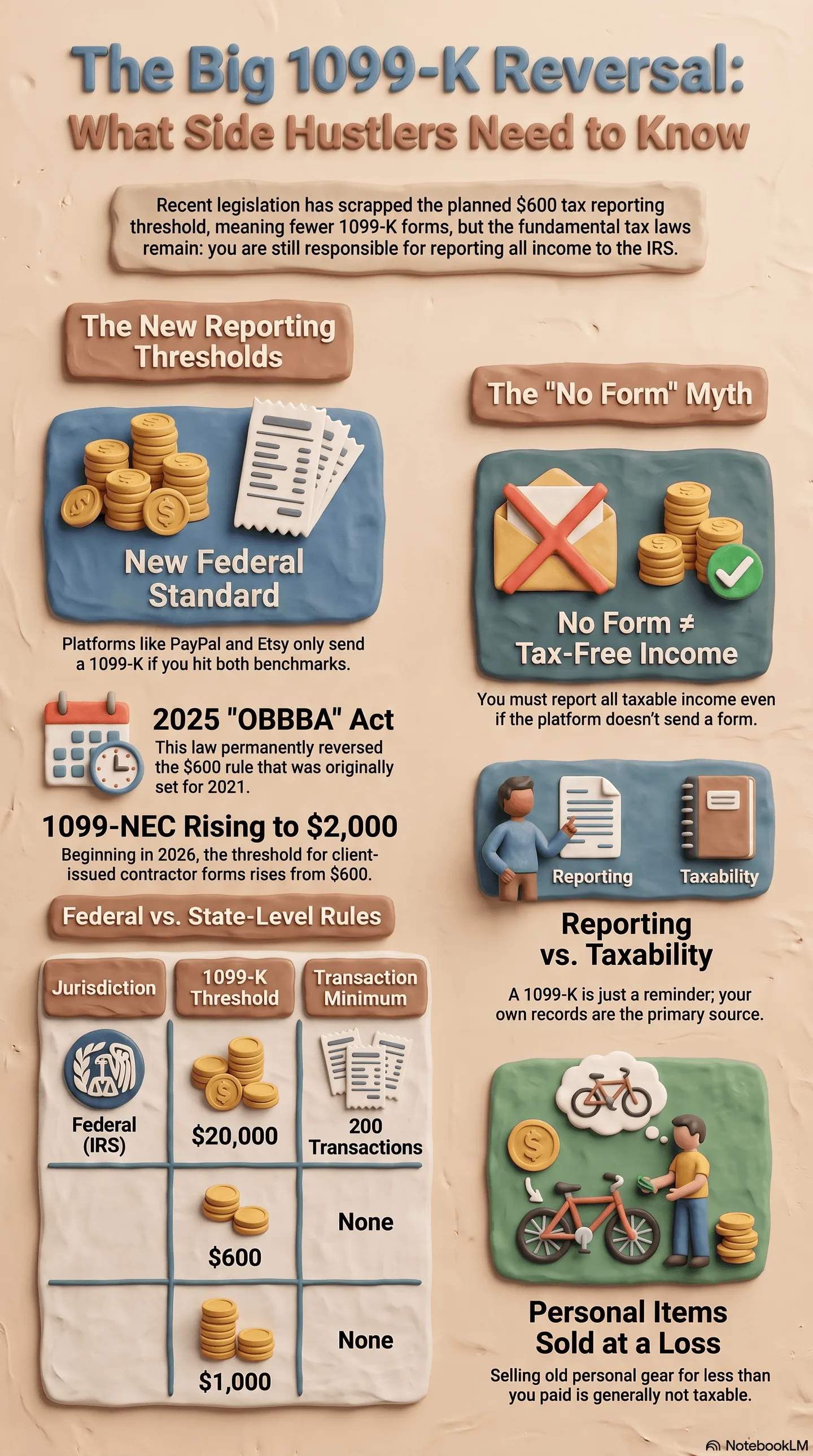
But before you relax completely, there's a catch that trips people up every year: whether or not you get a 1099-K has never determined whether your income is taxable. That part of the rule never changed.
What Actually Happened With the 1099-K Threshold
The $600 threshold everyone was bracing for came from the American Rescue Plan Act (ARPA) back in 2021. It was delayed repeatedly — first for 2022, then 2023 — and the IRS eventually settled into a phase-in plan aiming for full $600 reporting by 2026.
Then, on July 4, 2025, the One Big Beautiful Bill Act (OBBBA) scrapped that plan entirely. The 1099-K reporting threshold for third-party settlement organizations (think PayPal, Venmo for business, Cash App for business, Etsy, eBay) is now back to $20,000 in payments AND more than 200 transactions — for 2025, 2026, and beyond, unless Congress changes it again.
Practically, this means most casual sellers and small-scale side hustlers won't receive a 1099-K this year. If you sold a few hundred dollars of handmade goods on Etsy or picked up occasional gig shifts, the platform is no longer required to send you (or the IRS) a form.
The Part That Doesn't Change: You Still Owe Tax
This is where people get into trouble. The 1099-K threshold is a reporting rule — it determines when a platform has to tell the IRS about your payments. It has never been a taxability rule. The IRS is explicit about this on its own site: whether or not you receive a Form 1099-K, you must still report all taxable income on your tax return.
If you earned $3,000 selling crafts on Etsy this year and never receive a 1099-K because you're under the $20,000 threshold, that $3,000 is still taxable income. The absence of a form doesn't create an exemption — it just means you're relying on your own records instead of a form to know what you earned.
This matters most for people whose side income sits in that middle zone — enough to matter for taxes, but not enough to trigger a form. Use our Side Hustle Tax Calculator to see what you'd actually owe on income in that range, form or no form.
Watch Out for State-Level Thresholds
The $20,000 federal threshold doesn't automatically apply everywhere. Several states set their own, much lower 1099-K thresholds that platforms still have to follow:
- Massachusetts, Maryland, Vermont, Virginia, and Washington D.C.: $600 threshold, no transaction minimum
- Illinois: $1,000 threshold
If you live in one of these states, you could still receive a 1099-K even though you're well under the federal $20,000 mark. Check your state's specific rule if you're unsure — your resident state matters more than where the platform is based.
The Change That Actually Matters More: 1099-NEC and 1099-MISC
While the 1099-K story is a reversal, there's a real change that affects freelancers directly: starting with payments made in 2026, the reporting threshold for Form 1099-NEC (what clients issue for contract work) and Form 1099-MISC rises from $600 to $2,000.
In practice, this means if you do freelance or contract work for a business and they pay you $1,800 for the year, they're no longer required to send you a 1099-NEC — but that income is, again, still fully taxable. You'll need to rely on your own invoices and payment records to report it accurately.
What This Means for Your Recordkeeping
With fewer forms coming your way from platforms and clients, the responsibility shifts more heavily onto you to track your own income accurately:
- Keep a running log of all side income, regardless of amount or whether you expect a form
- Save payment confirmations, invoices, and bank deposits — these are your backup if a form never arrives
- Don't assume "no form" means "no tax owed." This is the single most common and costly misunderstanding among side hustlers
- Check your state's 1099-K threshold if you live in Massachusetts, Maryland, Vermont, Virginia, D.C., or Illinois
Frequently Asked Questions
Do I have to report side hustle income if I never received a 1099-K? Yes. The IRS requires you to report all taxable income regardless of whether you receive any tax form. The 1099-K threshold only controls when a platform must report to the IRS on your behalf — it doesn't change your personal filing obligation.
Will the $600 threshold come back in the future? It's possible — Congress has changed this rule multiple times since 2021. As of the OBBBA (signed July 2025), the $20,000/200-transaction threshold applies for 2025 and future years unless new legislation changes it again. Keep good records regardless, since the rule has proven unpredictable.
I got a 1099-K for a personal item I sold at a loss. Do I owe tax on it? No — a 1099-K can include personal transactions the platform can't distinguish from business sales. If you sold personal items at a loss (for less than you originally paid), that's not taxable income. Keep records of your original purchase price to show this if needed.
Does this affect gig work like DoorDash or Uber driving? Gig platforms typically pay through both 1099-K (for card/app payment processing) and sometimes 1099-NEC. The same rule applies either way: report your actual net earnings whether or not a form arrives. See our Gig Worker True Earnings Calculator to calculate your real take-home after taxes and expenses.