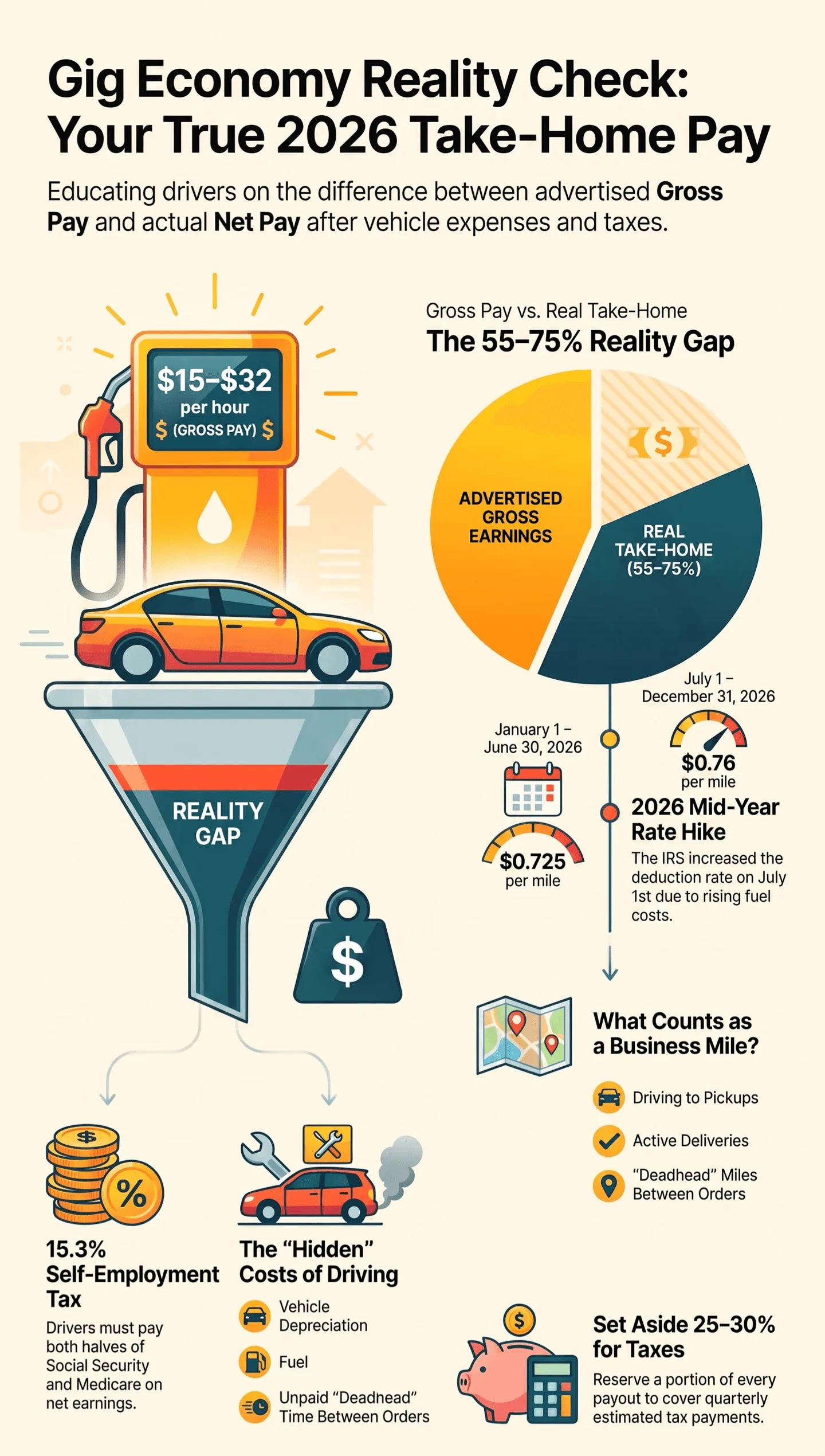
If you drive for DoorDash, Uber Eats, or Instacart, the number on your weekly earnings summary isn't what you actually keep. Gross pay looks good — often $15 to $25 an hour depending on your market and hours. What's left after vehicle costs, gas, and self-employment tax tells a different story, and it's the number that actually determines whether gig work is worth your time.
Why Gross Pay Overstates What You Keep
Gig platforms report earnings before subtracting anything. That headline number doesn't account for:
- Vehicle wear and depreciation — the part of your car's value you use up with every mile, invisible until repair or resale time
- Fuel costs for every mile driven, including the unpaid miles between deliveries
- Self-employment tax — 15.3% on your net earnings, since no employer is splitting this with you
- Unpaid time between accepting an order and starting the next one — the "active hourly rate" platforms sometimes advertise doesn't include this
Experienced gig drivers and independent researchers who track this closely generally find that true net pay after all these factors lands well below the advertised gross figure — often in the range of 55-75% of gross, depending heavily on your market, vehicle efficiency, and how selective you are about which orders you accept.
The Mileage Deduction: Your Single Biggest Tax Break, and It Just Changed
This is the deduction that does the most to reduce your tax bill as a gig driver, and there's an important update for 2026: the IRS mileage rate changed mid-year.
- January 1 – June 30, 2026: $0.725 per business mile
- July 1, 2026 onward: $0.76 per business mile
The IRS made this adjustment (Announcement 2026-11) specifically because of rising fuel prices — a rare mid-year change that has only happened a handful of times in the rate's history (most recently in 2022, when a similar fuel spike triggered a jump from 58.5¢ to 62.5¢ mid-year). If you're tracking mileage for tax purposes, you need to apply the correct rate to miles driven in each half of the year — a trip in June uses the $0.725 rate, one in August uses $0.76, even if you don't file the deduction until next spring.
This distinction matters more than it sounds like it should. A driver logging 15,000 business miles evenly across the year would claim roughly $5,437 for the first half (7,500 × $0.725) and $5,700 for the second half (7,500 × $0.76) — a combined $11,137, compared to $10,875 if the whole year were incorrectly calculated at the old rate.
What Counts as a Business Mile
The mileage deduction covers more than just the miles with a passenger or order in the car. For gig drivers, business miles generally include:
- Driving to a pickup location after accepting an order
- The delivery or ride itself
- "Deadhead" miles — driving between drop-offs while still logged into the app waiting for the next order
Miles driven to your first pickup of the day from home, and from your last drop-off back home, follow more nuanced rules depending on whether you have a dedicated home office for the gig work — but the miles between orders while actively working generally count.
Self-Employment Tax on Gig Income
Beyond mileage, gig income owes the same 15.3% self-employment tax that applies to any self-employed earnings — 12.4% for Social Security (up to the $184,500 wage base for 2026) plus 2.9% for Medicare, calculated on 92.35% of your net earnings after the mileage deduction and other business expenses. This is money that isn't withheld from your weekly payout the way it would be from a W-2 paycheck — it's your responsibility to set aside and pay, typically through quarterly estimated payments.
A Realistic Comparison
Take a driver earning $800 gross in a week, driving 200 miles for gig work, working 25 hours including wait time between orders:
- Gross hourly rate: $32/hour ($800 ÷ 25 hours) — the number that looks appealing before any deductions
- Mileage deduction: 200 miles × $0.76 (assuming second-half-of-2026 miles) = $152 reduces taxable income, but this is a tax deduction, not cash back in the same week
- Actual vehicle costs (fuel, wear) reduce real take-home pay directly, typically running $0.15-$0.30+ per mile depending on the vehicle
- Self-employment tax applies to net earnings after deductions
Once vehicle costs and the tax reserve are accounted for, the real hourly rate is meaningfully lower than the $32 headline number — often landing in a very different range depending on the specific vehicle, market, and how much of the 25 hours was spent actively delivering versus waiting. Use our Gig Worker True Earnings Calculator to see your specific numbers based on your actual platform, miles, hours, and vehicle costs.
Tips Are Taxable Income Either Way
Whether or not you qualify for the OBBBA's tip deduction (covered in our related article on the gig platform tip deduction), all tips you receive remain fully taxable income that must be reported — the deduction reduces what you owe tax on, not your obligation to report the income in the first place.
Frequently Asked Questions
Should I use the standard mileage rate or track actual vehicle expenses? For most gig drivers, the standard mileage rate is simpler and often yields a similar or larger deduction than tracking every individual expense (gas receipts, maintenance, insurance, depreciation). You must choose your method in the first year you use a given vehicle for business — switching from standard mileage to actual expenses later is more restricted than the reverse, so it's worth thinking through before your first tax filing with that vehicle.
Do I need to track miles differently for the first half and second half of 2026? Yes, if you want an accurate deduction. Because the IRS rate changed mid-year (from $0.725 to $0.76 starting July 1), your mileage log needs to reflect which miles were driven in which period. Most mileage-tracking apps handle this automatically once they're updated with the new rate — check that your app reflects the July 1 change rather than applying $0.725 to the entire year.
Why does gig work feel like it pays less than the app shows? Because the app's earnings summary shows gross pay before any of your real costs are subtracted — no gig platform's default dashboard shows your net hourly rate after vehicle costs and taxes. This is intentional in the sense that platforms aren't required to calculate your personal tax and vehicle cost situation; it's the same reason a W-2 paycheck shows gross pay before withholding, except gig platforms don't withhold anything at all.
How much should I set aside from each gig payout for taxes? A common starting estimate is 25-30% of net earnings (after mileage deduction) for combined self-employment tax and income tax, though your specific rate depends on your total income, filing status, and whether you have other income like a day job. If you have significant W-2 income already, your side gig earnings may stack at a higher marginal rate — see our article on marginal rate stacking for how that works, or use our Side Hustle Tax Calculator for a precise estimate.