If you drive for DoorDash, Uber Eats, or a similar delivery platform, there's a real tax break available to you starting with the 2025 tax year — but it comes with specific rules about what counts, and a common misunderstanding that could cost you if you get it wrong.
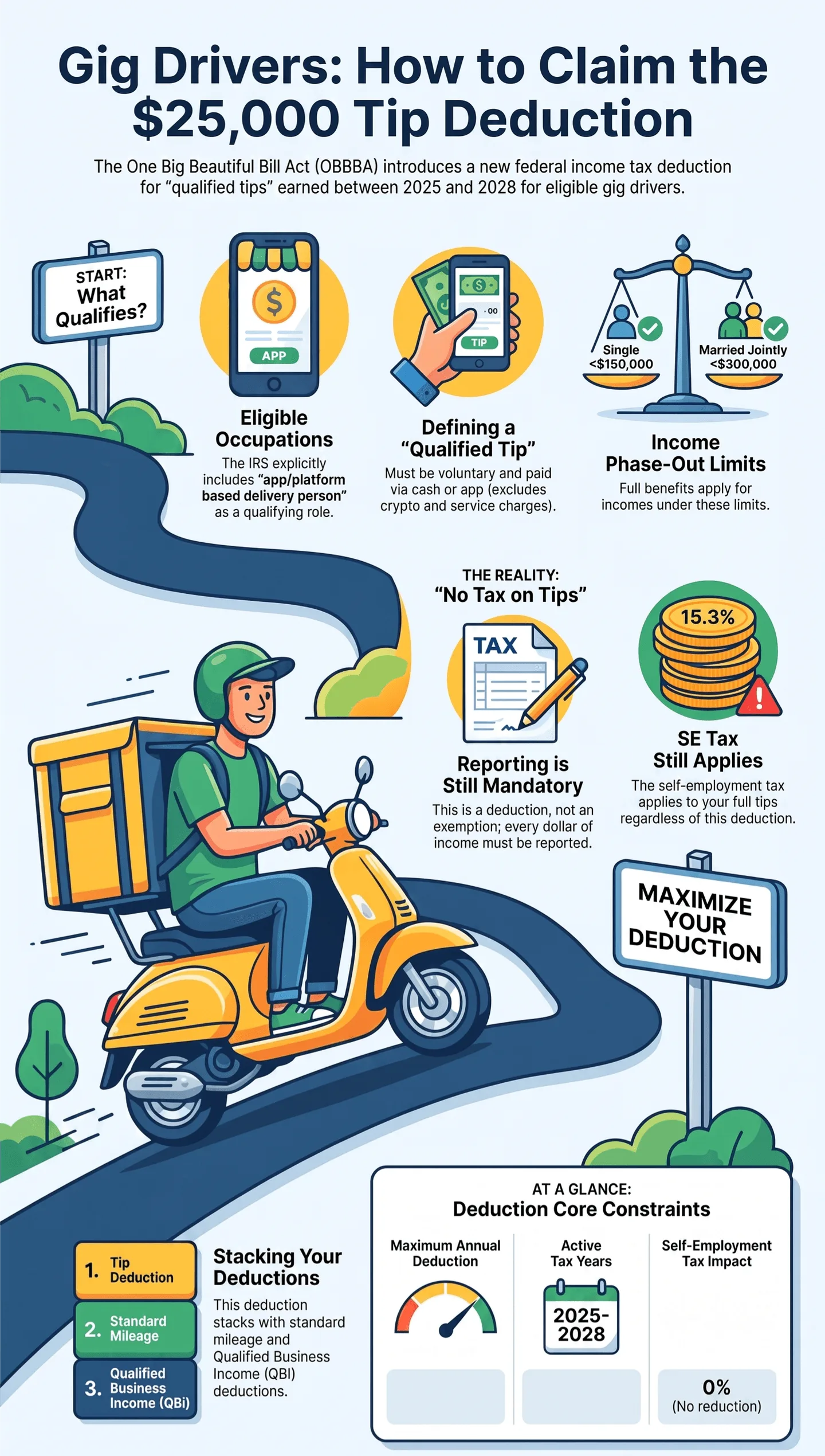
The Basics: Up to $25,000 in Tips, Deducted
Under the One Big Beautiful Bill Act (OBBBA), signed into law July 4, 2025, IRC Section 224 created a new above-the-line deduction for "qualified tips" — up to $25,000 per year, available for tax years 2025 through 2028. It's an above-the-line deduction, meaning you can claim it whether or not you itemize your other deductions.
On April 13, 2026, the IRS and Treasury finalized the rules for exactly who qualifies (T.D. 10044), confirming an exhaustive list of more than 70 occupations. Good news for gig drivers specifically: the final rule explicitly added "app/platform based delivery person" to the list of qualifying occupations under the Goods Delivery People category — a clarification made specifically in response to public comments about whether gig economy delivery drivers were covered.
Income Limits You Need to Know
The deduction phases out for higher earners. Based on IRS guidance, individuals must have modified adjusted gross income at or below $150,000 (single) or $300,000 (married filing jointly) to claim the full benefit — this is the same general threshold structure used for the 2025 tax year, with the deduction phasing out above these levels.
What Counts as a "Qualified Tip" — And What Doesn't
This is where the rule gets specific, and where gig workers most commonly get it wrong. A qualified tip must be:
- Paid voluntarily by the customer — not a mandatory service charge or automatic gratuity
- Paid in cash or cash equivalent — this includes tips paid through the app (charged to a credit card and passed through), but excludes payments in digital assets like cryptocurrency
- Received while performing duties within a qualifying occupation — for gig delivery drivers, this generally means the delivery role itself, not unrelated side activities
- Not a recharacterization of other compensation. The IRS finalized broad anti-abuse rules specifically to prevent platforms or workers from relabeling regular pay as "tips" to claim the deduction. If a tip amount is more accurately described as your base pay or a bonus dressed up as a tip, it doesn't qualify — and the IRS built in an "irrebuttable presumption" of recharacterization in certain ownership-related scenarios.
The Mistake That Could Cost You: "No Tax" Doesn't Mean "No Reporting"
The nickname "No Tax on Tips" is doing a lot of work to create a dangerous misunderstanding. This is a deduction, not an exemption from reporting. You still must report every dollar of tip income you receive — the deduction reduces how much of that reported income is subject to federal income tax, but it does not remove your obligation to report it in the first place.
Critically, this deduction has zero effect on self-employment tax. FICA-equivalent self-employment tax (the 15.3% that funds Social Security and Medicare) applies to your full tip income regardless of this deduction. The tip deduction only reduces your federal income tax liability — it does not touch the SE tax calculation at all.
Underreporting tip income to try to "double dip" — both hiding tips from your income and claiming they were somehow non-taxable — creates real audit exposure and potential penalties, on top of the fact that it's simply not how the rule works.
Specified Service Trade or Business (SSTB) — A Rule Currently in Limbo
The underlying law excludes tips earned in a "specified service trade or business" (a category that includes certain consulting, financial services, and similar professional fields) from qualifying for the deduction. However, the IRS has explicitly reserved guidance on how this SSTB exclusion applies and issued transition relief (Notice 2025-69) that effectively suspends enforcement of this exclusion until further rules are issued. For gig delivery and rideshare work, this is unlikely to be a relevant restriction — SSTB categories are aimed at professional services, not delivery driving — but it's a detail worth knowing if your gig work overlaps with a professional service field.
New Reporting Requirements Starting in 2026
If you receive tips through a platform, expect to see new reporting details on your tax forms starting with income earned in 2026. The IRS has finalized requirements for platforms and employers to report:
- Cash tip amounts using Box 12 with code "TP" on Form W-2 (less directly relevant for most gig drivers, who typically receive 1099 forms rather than W-2s)
- Treasury Tipped Occupation Codes (TTOC) identifying which qualifying occupation the tips relate to
For most gig delivery drivers operating as independent contractors, tip income is more likely to show up through 1099-NEC, 1099-MISC, or 1099-K reporting (or your own platform earnings summary) rather than a W-2, but the underlying deduction rules apply the same way regardless of which form reports the income.
How This Interacts With the Mileage Deduction and SE Tax
The tip deduction stacks alongside — not instead of — your other gig-work deductions. You can claim the standard mileage deduction (see our related article on real hourly pay after gas and taxes) and the qualified business income (QBI) deduction on your net gig earnings, while separately claiming the tip deduction on your qualifying tip income. Each operates independently, but none of them reduce your self-employment tax obligation — that 15.3% applies to your full net earnings regardless of these income tax deductions.
Frequently Asked Questions
Does the tip deduction apply to tips I received before the OBBBA was signed? The deduction applies to tax years 2025 through 2028 — meaning it covers the full 2025 tax year (filed in 2026) even though the law was signed partway through 2025, and continues through 2028. It does not apply retroactively to tips received in earlier tax years.
Do I need my platform to specifically label payments as "qualified tips" for me to claim the deduction? The final IRS rules place new reporting obligations on employers and platforms starting with 2026 earnings, using new W-2 codes and Treasury Tipped Occupation Codes. For self-employed gig workers, you're generally responsible for tracking and substantiating your own qualified tip income on your return, regardless of exactly how the platform's own reporting evolves — keeping your own records of tip amounts received is the safest approach.
Is this deduction permanent? No — it's explicitly temporary, running for tax years 2025 through 2028 under current law. Unless Congress extends or makes it permanent through future legislation, the deduction is scheduled to expire after the 2028 tax year.
Does the tip deduction reduce my self-employment tax? No. The qualified tip deduction only reduces your federal income tax liability. Self-employment tax (15.3%, covering Social Security and Medicare) is calculated on your full net self-employment earnings, including tip income, with no reduction from this deduction. See our Gig Worker True Earnings Calculator to see how this fits into your complete tax picture.
What if I do delivery work as a side hustle alongside a W-2 job? The tip deduction is available to both W-2 employees and self-employed individuals who receive qualifying tips in an eligible occupation — your day job doesn't disqualify you from claiming it on your gig income, as long as your total modified adjusted gross income stays within the phaseout thresholds.