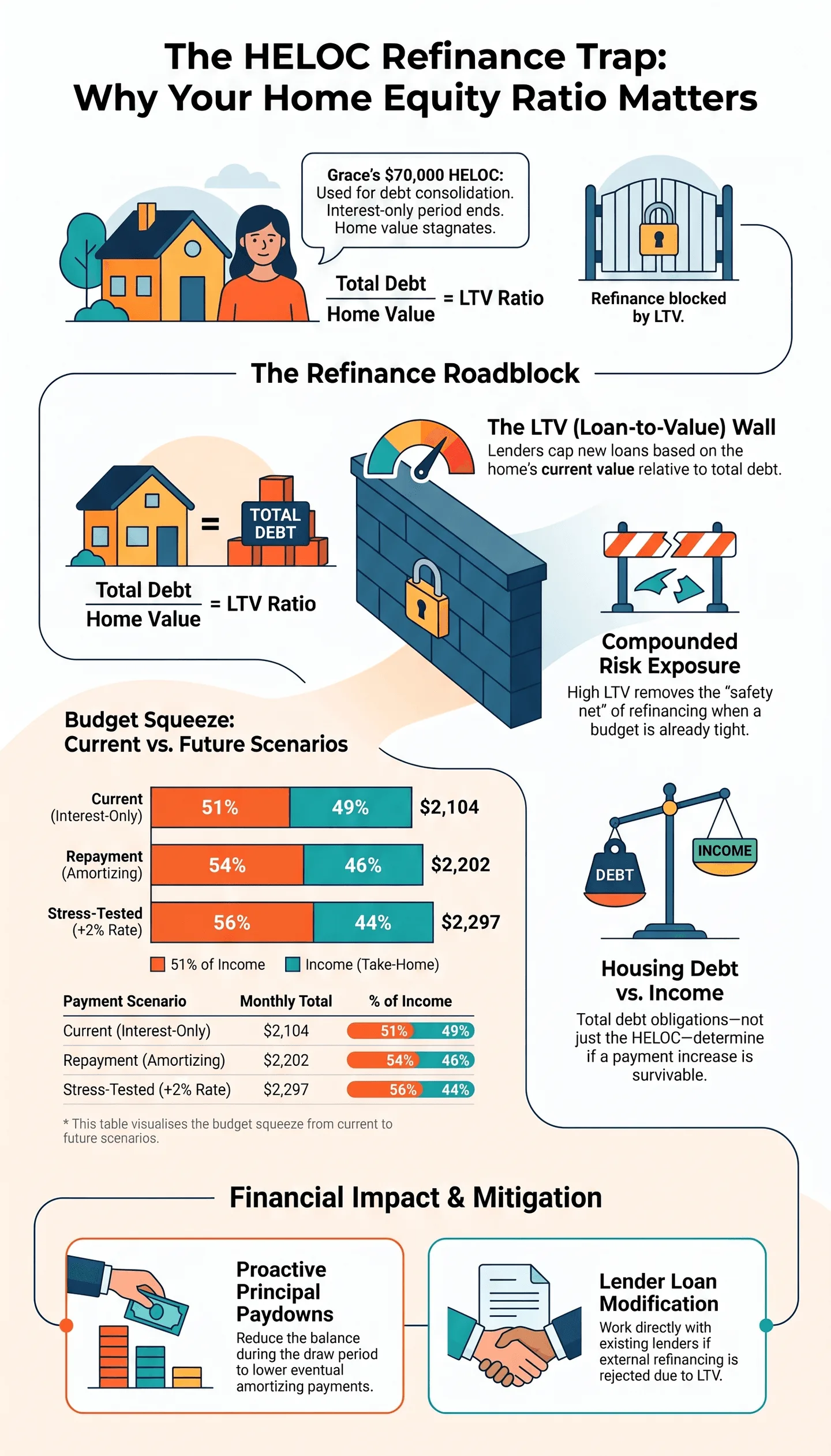
Grace is 38, a single parent earning $4,100 a month, who drew $70,000 against her home's equity three years ago to consolidate high-interest credit card debt. The interest-only payment during the draw period — about $554 a month — fit into an already tight budget alongside her $1,550 primary mortgage. As her draw period's end approached, she looked into refinancing before the repayment period hit, the way financial advice generally recommends. She discovered she couldn't — her home's value hadn't risen enough relative to her combined loan balances, and no lender would approve a new loan at her loan-to-value ratio.
A Budget That Was Already Tight
Even before any payment increase, Grace's primary mortgage and HELOC interest-only payment together came to $2,104 a month — just over half her take-home income. That left limited room to absorb any increase at all, which made the upcoming shift to a fully amortizing payment a bigger concern for her than it would be for someone with more breathing room in their budget.
The Refinance Option That Wasn't Available
The advice to refinance before a HELOC's repayment period begins assumes a borrower can qualify for a new loan — which depends on having enough home equity relative to the combined balance of the primary mortgage and the HELOC. In Grace's case, her home's value had grown only modestly since her purchase, while her combined loan balances left her loan-to-value ratio too high for most lenders to approve a new loan. The proactive refinance strategy that works well for borrowers with more equity cushion simply wasn't on the table for her.
The Full Math
- HELOC balance: $70,000
- Primary mortgage payment: $1,550/month
- HELOC draw-period payment (interest-only): $554/month
- Combined housing debt payment today: $2,104/month (51% of income)
- HELOC repayment-period payment (fully amortizing): $652/month
- Combined payment once repayment period begins: $2,202/month (54% of income)
- Stress-tested combined payment (+2 points): $2,297/month (56% of income)
Why This Risk Compounds Rather Than Stacking Independently
Two things happening at once made Grace's situation harder than either would have been alone: her budget had little slack to begin with, and the standard mitigation strategy — refinancing before the transition — wasn't available to her because of her loan-to-value position. A borrower with more room in their budget, or more home equity to refinance against, could absorb either problem individually. Facing both at the same time narrowed her options considerably.
What This Isn't
This isn't a story with no options left — Grace still has paths forward, including working directly with her current lender on a modification, prioritizing extra principal payments during any remaining draw period time, or adjusting her broader budget in advance of the transition. It's a reminder that the general advice to "refinance before the repayment period" assumes a loan-to-value position that not everyone has, and that combined debt obligations — not the HELOC payment in isolation — are what actually determine how much room there is to absorb a payment increase.
Check Your Own Number
Your loan-to-value ratio affects more than your original approval — it affects your options when the repayment period approaches. Run your draw amount, rate, and full financial picture through our HELOC Risk Stress Test to see where you stand before assuming refinancing will be available if you need it.
Frequently Asked Questions
Why would a high loan-to-value ratio prevent refinancing? Lenders generally cap how much they'll lend relative to a home's current value. If your primary mortgage and HELOC balance combined are already close to that limit, there may not be enough equity cushion for a lender to approve a new loan.
What can I do if I can't refinance before my HELOC's repayment period begins? Options include contacting your current lender about a modification, making extra principal payments during any remaining draw period to lower the eventual balance, or adjusting your broader budget in advance based on a stress-tested repayment estimate.
Should I evaluate my HELOC payment alone, or alongside my other debt? Alongside your other debt, especially your primary mortgage. A HELOC payment that looks manageable in isolation may represent a much larger share of your budget once combined with existing obligations.
Does a HELOC's loan-to-value limit apply only at origination? The original LTV limit applies when the loan is opened, but your position can change over time based on your home's value and any additional balances — which is exactly what determines whether refinancing is realistic when the repayment period approaches.