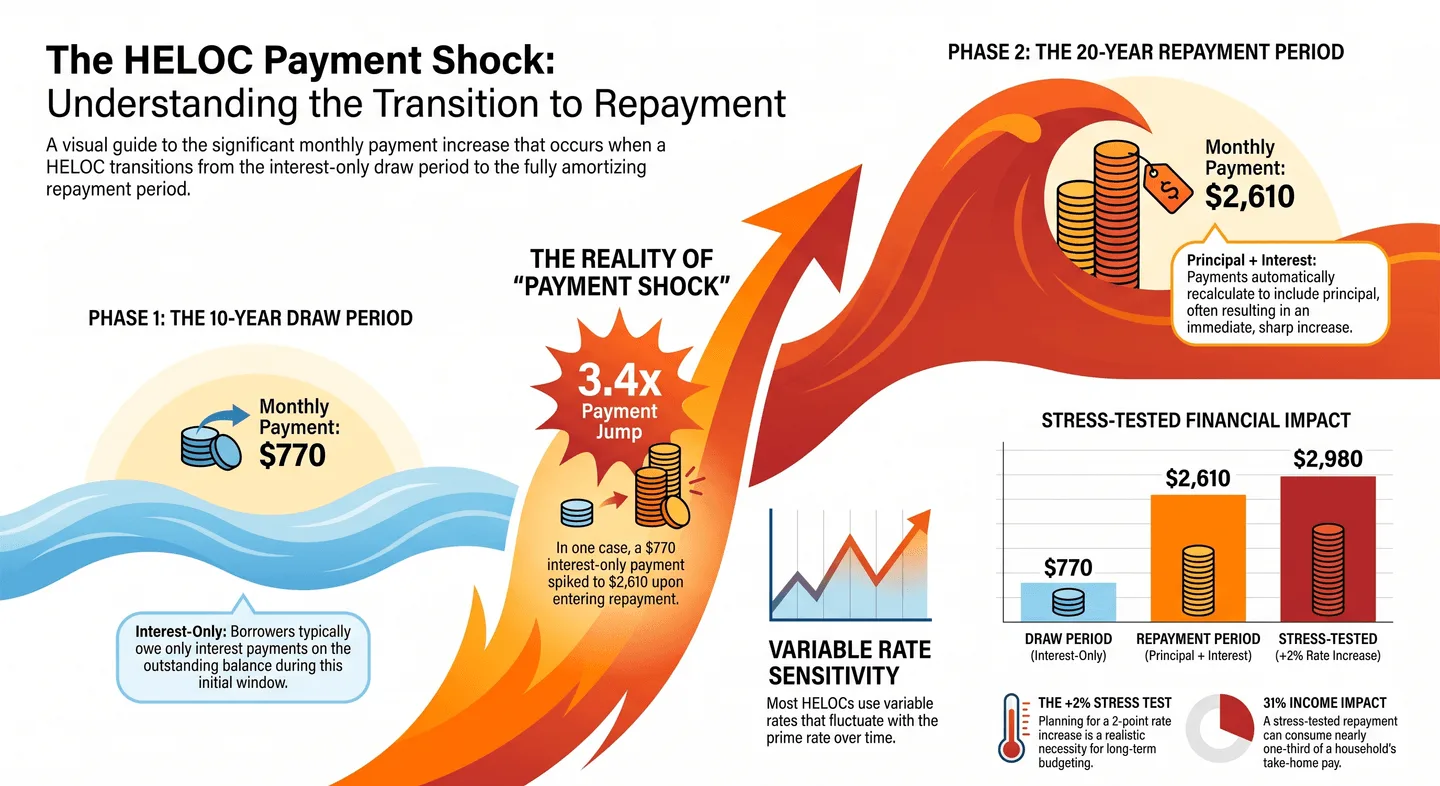
Mike and Priya own a primary residence worth $520,000 with $180,000 left on the mortgage. Two years ago, they pulled $120,000 out of it through a home equity line of credit to fund the down payment on a second property — a rental near a growing suburb. For most of the draw period, their required payment was interest-only: $770 a month. This year, the draw period ended. Their payment didn't creep up. It jumped to $2,610 a month — 3.4 times higher — and a quick stress test against a realistic future rate shows it could climb even further.
How Their HELOC Was Structured
Like most HELOCs, theirs was split into two phases at origination: a 10-year draw period, followed by a 20-year repayment period. During the draw period, the lender only required interest payments on whatever balance was outstanding — standard for nearly every HELOC product, not a special term Mike and Priya negotiated. That's why their early payment felt manageable relative to the size of the draw: $120,000 borrowed, but only the interest portion due each month.
Neither of them had modeled what would happen once the draw period ended. They budgeted around the $770 figure because that was the number on their statement every month for eight years.
The Draw Period vs. Repayment Period Math
When the repayment period began, the required payment recalculated automatically — no renewal application, no new disclosure beyond what was already in their original loan documents. The full $120,000 balance now had to be paid off, principal and interest, over the remaining loan term.
- Draw period payment (interest-only): $770/month
- Repayment period payment (fully amortizing, same balance, same rate): $2,610/month
Nothing about their rate changed to produce that jump. The payment structure did.
Running the Numbers Through a Rate Stress Test
Mike and Priya's HELOC carries a variable rate tied to the prime rate. A 2-point rate increase over an 8-to-10-year draw period is a realistic planning assumption, not a worst-case scenario — prime rate has moved by that much or more within similar windows in recent history. Stress-tested at that higher rate, their repayment-period payment rises further, to roughly $2,980 a month.
The Full Math
- HELOC draw amount: $120,000
- Draw period payment (interest-only): $770/month
- Repayment period payment (fully amortizing): $2,610/month
- Stress-tested payment (+2 points): approximately $2,980/month
- Combined household take-home income: $9,500/month
- Stress-tested payment as share of income: approximately 31%
What This Isn't
This isn't a case against using a HELOC to fund a rental property purchase — plenty of investors do this successfully, and the strategy itself isn't the problem. What went wrong for Mike and Priya was planning around a payment that was only ever temporary by design. The interest-only figure was never going to be the real cost of the $120,000 they borrowed; it was a preview of the smallest possible monthly obligation, for a limited window, on a debt that eventually has to be paid down in full.
The math also assumes their rental continues cash-flowing at roughly its current level. A vacancy, a rate increase larger than 2 points, or an unplanned repair in the same year the repayment period begins would each independently make the 31%-of-income figure worse, not better.
Check Whether Your Situation Qualifies
If you're considering a HELOC to fund a rental property, or you already have one and haven't checked what your payment looks like once the draw period ends, the qualifying detail isn't your current interest-only payment — it's the fully amortizing, stress-tested number. Run your own draw amount, rate, and income through our HELOC Risk Stress Test before assuming the payment you see today is the payment you'll have for the life of the loan.
Frequently Asked Questions
How long is a typical HELOC draw period? Most HELOCs have a draw period of 5 to 10 years, though this varies by lender. During this window, payments are usually interest-only on whatever balance is currently outstanding.
Does my payment jump immediately when the draw period ends? Yes, typically with no grace period. The month after the draw period ends, the required payment recalculates to a fully amortizing principal-and-interest payment based on the outstanding balance and the remaining repayment term.
What's a realistic rate increase to stress-test against? A 1 to 2 percentage point increase over the draw period is a reasonable planning assumption for a variable-rate HELOC, since rates are typically tied to the prime rate, which has moved by that much or more within comparable timeframes historically.
Can I refinance or extend a HELOC before the repayment period starts? Often, yes — many lenders allow refinancing into a new HELOC, a fixed home equity loan, or in some cases an extended draw period, though this usually requires re-qualifying based on current credit and income. This is worth evaluating well before the transition date, not after the higher payment has already started.