Two landlords each spend $1,800 on their rental this year. One deducts the full amount immediately. The other has to spread that same $1,800 across 27.5 years, getting back roughly $65 a year. Same dollar amount, wildly different tax outcome — and the difference comes down to a specific IRS rule that most landlords have never heard of.
The Basic Distinction: Repairs vs. Improvements
The IRS draws a sharp line between two categories of spending on your rental:
- Repairs keep the property in its ordinary operating condition — patching a leak, fixing a broken window, repairing a section of drywall. These are fully deductible in the year you pay for them.
- Improvements add value, adapt the property to a new use, or restore it after significant deterioration — a new roof, a full kitchen remodel, replacing an entire HVAC system. These must be capitalized and depreciated over 27.5 years (residential rental property).
Same cash out of pocket. Very different tax result — a repair gives you the full deduction this year; an improvement gives you a small slice of that deduction every year for nearly three decades.
The $2,500 Rule That Skips the Analysis Entirely
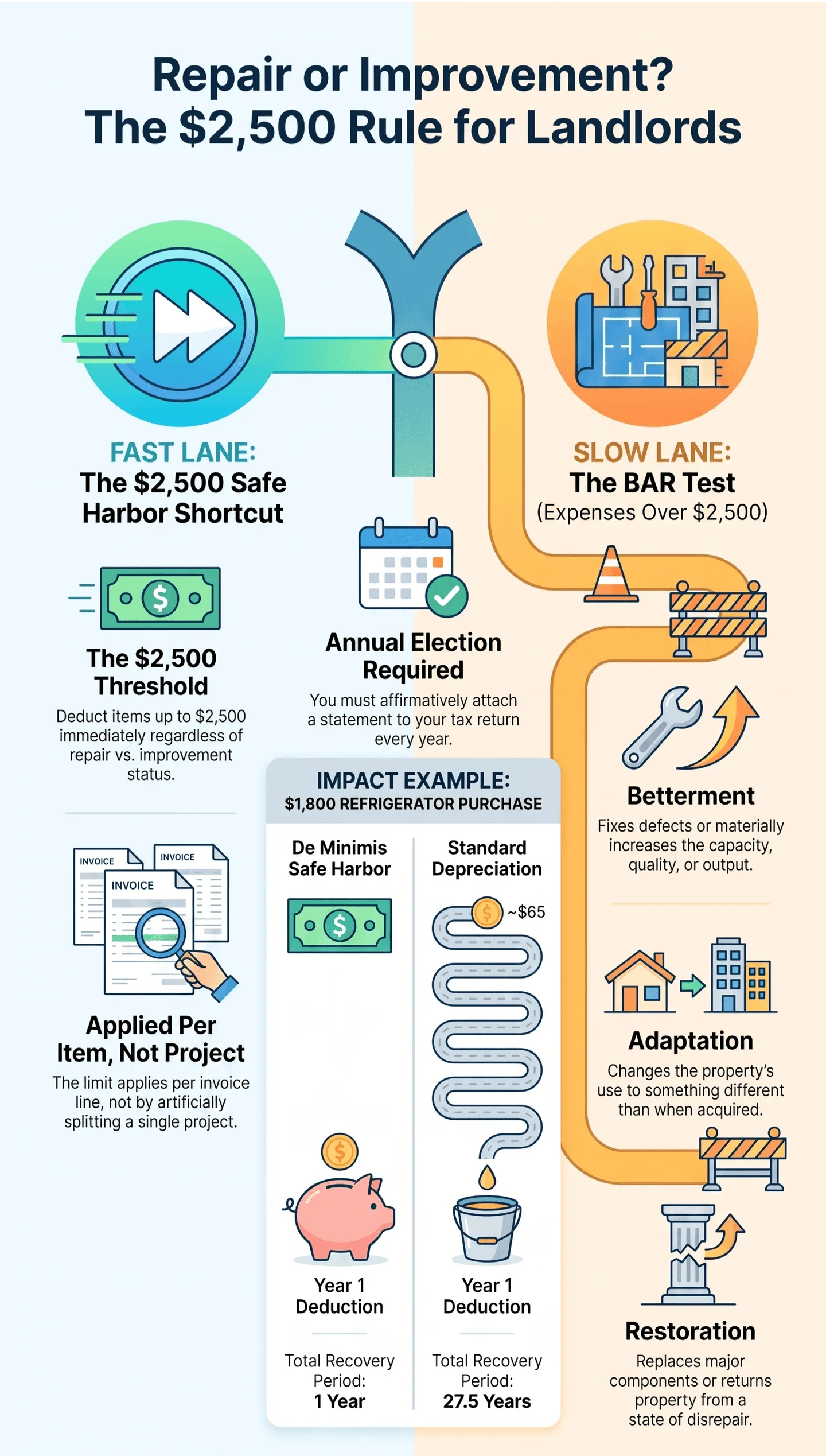
Here's where most landlords are leaving money on the table without realizing it. The IRS created a de minimis safe harbor (IRS Notice 2015-82) that lets you skip the repair-vs-improvement analysis entirely for smaller purchases: items or invoice lines costing $2,500 or less can be deducted immediately, even if they would technically qualify as improvements — as long as you make the election on your return.
This means a $1,800 refrigerator replacement — which is technically an improvement, since it's a new asset with its own useful life — can be fully deducted this year under the de minimis safe harbor, instead of depreciated over its normal recovery period. The threshold rises to $5,000 per item or invoice if you have an "applicable financial statement" (a formal audited financial statement, which applies to very few individual landlords, but matters if you own through a larger entity).
This is an annual election, not automatic. You have to affirmatively elect the de minimis safe harbor on your tax return each year by attaching a required statement — skip the election, and you forfeit the safe harbor treatment for that year even if your expenses would have qualified.
The Mistake That Trips Up Landlords in Both Directions
Understanding this rule prevents two opposite and equally costly mistakes:
Mistake #1: Capitalizing things that should be expensed. A landlord who doesn't know about the de minimis safe harbor might depreciate that $1,800 refrigerator over its useful life, spreading out a deduction they could have taken in full this year — needlessly delaying cash-flow-relevant tax savings.
Mistake #2: Trying to stretch de minimis to cover things it doesn't. The safe harbor applies per item or per invoice line, not per project. A $7,000 partial roof repair doesn't qualify just because you'd like it to — de minimis safe harbor doesn't cover this kind of expenditure, and attempting to force it through as several smaller "line items" to stay under $2,500 each is the kind of pattern the IRS specifically watches for.
When De Minimis Doesn't Apply: The BAR Test Takes Over
For expenses above the safe harbor threshold, you're back to the full repair-vs-improvement analysis, governed by what's known as the BAR test (Treasury Regulation §1.263(a)-3): an expenditure must be capitalized if it results in a Betterment, an Adaptation, or a Restoration of the property. Meet any one of these three tests, and it's an improvement requiring depreciation.
- Betterment: Fixes a pre-existing defect, or results in a material increase in capacity, quality, or output
- Adaptation: Changes the property's use to something different from when you acquired it
- Restoration: Returns the property from a state of disrepair, or replaces a major component or substantial structural part
Critically, the BAR test is applied at the "unit of property" level, not the entire building. A major system replacement (all-new electrical wiring, a full HVAC replacement) is evaluated against that specific system, not the building as a whole — which is why a fire alarm system replacement can be an improvement even though it's a small fraction of the building's total value.
Two Other Safe Harbors Landlords Often Miss
De minimis gets the most attention, but two additional safe harbors are worth knowing:
Routine Maintenance Safe Harbor: Recurring activities you reasonably expect to perform more than once within 10 years (for buildings and structural components) are currently deductible as repairs, regardless of cost — this covers things like periodic HVAC servicing or roof inspections that you know you'll need to repeat.
Small Taxpayer Safe Harbor: If your building's unadjusted basis is $1 million or less, you can deduct total annual repairs and improvements up to the lesser of $10,000 or 2% of the building's unadjusted basis — covering everything for that property in a given year, without running each expense through the BAR test individually.
These three safe harbors can be combined and used in the same year for different expenses, but each has its own election requirements and eligibility rules — this is an area where a CPA's guidance pays for itself in avoided misclassification.
Why Getting This Wrong Creates Real Audit Risk
Misclassifying a major improvement as a repair to grab an immediate deduction is one of the more common triggers for IRS scrutiny on rental property returns. If the IRS reclassifies an expense you deducted as a repair into a capital improvement, you don't just lose the current-year deduction — you may owe back taxes, penalties, and interest on the difference. Good documentation (invoices, contractor descriptions, before/after photos, and a clear record of which safe harbor or BAR test conclusion applied to each expense) is your primary defense if a classification is ever questioned.
Frequently Asked Questions
Does the de minimis safe harbor apply to a $2,500 improvement, or only to repairs? It applies to both. The de minimis safe harbor lets you deduct qualifying items immediately regardless of whether they would otherwise be classified as a repair or an improvement — that's the entire point of the safe harbor. A $2,000 replacement dishwasher, which is technically an improvement, still qualifies for immediate deduction under de minimis.
Can I split a $6,000 expense into multiple $2,000 invoices to stay under the de minimis threshold? No — the IRS applies the threshold per item or per invoice line for genuinely separate items, not as a way to artificially fragment a single project into smaller pieces to dodge capitalization. A $6,000 water heater replacement is one item regardless of how the invoice is structured, and attempting to split it is the kind of pattern that increases audit risk rather than reducing tax liability.
What happens if I forget to make the de minimis safe harbor election on my return? You lose the safe harbor treatment for that tax year, even for expenses that would have otherwise qualified. The election is not automatic — it requires attaching a specific statement to your return each year you want to use it. This is worth confirming with whoever prepares your return, since a missed election on an otherwise-qualifying $2,000 item means unnecessarily depreciating it over 27.5 years instead of deducting it immediately.
How does a cost segregation study interact with these repair/improvement rules? They operate at different stages. The tangible property regulations (de minimis, BAR test, and other safe harbors) determine what counts as capitalized basis in the first place. Once something is capitalized, a cost segregation study can then identify whether that capitalized cost belongs in a shorter depreciation category (5, 7, or 15 years) rather than the standard 27.5-year building depreciation — see our related article on 100% bonus depreciation and cost segregation for how that acceleration works. Whichever way an expense is classified, run your full numbers through our Landlord Tax Estimator to see the actual tax impact on your specific Schedule E.