Nathan is 52 and drew $95,000 against his home's equity seven years ago to fund a renovation. His HELOC had a 7-year draw period — meaning the repayment period was approaching, and his payment was about to shift from interest-only to fully amortizing on a variable rate. Instead of waiting for that transition to happen automatically, he checked the exact date 18 months in advance and used the time to refinance into a fixed-rate loan before the higher, rate-exposed payment ever arrived.
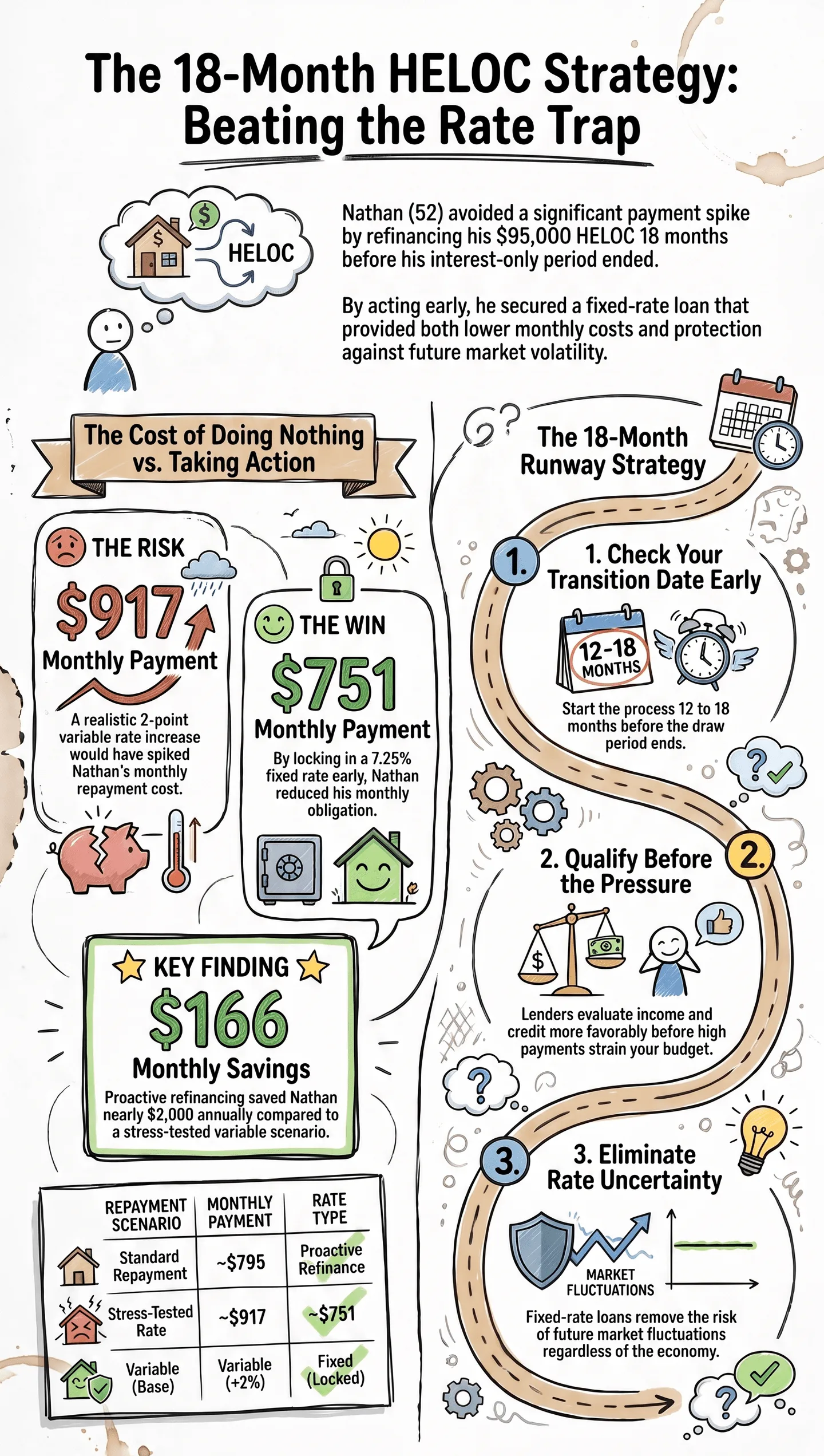
What Doing Nothing Would Have Looked Like
Had Nathan simply let the draw period end on schedule, his $95,000 balance would have shifted to a fully amortizing payment of approximately $795 a month at his HELOC's rate at the time. Because that rate was variable, a realistic stress test — a 2-point increase over the life of the 20-year repayment period — would have pushed that payment to roughly $917 a month over time.
What He Did Instead
Roughly a year and a half before his draw period ended, Nathan contacted his lender and shopped a refinance into a fixed-rate home equity loan. He locked in a rate of 7.25% — lower than the stress-tested variable scenario — on the same $95,000 balance and the same 20-year term. His new fixed payment: approximately $751 a month, with no future rate exposure at all.
The Full Math
- HELOC balance at transition: $95,000
- Repayment-period payment if left on the original variable rate: approximately $795/month
- Stress-tested payment (+2 points over the loan term): approximately $917/month
- Fixed-rate refinance payment (locked in proactively): approximately $751/month
- Monthly savings vs. the stress-tested scenario: approximately $166
Why the Timing Mattered
Refinancing options are generally easiest to arrange before a borrower is under payment pressure — lenders evaluate the refinance based on current credit and income, not a strained budget from an already-higher payment. Nathan's 18-month runway gave him time to shop multiple lenders, compare fixed-rate terms, and complete the process on his own schedule rather than reacting after a statement showed a payment increase he hadn't planned for.
What This Isn't
This isn't a guarantee that refinancing is always available or always the right move — it depends on the borrower's credit, the property's current value, and the rate environment at the time. Nathan's fixed rate happened to land below the stress-tested variable scenario, which won't be true in every case; sometimes the more valuable outcome of an early refinance is simply eliminating future rate uncertainty, even if the fixed rate isn't meaningfully lower than a stress-tested variable estimate.
Check Your Own Number
If your HELOC's draw period is still a few years out, the useful move isn't waiting to see what happens — it's calculating your stress-tested repayment-period payment now, while you still have time to refinance, pay down principal, or otherwise adjust before the transition happens automatically. Run your numbers through our HELOC Risk Stress Test.
Frequently Asked Questions
How far in advance should I check my HELOC's draw-to-repayment transition date? As early as possible, but at least 12 to 18 months out gives meaningful time to shop refinance options, compare lenders, and complete the process without time pressure.
Will refinancing always get me a lower payment? Not necessarily — it depends on current rates, your credit, and your home's value at the time. The main benefit is often eliminating future rate uncertainty by locking in a fixed rate, even if it's not dramatically lower than a stress-tested variable estimate.
Do I need good credit to refinance a HELOC before the repayment period? Generally yes — refinancing requires re-qualifying based on your current credit profile and income, similar to originating a new loan, which is another reason to start the process well before any financial strain from a payment increase.
What if I can't refinance for some reason? Other options include making extra principal payments during the draw period to reduce the eventual repayment-period balance, or adjusting your budget in advance based on a stress-tested payment estimate rather than being surprised by it.