Rita has owned a $380,000 rental property for 12 years, renting it long-term the entire time. With her kids grown and her own work shifting to part-time consulting, she's considering converting it to a short-term rental — partly for the income potential, partly because she's heard about landlords using STR status to offset other income. Her situation turns out to be a useful example of what actually changes in a conversion, and a case where the STR loophole may not even be the deciding factor.
What Doesn't Reset When Rita Converts
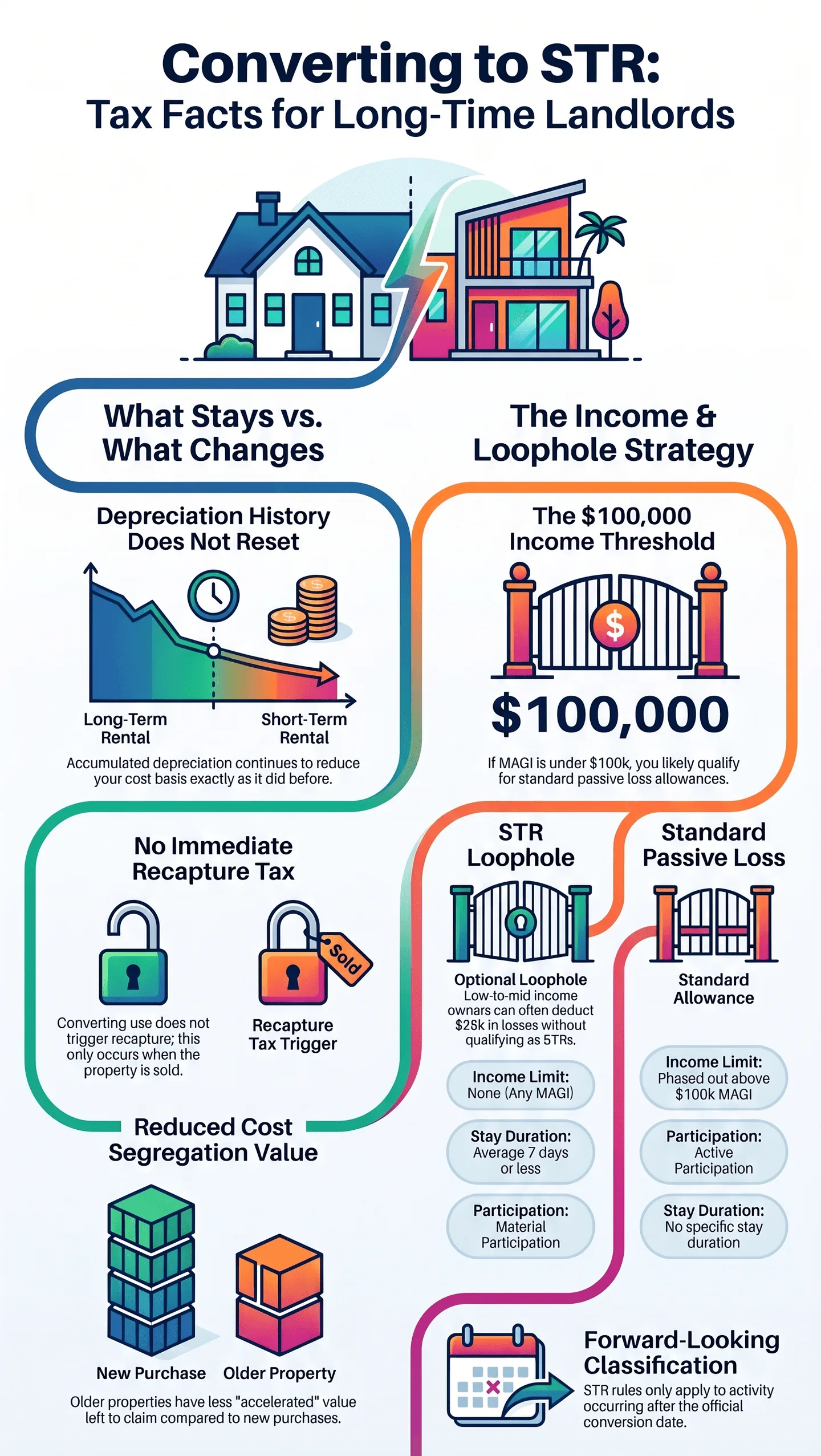
The most important thing to understand about converting an existing rental: your depreciation history doesn't restart. Over 12 years of standard long-term rental ownership, Rita has claimed roughly $140,945 in depreciation on the property's $380,000 value (using the standard 27.5-year residential schedule on the building portion). That accumulated depreciation continues to reduce her cost basis exactly as it has been — converting the property's use doesn't erase or reset this history, and it will still factor into recapture tax whenever she eventually sells, regardless of how the property is used between now and then.
What Does Change: How Future Activity Is Classified
Once Rita converts to short-term rental use, the classification rules that apply going forward are different from what governed her property as a standard long-term rental. If her average guest stay comes in at 7 days or less and she materially participates in managing the property, the STR rules (rather than standard passive rental treatment) would apply to her activity from the conversion date forward — but this is a forward-looking classification question, separate from her existing depreciation history.
The Detail That Makes Rita's Case Different From a New Purchase
Because Rita has owned this property for 12 years, a cost segregation study performed now would only identify components that either weren't captured in an original study (if one was ever done) or that have been added or replaced since acquisition — a "look-back" cost segregation study, which can still be valuable but generally identifies a smaller pool of accelerated-depreciation components than a study performed on a property in its first year of ownership, since much of the property's depreciable life has already elapsed under the standard schedule.
Does Rita Actually Need the STR Loophole?
Here's the part of Rita's situation that's easy to overlook: her MAGI, at roughly $95,000 from her part-time consulting work, sits comfortably under the $100,000 threshold where the standard $25,000 passive loss allowance begins phasing out (see our related article on the $25,000 passive loss trap). This means that even without qualifying for the STR loophole at all — even if her average stay came in above 7 days, or she didn't clear the material participation test — Rita could still deduct up to $25,000 in rental losses against her other income under the standard active participation rules, no special STR qualification required.
For a landlord in Jennifer and Mike's income bracket (a combined $250,000, well above the phase-out), the STR loophole is often the only path to using a large rental loss against other income. For Rita, at her more modest income level, the standard passive loss allowance may already cover a meaningful portion of what she'd generate — making the STR loophole a potential enhancement rather than a necessity.
What This Means for Rita's Decision
Rita's choice to convert to short-term rental can reasonably be driven by the income potential and lifestyle fit of STR hosting, without the tax strategy being the deciding factor — which takes some pressure off needing to hit the 7-day average and material participation tests precisely. If she qualifies for STR treatment, it's a genuine bonus at higher loss amounts; if she doesn't quite clear one of the tests in a given year, she likely still has meaningful loss usability through the standard $25,000 allowance given her income level.
The Conversion Itself Has Practical Considerations Beyond Taxes
Converting an existing long-term rental to short-term use typically requires checking local zoning and short-term rental permit requirements (many municipalities regulate STRs separately from long-term rentals), updating insurance coverage (standard landlord policies often don't cover short-term rental activity), and potentially furnishing the unit, none of which are tax questions but all of which affect whether the conversion makes sense before the tax analysis even applies.
Run Your Own Numbers Either Way
Whether or not the STR loophole ends up being the deciding factor for your situation, understanding your standing depreciation history and where your income falls relative to the passive loss thresholds is worth doing before converting an existing rental. See how your specific numbers work with our Airbnb Host Tax Classifier.
Frequently Asked Questions
Will converting to short-term rental trigger depreciation recapture immediately? No — depreciation recapture is triggered by a sale, not by a change in how the property is used while you still own it. Rita's accumulated depreciation continues to reduce her basis, and recapture tax will apply based on that accumulated amount whenever she eventually sells, regardless of whether the property was long-term or short-term rental in its final years of her ownership.
Is a cost segregation "look-back" study worth it for a 12-year-old property? It depends on what's changed since acquisition — if Rita has done renovations, added furnishings, or made improvements since her original purchase, a look-back study can identify accelerated-depreciation opportunities on those specific additions. For the original building components, most of the depreciable value has already been claimed under the standard schedule over 12 years, which limits how much a look-back study can meaningfully add compared to a study on a newly acquired property.
If Rita's income grows and she eventually exceeds the $150,000 MAGI threshold, does she need to qualify for the STR loophole then? If her income grows to the point where the standard passive loss allowance phases out or disappears, qualifying for STR treatment (7-day average stay plus material participation) would become more consequential for her ability to use rental losses against other income — worth revisiting if her financial situation changes materially in future years, rather than assuming her current setup remains optimal indefinitely.