Ask ten landlords whether you need an LLC for your rental properties and you'll get ten confident, contradictory answers. Real estate forums are split roughly in half — one side insists LLCs are essential structural protection, the other calls them "oversold" and points to the ongoing costs. Both sides have real numbers behind their position. The right answer depends on your specific portfolio, not on which side argues louder.
What Each Option Actually Does — And Doesn't Do
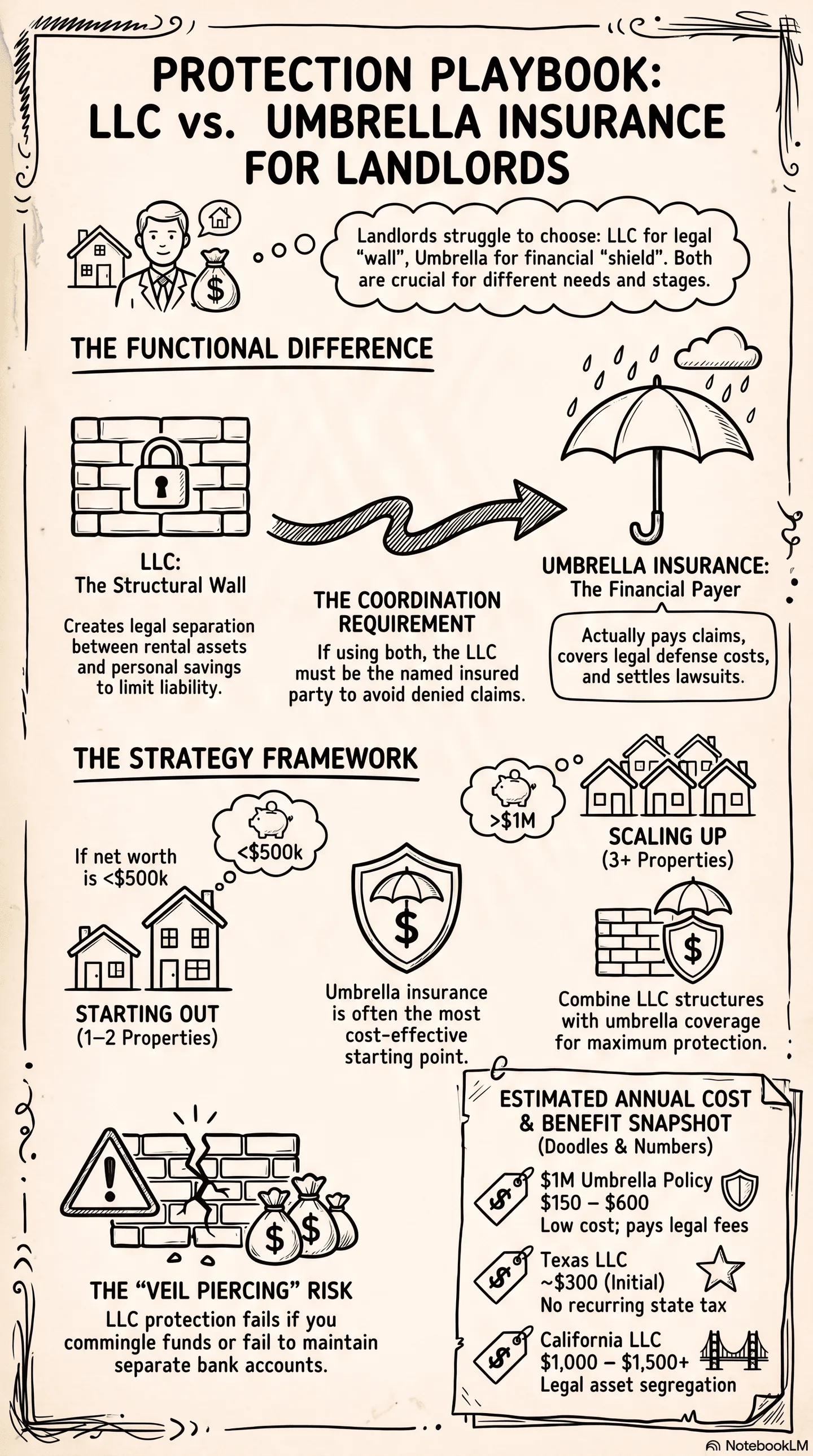
An LLC creates legal separation. If a tenant or guest sues over an incident at a properly-titled LLC-owned property, the claim generally runs against the LLC's assets, not your personal home, savings, or other investments — provided the LLC is maintained correctly (separate bank accounts, proper titling, no commingling of funds). What an LLC does not do: pay claims, provide legal defense, or settle a lawsuit. It's a structural wall, not insurance.
Umbrella insurance actually pays. A personal umbrella policy extends your liability coverage beyond your standard landlord policy limits, typically starting at $1 million. It pays claims, covers legal defense costs, and settles cases — real insurance functions an LLC cannot perform on its own. What it doesn't do: create a legal barrier protecting your personal assets if a judgment exceeds your policy limit.
The Actual 2026 Cost Numbers
Umbrella insurance: A $1 million policy typically runs $150–$600 per year depending on your insurer, location, claims history, and risk profile, with each additional $1 million in coverage adding roughly $50–$100 annually. This is genuinely one of the most cost-effective protection tools available — often less than $2 a day for meaningful additional coverage.
LLC formation and maintenance: Costs vary enormously by state, which is the detail most generic advice glosses over. Texas charges a one-time $300 filing fee with no recurring annual state tax. California charges an $800 minimum annual franchise tax — every year, regardless of whether the LLC made any money — on top of formation costs. Add registered agent fees (often $100–$300/year if you use a service) and separate tax preparation for the entity (commonly $500–$1,500+/year with a CPA), and a single LLC in a high-cost state can run $1,000–$1,500+ annually, while the same LLC in Texas might cost a few hundred dollars a year after the first year.
The Rule of Thumb Real Estate Attorneys Actually Use
A pattern that shows up consistently across estate attorneys and landlord communities: if you own 1–2 properties and your net worth outside those properties is under roughly $500,000, umbrella insurance alone is often the more cost-effective starting point. The math simply favors it — a few hundred dollars a year in premium against a $1,000+/year LLC cost, especially when insurance actually pays claims and an LLC alone does not.
Once you own 3 or more properties, or your net worth exceeds roughly $1 million, the calculus shifts toward combining an LLC structure with umbrella coverage — the value of legal asset segregation becomes more meaningful as there's more to protect, and the per-property LLC cost becomes a smaller percentage of your overall portfolio value.
This isn't a hard rule — it's a starting framework. Run your specific numbers (portfolio size, state, net worth outside real estate, risk factors like short-term rentals or self-management) through our LLC vs Umbrella Insurance Calculator rather than relying on a generic threshold.
Why "Just Do Both" Isn't a Complete Answer Either
Many landlords land on "I'll just do both" without working through the specifics — and while layering both strategies is genuinely common practice for larger portfolios, doing it without planning creates its own problems. If your property is titled in an LLC, your insurance policy needs to list the LLC as the insured party, not you personally — a mismatch here can result in a denied claim for lack of insurable interest, precisely when you need the coverage most. Combining both strategies requires coordinating the entity structure and the insurance paperwork together, not treating them as two independent purchases.
The Detail That Weakens an LLC's Protection: Personal Guarantees
If you personally guaranteed a mortgage on a property now held in an LLC — common with conventional residential loans — that guarantee means the lender can pursue you personally if the LLC defaults, regardless of the entity structure. This doesn't eliminate the LLC's value for tenant lawsuits or general liability claims, but it means the LLC isn't a complete shield for that specific property's debt obligations. Some investors address this over time by refinancing into commercial or DSCR loans (which qualify based on the property's cash flow rather than a personal guarantee) as their portfolio matures.
What Governance Actually Requires If You Choose an LLC
An LLC that isn't properly maintained provides little real protection — courts can "pierce the corporate veil" and hold you personally liable anyway if you haven't treated the entity as genuinely separate from yourself:
- Separate business bank account, with zero commingling of personal and LLC funds
- Every insurance policy and lease signed in the LLC's name, not yours
- Annual state filings and registered agent fees paid on time
- If properties span multiple states, check whether your LLC needs to register as a "foreign LLC" in each state where a property is located
Frequently Asked Questions
If I own properties in multiple states, do I need a separate LLC in each state? Not necessarily a separate LLC, but you likely need to register your existing LLC as a "foreign LLC" in any state where you own property beyond the state where the LLC was originally formed — this typically involves an additional filing fee and sometimes a separate registered agent in that state. Skipping this registration can affect the LLC's legal standing and liability protection for that specific property.
Does forming an LLC affect my ability to get a mortgage? It can complicate refinancing or new purchases through conventional residential lenders, many of whom prefer lending to individuals rather than entities. Many investors use commercial or DSCR loans (which underwrite based on the property's rental income rather than personal income or a personal guarantee) specifically to work around this friction once they're operating through an LLC structure.
Is a Series LLC a good option for landlords with multiple properties? A Series LLC (available in states including Delaware, Texas, and a handful of others) allows internal liability walls between individual properties under one parent entity, at lower administrative cost than forming a fully separate LLC for each property. It's a more complex structure to set up and maintain correctly, and not every state recognizes Series LLCs formed elsewhere, which matters if your portfolio spans state lines — this is worth discussing with an attorney rather than setting up independently.
Should the insured party on my umbrella policy be me personally or my LLC? If your properties are titled in an LLC, the LLC generally needs to be listed on both your underlying landlord policy and your umbrella policy — not just you personally — or a claim can be denied for lack of insurable interest. This coordination between your entity structure and your insurance paperwork is exactly the kind of detail worth a direct conversation with your insurance agent and attorney before finalizing either structure.