Jennifer and Mike have a combined $250,000 in W-2 income — she's a director at a healthcare company, he manages engineering teams at a software firm. Neither of them has real estate as a career. This year, they bought a $620,000 short-term rental property near a national park, and by year-end, that single purchase had reduced their taxable income by more than half. Here's exactly how, and what had to be true for it to work.
What They Bought and How They Set It Up
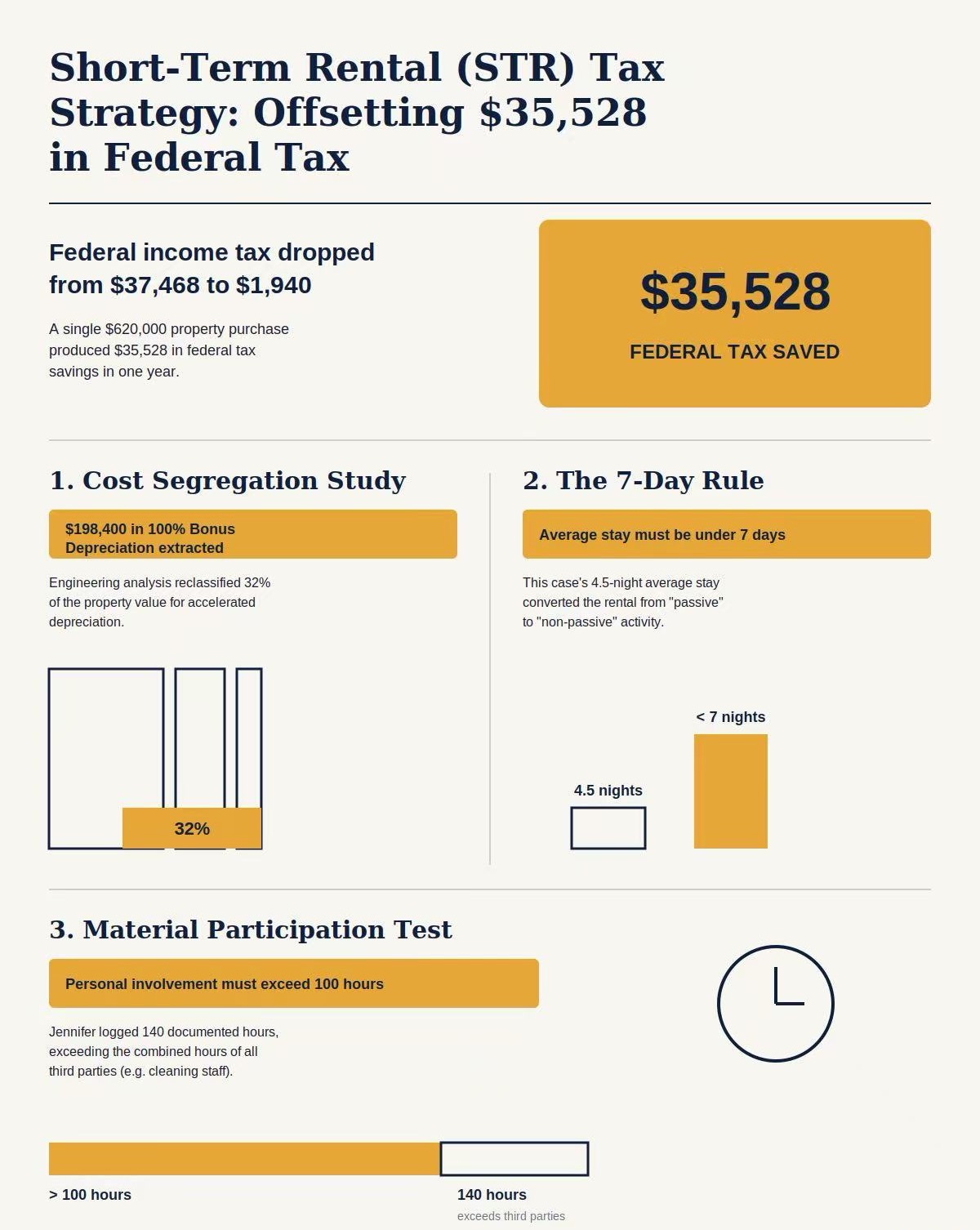
The property is a four-bedroom cabin, purchased specifically as a dedicated short-term rental rather than a personal vacation home. Average guest stay across their bookings for the year: 4.5 nights — comfortably under the 7-day threshold that determines whether a rental counts as a "rental activity" for passive loss purposes. Jennifer handles all guest communication, pricing adjustments, and coordinates the cleaning crew between stays — roughly 140 hours of documented work over the year, more than the property manager's cleaning contractor logged.
Both of these facts matter independently: the 7-day average stay and Jennifer's material participation (clearing the 100-hour test, with no one else participating more) are two separate requirements, both of which needed to be true for what happened next.
The Cost Segregation Study
Before year-end, they commissioned a cost segregation study on the property. The engineering analysis identified roughly 32% of the property's value — flooring, cabinetry, certain fixtures, outdoor decking, and landscaping — as components that qualify for accelerated 5, 7, or 15-year depreciation rather than the standard 27.5-year building schedule.
$620,000 × 32% = $198,400 in reclassified components.
Why 100% Bonus Depreciation Made This Immediate
Under the pre-2025 phase-down schedule, only a fraction of that $198,400 could have been deducted in the first year — the rest would have trickled out over years. With 100% bonus depreciation permanently restored under the OBBBA (see our related article on 100% bonus depreciation and cost segregation), the entire $198,400 was eligible for immediate deduction in the year the property was placed in service.
Why This Loss Could Touch Their W-2 Income At All
Under the default passive activity rules, a $198,400 rental loss would simply pile up as a suspended passive loss, unusable against Jennifer and Mike's salaries. What makes this case different is that the property cleared both the 7-day rule and Jennifer's material participation test (covered in detail in our related article on the STR loophole) — which means the activity isn't classified as passive at all. The loss functions like an ordinary business loss, available to offset any income on their joint return, including both of their salaries.
The Full Math
- Combined W-2 income: $250,000
- Taxable income before this deduction (after standard deduction of $32,200): $217,800
- Federal income tax before the STR loss: approximately $37,468
- Accelerated depreciation from cost segregation: $198,400
- Taxable income after the deduction: $19,400
- Federal income tax after the STR loss: approximately $1,940
Federal income tax savings this year: approximately $35,528
What This Isn't
This isn't free money, and it isn't a strategy that works by simply buying any rental property. Three things had to be true simultaneously: the average stay had to genuinely be under 7 days (not adjusted after the fact), Jennifer's participation had to be real, documented, and greater than anyone else's, and the cost segregation study had to be a legitimate engineering analysis, not a rough estimate. Miss any one of these, and the property reverts to standard passive rental treatment, with the loss suspended rather than usable against their salaries.
It's also a timing acceleration, not a permanent tax reduction — every dollar of depreciation claimed this year reduces what's available in future years, and increases the depreciation recapture liability they'll face if they eventually sell (see our related article on the depreciation recapture trap).
Why This Case Represents the Upper End of What's Achievable
Jennifer and Mike's outcome sits near the favorable end of what this strategy can realistically produce — a large enough property purchase, a strong cost segregation percentage, and clean qualification on both the 7-day and material participation tests. Not every STR purchase produces a result this dramatic; smaller properties, longer average stays, or participation that doesn't clearly exceed a property manager's hours can each independently prevent the strategy from working as intended.
Check Whether Your Situation Qualifies
If you're considering a short-term rental with this strategy in mind, the qualification details matter more than the purchase price. Run your specific property and participation numbers through our Airbnb Host Tax Classifier before assuming a large deduction is guaranteed.
Frequently Asked Questions
What would have happened if their average stay had been 8 nights instead of 4.5? Crossing the 7-day average would classify the property as a standard rental activity, subject to the normal passive loss rules — meaning their $198,400 loss would be capped by the $25,000 passive loss allowance (which phases out entirely above $150,000 MAGI, well below their combined income) and suspended rather than usable against their W-2 income this year.
Does Mike need to participate as well, or is Jennifer's participation enough? Material participation hours combine for married couples filing jointly, but only one spouse needs to clear the relevant test — Jennifer's 140 hours, exceeding the property manager's documented hours, was sufficient on its own. Mike's lack of direct involvement doesn't disqualify the strategy, as long as the combined household participation and specifically Jennifer's individual hours meet the test.
|
Purchase
$620,000 cabin near a national park
|
Short Stays
Average 4.5 nights per guest
|
Documented Work
Jennifer logged 140 hours
|
|
Cost Segregation Study
Reclassified 32% ($198,400) into shorter depreciation schedules.
|
→ |
100% Bonus Depreciation
Allowed the entire $198,400 to be deducted in Year 1 under OBBBA.
|
→ |
Ordinary Business Loss
Offsets any income on their joint return, including salaries.
|
|
$217,800
Taxable income before STR loss
|
$19,400
Taxable income after STR loss
|
$35,528
Total federal tax savings
|
- Depreciation Recapture — claiming this deduction now increases the tax owed when the property is eventually sold.
- Audit Risk — requires meticulous documentation; missing either test reverts the loss to standard passive treatment.
- Not Guaranteed — this case sits near the favorable end of outcomes; smaller properties or longer average stays produce smaller results.
- Average Stay — genuine average guest stay under 7 days.
- Material Participation — real, documented hours exceeding 100 and exceeding any third party's hours.
- Cost Segregation — a legitimate engineering-based study, not a rough estimate.