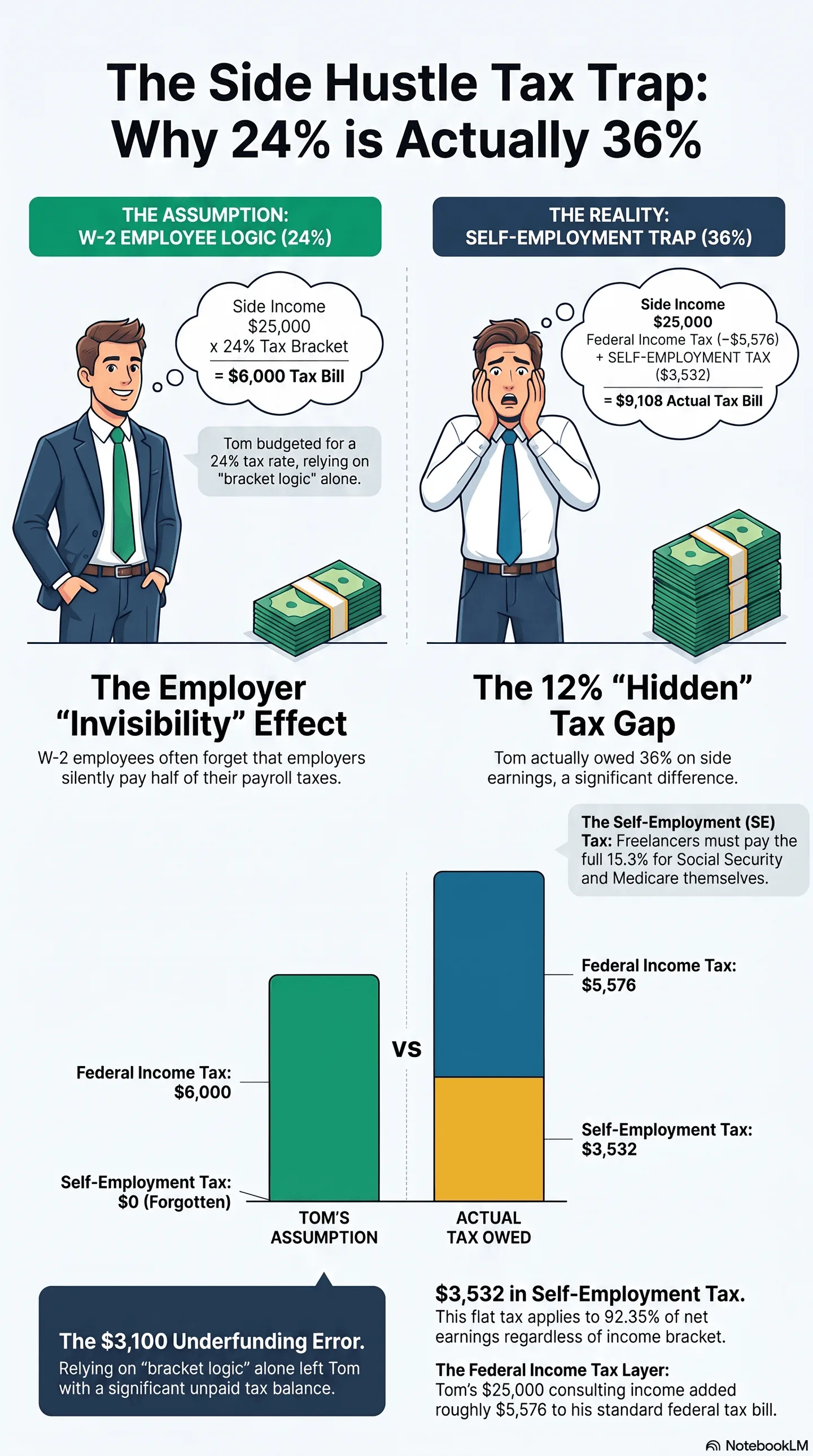
Tom is a senior software engineer earning $140,000 at a mid-sized tech company. He picked up freelance consulting work on the side — architecture reviews and technical due diligence for startups — bringing in $25,000 net this year. He knew his day job put him "in the 24% bracket" and assumed his consulting income would be taxed the same way. It is, in terms of the income tax bracket — but that's only part of what he actually owes.
Confirming Tom's Bracket — This Part He Had Right
After the standard deduction, Tom's W-2 taxable income comes to $123,900, which does sit in the 24% federal bracket. His assumption about his day job's bracket was accurate. Where the assumption breaks down is in assuming his consulting income gets the same, complete treatment.
The Income Tax Side: Correct, But Incomplete
Layering his $25,000 in consulting income on top of his W-2 taxable income (after accounting for the deduction he gets for half his self-employment tax) pushes his total taxable income to roughly $147,134 — which, at his income level, stays within the same 24% bracket rather than crossing into the next one at $201,775. So on pure income tax, Tom's instinct was actually correct: his consulting income is taxed at 24%, working out to roughly $5,576 in additional income tax.
This is where most people stop calculating — and where the real number is still significantly higher than what they've budgeted.
The Piece That Changes Everything: Self-Employment Tax
Tom's W-2 salary has payroll tax split with his employer — he pays half of Social Security and Medicare, his employer pays the other half, invisibly, before it ever shows up as a line item he thinks about. His consulting income doesn't get that split. As self-employment income, it owes the full 15.3% self-employment tax on 92.35% of net earnings, with no employer covering any portion of it.
SE tax on Tom's $25,000: roughly $3,532
The Combined Number
| Amount | |
|---|---|
| Income tax on consulting income (24% bracket, correctly assumed) | ~$5,576 |
| Self-employment tax (not on his radar at all) | ~$3,532 |
| Total tax on the $25,000 | ~$9,109 |
| Effective rate on side income | ~36% |
Tom's bracket instinct — 24% — accounted for about $6,000 of what he actually owes. The self-employment tax piece, which many W-2 employees have never had to think about because their employer always handled half of it silently, adds another $3,500 he likely hadn't set aside.
Why This Specific Gap Is So Common at Tom's Income Level
People who've spent their careers exclusively as W-2 employees often have an accurate mental model of income tax brackets — they see this reflected on every paystub and W-2 form — but genuinely no working knowledge of self-employment tax, because it's never applied to them before. The bracket assumption isn't wrong; it's just half the picture, and the missing half happens to be a flat 15.3% that applies regardless of how high your existing income already is (up to the Social Security wage base).
A Detail Worth Watching as Tom's Consulting Income Grows
If Tom's consulting practice grows and his combined taxable income eventually crosses $201,775, the marginal rate on his next dollar of side income jumps to 32% — a much larger stacking effect than what he's experiencing this year. This is worth monitoring rather than assuming this year's math holds indefinitely as the business scales.
Set Aside the Right Amount, Not the Bracket Number
If Tom has been setting aside 24% of his consulting income for taxes — a reasonable-sounding number based on an accurate bracket — he's underfunded by roughly 12 percentage points relative to his actual 36% obligation. Run your specific W-2 and side income numbers through our Side Hustle Tax Calculator to see your real combined rate, including the self-employment tax piece that bracket alone doesn't capture.
Frequently Asked Questions
Does self-employment tax apply the same way regardless of how high someone's W-2 income already is? The Medicare portion (2.9%) always applies with no cap. The Social Security portion (12.4%) only applies up to the annual wage base ($184,500 for 2026), and this cap is shared across combined W-2 wages and self-employment income. Since Tom's W-2 income alone ($140,000) is below this cap, his full self-employment income is subject to the Social Security portion — someone with W-2 income already near or above $184,500 would see a lower effective SE tax rate on their side income specifically.
Would Tom owe less in self-employment tax if he formed an LLC or elected S-Corp status? An LLC alone doesn't change self-employment tax treatment for a single-member entity taxed as a sole proprietorship. Electing S-Corp status can reduce self-employment tax exposure by splitting income between a W-2 salary (subject to payroll tax) and distributions (not subject to self-employment tax) — but this only becomes cost-effective at higher income levels once payroll administration and separate tax filing costs are factored in. See our LLC vs S-Corp Calculator to check whether Tom's consulting income has reached that threshold.