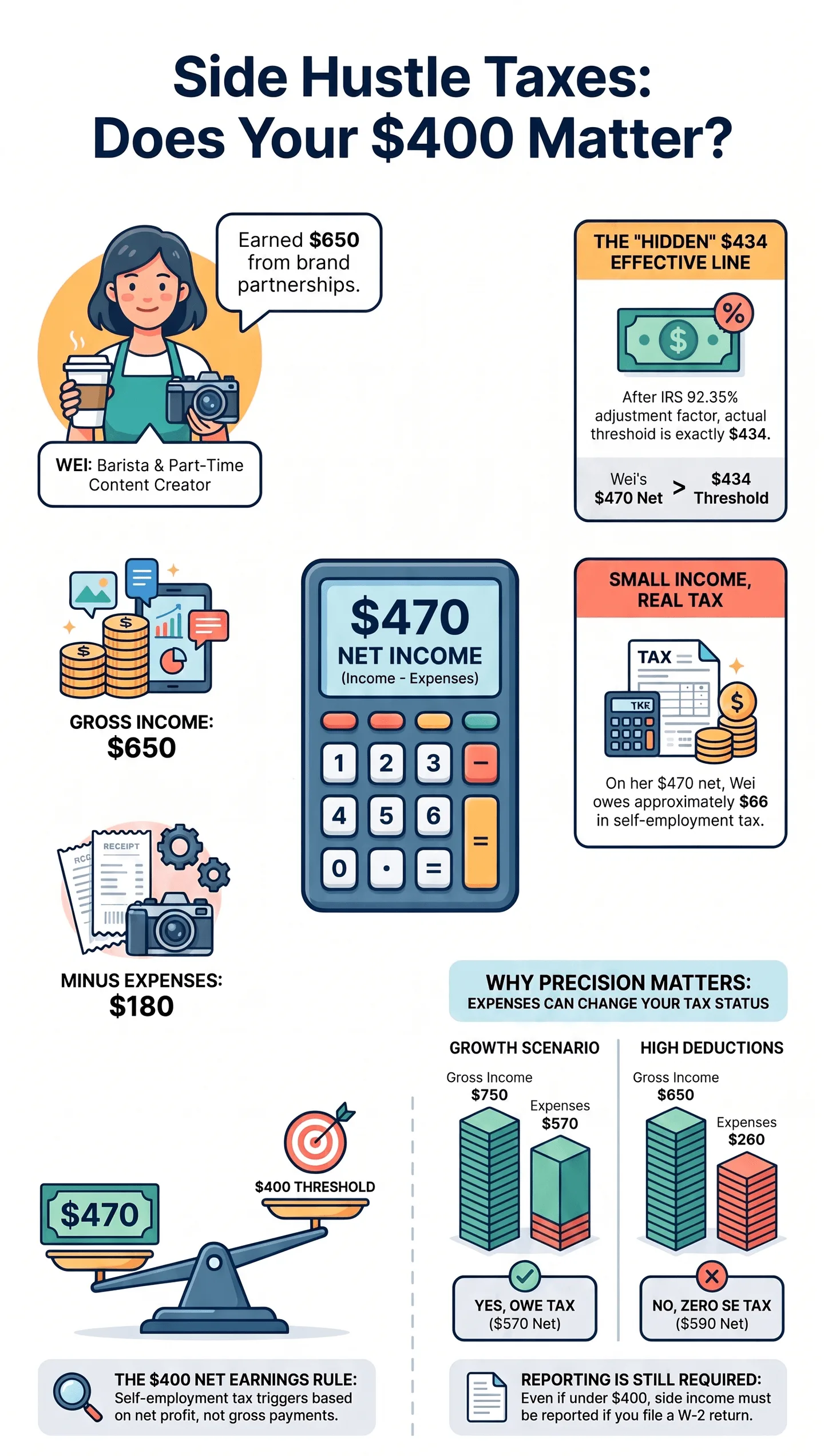
Wei works full-time as a barista and posts coffee content on the side — mostly for fun, occasionally getting small paid partnerships from local roasters and one coffee equipment brand. This year, those partnerships added up to $650 in gross payments. After a portion of her phone bill and a ring light she bought partly for this purpose, her actual net earnings come to $470. She wasn't sure if an amount this small was even worth thinking about at tax time.
It is — and her specific numbers land close enough to the line that this case is worth walking through carefully rather than guessing.
Where Wei's Numbers Actually Land
The $400 self-employment tax threshold applies to net earnings, not gross payments — this is the detail that changes the analysis for someone like Wei with real, if modest, business expenses.
- Gross payments received: $650
- Business expenses (portion of phone bill, ring light depreciation): $180
- Net self-employment earnings: $470
At $470 in net earnings, Wei is above the $400 threshold — and also above the more precise $434 line the IRS's Schedule SE instructions actually use after applying the 92.35% adjustment factor. This means Wei owes self-employment tax on this income, even though the total dollar amount involved is small enough that it might not feel worth the paperwork.
What This Actually Costs Wei
Self-employment tax on $470: roughly $66. Combined with whatever marginal income tax rate applies once this is added to her barista W-2 wages, her total tax obligation on this income is a modest but real amount — nowhere near enough to change her financial life, but also not zero, and not optional to report.
Why the Expense Deduction Matters More at This Scale Than It Seems
If Wei hadn't tracked her $180 in expenses and simply reported the full $650 as her net earnings, she'd owe self-employment tax on $180 more than she actually needs to — a small amount in absolute dollars, but a completely avoidable overpayment. At small income scales like this, accurate expense tracking often matters proportionally more than at higher income levels, since a fixed dollar amount of legitimate deductions represents a larger share of a smaller income.
What If Wei's Numbers Had Landed Slightly Differently
This case is worth sitting with specifically because a small shift either direction changes the outcome:
- If Wei's expenses had been $260 instead of $180, her net earnings would drop to $390 — under the $400 threshold, meaning no self-employment tax obligation on this income at all, though she'd still generally need to report it if she has other income requiring a return.
- If her gross payments had been $750 instead of $650, her net earnings would rise to $570 — comfortably over the threshold with no ambiguity.
Wei's actual numbers sit close enough to the line that the outcome genuinely depends on precise recordkeeping, not a rough estimate. This is exactly the scenario where "I'll just round down and assume it doesn't matter" produces the wrong answer.
The Part That Doesn't Depend on the Dollar Amount
Regardless of how small this income is, Wei's barista W-2 job already requires her to file a tax return — being under the $400 self-employment threshold wouldn't have exempted her from filing altogether, only from the specific Schedule SE self-employment tax calculation on this particular income. Small side income doesn't disappear from a return just because it's small; it either triggers the SE tax calculation or it doesn't, but it's part of her taxable income either way once combined with her W-2 wages.
Don't Guess — Calculate
If your side income is small enough that you're not sure whether it's worth tracking closely, that uncertainty is usually a sign it's exactly the kind of amount that needs a precise calculation rather than a rough guess. Run your actual numbers — gross payments and real expenses — through our Side Hustle Tax Calculator to see exactly where you land relative to the threshold, the same way Wei's $470 turned out to matter more than her instinct suggested.
Frequently Asked Questions
If Wei's side income is under $400 next year, does she need to do anything different? If her net self-employment earnings for a future year land under $400, she wouldn't owe self-employment tax on that specific income, though she'd still generally need to report it as part of her overall tax return if she's otherwise required to file (which she is, given her W-2 job). The $400 threshold determines the SE tax calculation specifically, not her overall filing requirement.
Does it matter that Wei's content creation started as a hobby rather than a real business? The IRS doesn't classify activity based on your original intent — it looks at whether the activity is conducted with a genuine profit motive and in a businesslike manner (keeping records, tracking expenses, making decisions aimed at profitability). Occasional paid partnerships that generate real income and real expenses, tracked accurately, generally support treatment as a legitimate side business rather than a hobby, even if it started casually.