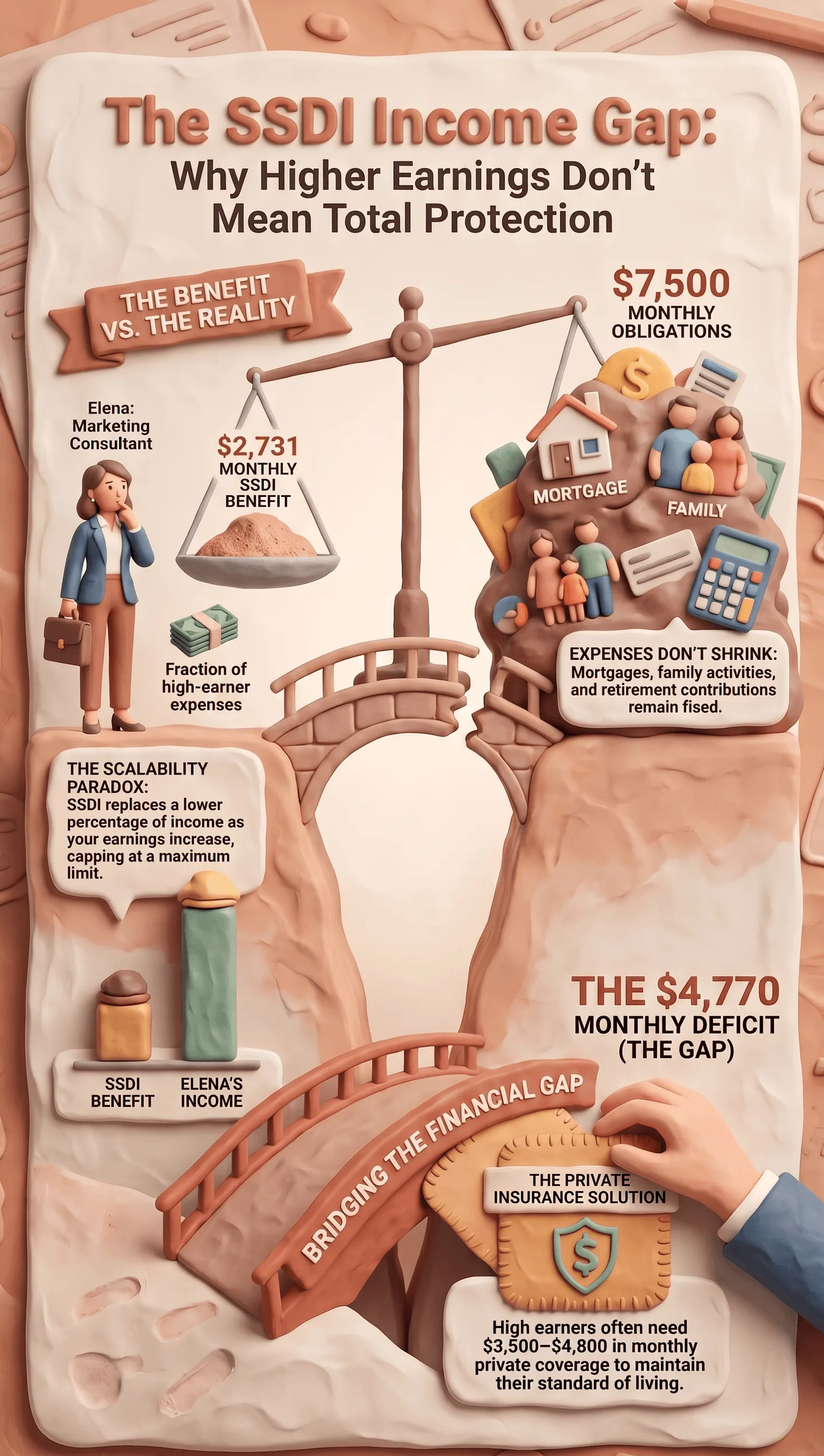
Elena is a 41-year-old independent marketing consultant earning $120,000 a year. Unlike a lot of freelancers earlier in their career, her SSDI estimate isn't understated by the national average figure — at her income level, the math actually scales the other way, toward a benefit higher than average. That didn't mean she had nothing to worry about. Once she ran her actual expenses against that higher estimate, she still found a monthly gap of $4,770.
Her SSDI Estimate Scales Up, Not Down
At $120,000 a year, Elena's income is well above the threshold where SSDI's calculation starts scaling toward the higher end of the benefit range rather than the flat average. Her estimated benefit comes out to approximately $2,731 a month — over a thousand dollars more than the roughly $1,630 national average figure that gets quoted casually.
It would be easy to see a number like that and assume the gap is small. It isn't, because the other side of the equation — her actual monthly expenses — scaled up along with her income.
Running Her Real Numbers
Elena's household expenses, including a mortgage, her children's activities, and her own retirement contributions she'd need to maintain, come to roughly $7,500 a month. Against an SSDI estimate of $2,731, that's a gap of $4,770 a month if she were unable to work at all.
The Full Math
- Annual net income: $120,000
- Monthly income: $10,000
- Monthly expenses: $7,500
- Estimated SSDI benefit if unable to work: approximately $2,731/month
- Monthly gap if unable to work: approximately $4,770
- Estimated private policy needed to close the gap: in the range of $3,500–$4,800/month in benefit, depending on how much of the gap she wants covered
Why Higher Earners Aren't Automatically "Fine"
The instinct to assume higher earners need less protection isn't unreasonable — their SSDI benefit really is higher, both in dollar terms and often as a share of what a lower earner would receive. But disability insurance isn't really about replacing a percentage of income; it's about replacing the dollars needed to maintain your actual financial obligations. A household built around a $120,000 income typically carries commitments — a larger mortgage, family expenses, retirement savings targets — sized to that income, and those commitments don't shrink just because SSDI's replacement percentage looks more generous on paper.
What This Isn't
This isn't an argument that higher earners need proportionally more coverage than everyone else, or that Elena is somehow worse off than a lower-earning freelancer. Her situation is different, not necessarily worse — she has a genuinely higher SSDI floor to work from, and likely more capacity to self-insure through savings if she chooses. The point is simply that "my SSDI estimate is above average" isn't the same question as "is my gap small," and the two are worth checking separately.
Check Your Own Number
Whether your income is above or below the national average, the gap between your real SSDI estimate and your real expenses is the number that matters — not either figure on its own. Run your numbers through our Disability Insurance Calculator to see both sides of your own equation.
Frequently Asked Questions
Do higher earners get a proportionally higher SSDI benefit? Not exactly proportional — SSDI's formula replaces a higher percentage of lower earnings and a lower percentage of higher earnings, so the benefit does increase with income but at a decreasing rate, up to a maximum monthly benefit.
Is there a maximum SSDI benefit amount? Yes — the maximum SSDI benefit for 2026 is approximately $4,152 a month, reserved for people with a long history of maximum taxable earnings.
Should high earners still consider private disability insurance? Often yes, if their expenses and financial commitments scale with their income, which is common. The relevant question isn't the replacement percentage but whether the dollar gap between SSDI and real expenses is one you're comfortable covering from savings versus insurance.
Does SSDI's benefit calculation ever get reduced for high earners? No reduction beyond the standard formula and the overall maximum — SSDI doesn't penalize higher earners, it simply replaces a smaller percentage of their income than it does for lower earners, which is a different thing than a reduction.