You spent $6,000 on a rental last spring. Was it a repair or an improvement? The answer decides whether you deduct $5,782 of it this year or $218 a year for the next 27 years — and if you're trying to answer that question now, a year later, from an invoice that just says "kitchen work," you've already lost the ability to answer it correctly. The invoice doesn't say what was actually done. Only you knew, at the time, and only if you wrote it down.
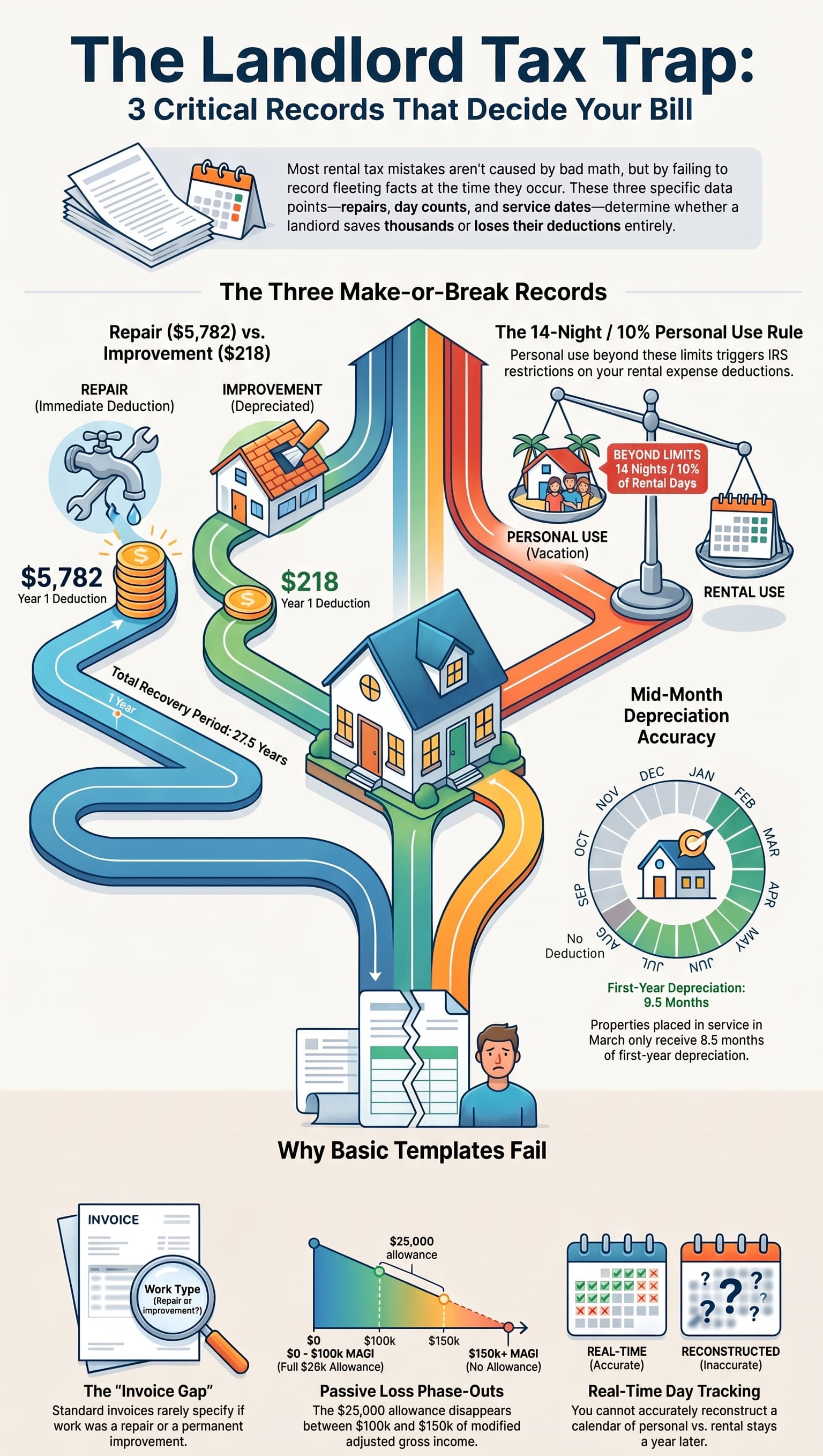
That's the pattern behind almost every rental tax mistake: not a hard calculation, but a fact that existed for exactly one day and was never recorded.
Who this is for
Owners of one to three residential rentals filing Schedule E — landlords who bought a property, maybe two or three, and are managing them alongside a regular life rather than running a property business with staff and software. If you have ten units and a property manager keeping books, you probably have systems already. If you have a duplex and a spreadsheet you update twice a year, this is closer to the gap.
What actually costs landlords money — with real numbers
Repair or improvement, decided a year too late. A repair is deducted this year; an improvement is recovered over 27.5 years. On a $6,000 spend that's roughly $5,782 of deduction now versus $218 a year — and it turns on what was actually done, which an invoice almost never records on its own. The expense log has to ask at the moment you enter it, not reconstruct it later.
Day counts nobody keeps. Personal use above the greater of 14 nights or 10% of nights rented starts limiting your deductions. An average stay of seven nights or fewer takes the property out of the default rental rules entirely. Both facts come from a calendar kept all year — there's no way to build one afterward, and it's the one record almost no rental template on the market actually tracks.
Depreciation taken wrong at both ends. A property placed in service in March doesn't get a full year of depreciation — it gets 9.5 months. A property finishing its 27.5 years gets a part-year and then nothing. Templates that just divide the basis by 27.5 and stop are wrong in a property's first year, and keep paying out deductions on buildings that have nothing left to write off.
A loss you may not be allowed to use. Rental losses are passive by default. The $25,000 active-participation allowance phases out between $100,000 and $150,000 of modified AGI — and married filing separately is a genuinely different rule, not a smaller version of the same one. Without working through the phase-out, it's easy to assume a loss is usable when it isn't, or leave one unused that actually was.
What's in the workbook
- Dashboard — the year to date, plus what your day counts actually mean for each property
- Properties — purchase figures in, depreciation and years remaining calculated out, per-property
- Rent, Expenses, Mileage, and Day count logs — the day count log in particular is the one piece almost nothing else tracks
- Participation log — the dated evidence the $25,000 allowance actually rests on, in case it's ever asked for
- Schedule E Organizer — one column per property, sorted into the form's own lines
- Loss planner, Rates 2026, and a page for your preparer
Why this one and not a free template you already found
The depreciation, day-count, and passive-loss rules come from the same constants file the free calculators on this site read — the same logic behind the Landlord Tax Estimator and the Short-Term Rental Classifier. It doesn't just add up your rent and expenses; it works out what your day counts mean for how a property is treated and how much of a loss you're actually allowed to use this year. Every release goes through a structural check, tax-regression tests, and a full recalculation of every formula — a landlord-specific example, an aggregate cell pointing at the wrong row after a layout change, was caught this way before anyone downloaded a copy.
It doesn't cover partnerships and S corporations, commercial property, royalties, Schedule E Parts II–V, prior-year suspended losses, at-risk limits, sales and 1031 exchanges, the QBI deduction, or state and local tax. It's an organizing and planning tool for one to three properties — not a substitute for a preparer on anything past that.
Where to start
If you want the reasoning behind the day-count rules first, read what landlords should be recording all year — it's the same logic this workbook is built around, in article form.
The kit is free while it's in beta: every formula has been machine-evaluated and every tax figure regression tested, but the layout, charts, and print setup have been checked in code and not yet by a person with Excel open. Get the Landlord Tax Kit →
Frequently Asked Questions
I have a property manager who sends me a year-end statement. Do I still need this?
It depends what's in the statement. Most property-manager statements cover rent collected and their own fees, not the repair-versus-improvement classification, day counts, or depreciation schedule the IRS actually needs. If your statement already sorts expenses into Schedule E's categories and tracks personal-use nights, you may only need the depreciation and loss-planning sheets.
Does it handle a property I sold partway through the year?
It handles the placed-in-service side of depreciation — the partial first year. A sale mid-year has its own set of calculations (gain, depreciation recapture, possible 1031 treatment) that this kit does not cover; that's a preparer conversation.
What if I co-own a property with a spouse or partner?
The workbook assumes one filer's Schedule E. If you file separately, the passive-loss allowance rules are meaningfully different (see the passive-loss numbers above) — the Loss planner sheet works through the married-filing-separately case specifically rather than treating it as a smaller version of the joint rule.