Every rental property investor eventually hears some version of this claim: "I used my Airbnb losses to wipe out my W-2 tax bill." It sounds like exaggeration or a red flag for an audit. It's neither — it's a real, well-documented tax mechanism called the STR loophole, and understanding exactly how it works (and where it fails) is the difference between using it correctly and losing the deduction entirely.
Why Rental Losses Are Stuck By Default
Under IRC Section 469, rental real estate is treated as a passive activity automatically — regardless of how hands-on you are. Passive losses can only offset passive income, not your salary or business profit. Excess losses pile up on Form 8582, waiting for passive income to absorb them or for you to sell the property. There's a narrow $25,000 allowance for active participation (covered in our related article on the $25,000 passive loss trap), but it phases out entirely above $150,000 MAGI — useless for most higher earners.
The traditional way around this passive box is Real Estate Professional Status (IRC §469(c)(7)), which requires more than 750 hours per year in real property trades and more than half of your total working hours — a bar that's essentially unreachable for anyone with a full-time W-2 job unrelated to real estate.
The Second Door: Proving the Property Isn't a "Rental Activity" At All
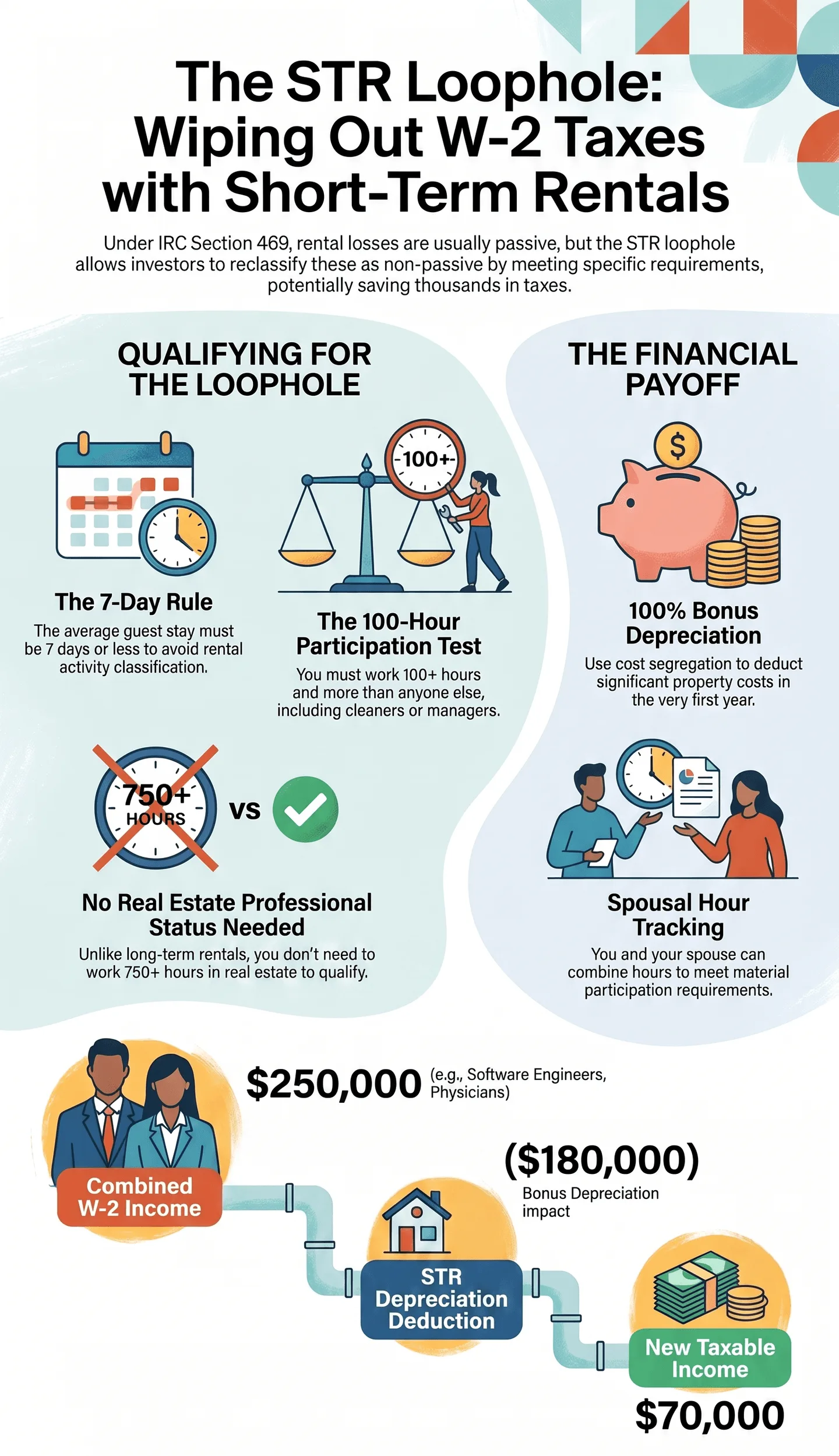
The STR loophole takes a different approach entirely — instead of trying to qualify as a real estate professional, it exploits the fact that the technical definition of "rental activity" (found in Treasury Regulation §1.469-1T(e)(3), not the statute itself) has six built-in exceptions. The one that matters here: under §1.469-1T(e)(3)(ii)(A), an activity is not a rental activity if the average period of customer use is 7 days or less.
If your short-term rental clears this bar, it simply isn't classified as a "rental activity" in the first place — which means the passive activity restrictions that apply to rentals don't automatically apply to it either. Calculate your average stay by dividing total rental days for the year by the number of separate guest stays. Forty bookings averaging four nights each is comfortably under 7. One 20-night booking mixed in with a season of short stays, however, can pull your annual average over the line and pull the whole property back into "rental activity" treatment for the year.
The Second Requirement: Material Participation
Clearing the 7-day threshold only gets you halfway. You also need to materially participate in the activity — a completely separate test from the 7-day rule, governed by Treasury Regulation §1.469-5T. The IRS provides seven ways to establish material participation, but two dominate in practice for STR owners:
- The 500-hour test: You participated more than 500 hours during the year — a high bar, but the cleanest one to document
- The 100-hour test: You participated more than 100 hours, and no other individual (including a co-host, cleaner, or property manager) participated more hours than you did
The 100-hour test is the one most STR owners actually rely on, and it's also where the strategy most often falls apart. If your property manager or cleaning crew logs more documented hours than you do, you fail this test — regardless of how many hours you personally worked. Keep a contemporaneous log, because the burden of proof is on you if the IRS ever questions the claim.
One detail worth flagging directly: hours spent on a qualifying STR do not count toward the 750-hour Real Estate Professional threshold, since by definition the STR isn't classified as a real property trade or business for that purpose. These are two separate strategies with two separate hour-counting rules — don't assume STR hours build toward REPS.
What Meeting Both Tests Actually Unlocks
Once a property clears the 7-day threshold and you materially participate, the activity is treated as non-passive — meaning losses from it can offset active income, including W-2 wages, without the $25,000 cap or MAGI phase-out that constrains ordinary rental losses.
This is where cost segregation and 100% bonus depreciation (covered in our related article on bonus depreciation and cost segregation) combine with the STR loophole to generate substantial first-year deductions. A cost segregation study identifies components of the property — flooring, fixtures, certain land improvements — that qualify for accelerated 5, 7, or 15-year depreciation instead of the standard 27.5-year schedule. With 100% bonus depreciation now permanent under the OBBBA, those reclassified components can be fully deducted in year one.
A Realistic Example
A married couple with a combined $250,000 in W-2 income purchases a $600,000 short-term rental. A cost segregation study identifies 30% of the depreciable basis ($180,000) as short-life property. With 100% bonus depreciation, the full $180,000 is deducted in the first year. If the property qualifies under the 7-day rule and one spouse materially participates under the 100-hour test, that $180,000 loss can directly offset their W-2 income: $250,000 − $180,000 = $70,000 in taxable income for the year — a significant reduction achieved without either spouse quitting their job or claiming Real Estate Professional status.
Where This Strategy Actually Fails — Three Common Mistakes
Mistake #1: Averaging stays across too broad a mix of bookings. A property with mostly short stays but a few long-term bookings mixed in can accidentally cross the 7-day average for the year. Track this per property, per year — it isn't a one-time qualification.
Mistake #2: Assuming property management work counts against you by default. Using a property manager doesn't automatically disqualify you from material participation, but it raises the bar — you need documented hours exceeding theirs, which becomes harder the more you delegate.
Mistake #3: Treating this as a one-time election rather than an annual requirement. Material participation must be re-established for each property, every year. A great qualifying year followed by a year where you traveled extensively and let a manager run everything can flip the property back to passive treatment for that specific year.
Frequently Asked Questions
Do I need to be a real estate professional to use the STR loophole? No — this is the entire point of the strategy. Real Estate Professional Status requires 750+ hours and more than half your total working time in real property trades, which is impractical for most people with an unrelated full-time job. The STR loophole works through a different mechanism (the 7-day rule removing the property from "rental activity" classification), requiring only material participation in that specific property, not your overall career composition.
Does self-employment tax apply to STR income treated as non-passive under this loophole? Generally no, if you're reporting on Schedule E. Material participation for passive-loss purposes and self-employment tax exposure are governed by different rules — self-employment tax generally applies only if you're providing "substantial services" that push the activity to Schedule C. It's possible to be non-passive (material participation met) while still avoiding self-employment tax, as long as you're not providing hotel-like services to guests.
What happens if my average guest stay creeps over 7 days in a later year? The property reverts to standard rental activity treatment for that year, and losses become subject to the normal passive activity limitations again. This needs to be evaluated annually, not once at purchase — a property that qualified in year one isn't guaranteed to qualify in year three if your booking pattern shifts toward longer stays.
Can my spouse's hours count toward my material participation test? Yes — under Treasury Regulation §1.469-5T(f)(3), spouses' hours combine for material participation purposes on a joint return, regardless of whose name is on the property title. This is different from the Real Estate Professional Status rules, where spouses generally cannot combine hours for the 750-hour and more-than-half-time tests, but can combine for material participation specifically.