The Chens did almost everything right. Their short-term rental's average guest stay was 4 nights, comfortably under the 7-day threshold. They commissioned a legitimate cost segregation study. They had real income to offset — a combined $310,000 in W-2 salaries. On paper, this looked like a textbook STR loophole case. It wasn't, and the reason is worth understanding in detail because it's one of the most common ways this strategy actually fails.
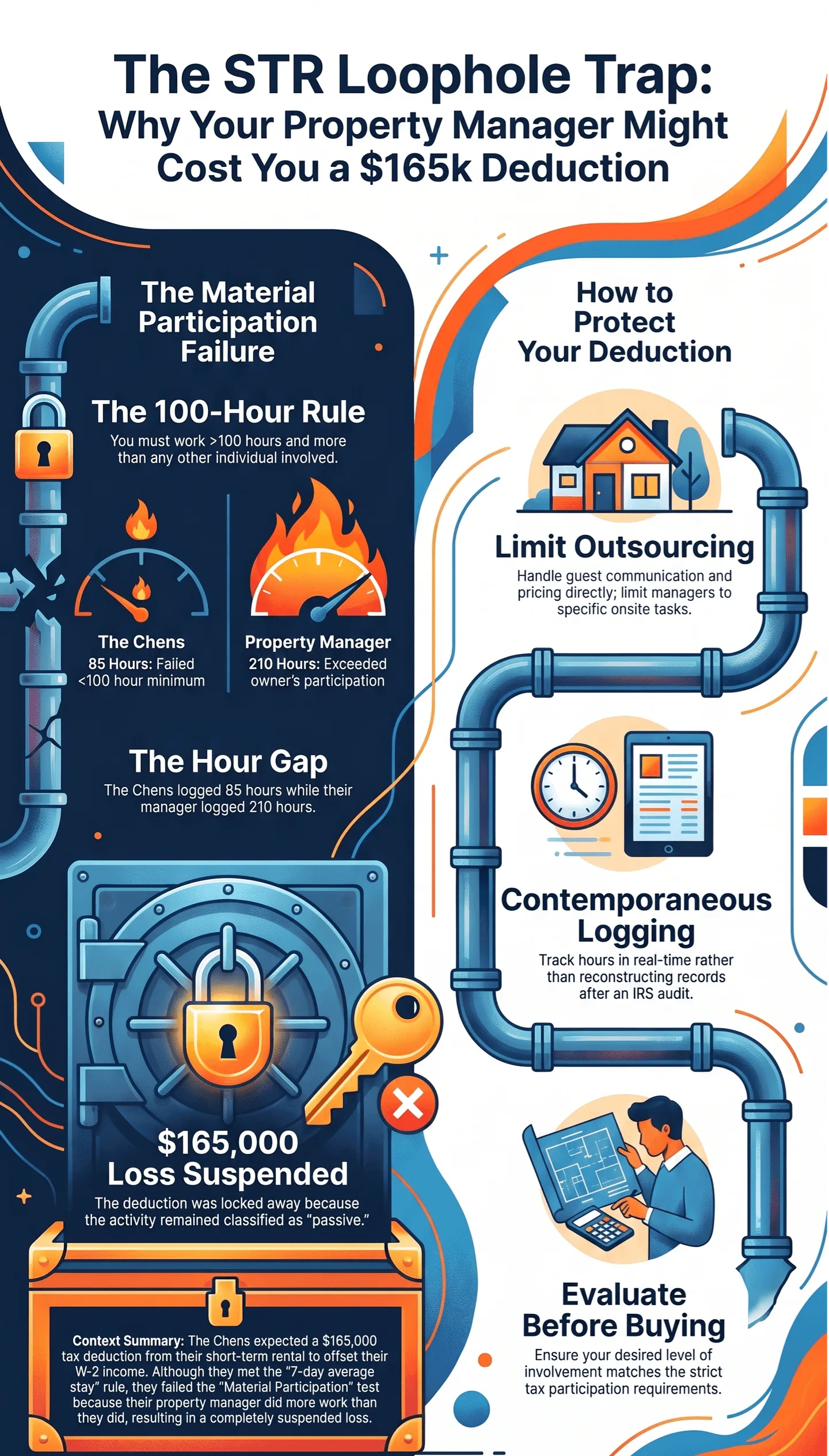
What the Chens Assumed Was Enough
The Chens hired a full-service property management company to handle their short-term rental from day one — guest communication, cleaning coordination, pricing adjustments, maintenance calls. This is a completely normal, sensible decision for two working professionals who don't have time to personally manage a rental. What they didn't realize is that outsourcing this heavily creates a direct conflict with one of the two requirements the STR loophole depends on.
The Two Numbers That Decided the Outcome
Material participation under the commonly used 100-hour test requires both of the following to be true simultaneously:
- You personally participated more than 100 hours during the year
- No other individual — including a property manager, cleaner, or co-host — participated more hours than you did
The Chens' actual numbers, reconstructed after the fact from their limited records:
- Their own documented participation: approximately 85 hours (reviewing financial reports, occasional guest issue escalations, periodic property visits)
- Property management company's documented hours: approximately 210 hours (day-to-day guest communication, cleaning coordination, maintenance dispatch)
They failed both parts of the test. 85 hours falls short of the 100-hour minimum on its own — and even if it hadn't, it's dramatically less than the 210 hours their property manager logged, which independently disqualifies them regardless of their own hour count.
What This Actually Cost Them
The cost segregation study on their $550,000 property had identified roughly $165,000 in accelerated depreciation — a real, legitimate deduction. But because the material participation test failed, the property remained classified as a standard passive rental activity. That $165,000 loss didn't disappear, but it also couldn't touch their W-2 income the way they'd expected.
Worse, because their combined MAGI ($310,000) is well above the $150,000 threshold where the standard $25,000 passive loss allowance phases out completely (see our related article on the $25,000 passive loss trap), none of that $165,000 loss was usable against any of their income this year. The entire amount became a suspended passive loss, carried forward on Form 8582 — available against future passive income, or fully released whenever they eventually sell the property, but locked away for the year they'd planned around it mattering most.
Why This Happens to Careful, Well-Intentioned Owners
The Chens didn't cut corners or misunderstand the tax code out of carelessness — they simply made a business decision (full outsourcing to a property manager) that happens to be in direct tension with a tax strategy that specifically requires hands-on involvement. Many owners considering the STR loophole focus heavily on the 7-day average stay rule, since it's the more commonly discussed piece, and underestimate how demanding the material participation requirement actually is once real property management support is involved.
What Would Have Needed to Change
To have qualified, the Chens would have needed to either dramatically reduce their reliance on the property manager (handling guest communication and coordination themselves, keeping the manager for narrower tasks like on-site cleaning only) or accept a much more limited management role for the property manager specifically to keep their own hours documented as exceeding it. Neither adjustment is necessarily practical for two full-time working professionals — which is exactly the tension this strategy creates for busy owners who want the tax benefit but also want genuinely passive ownership.
The Documentation Gap Made a Bad Situation Worse
A secondary problem compounded the Chens' situation: their own hours were reconstructed after the fact rather than tracked contemporaneously throughout the year. Even in a scenario where the actual hours might have been closer, the absence of a real-time log makes it harder to substantiate participation if the IRS ever questions the claim — this is a documentation failure independent of whether the underlying hours would have qualified.
The Lesson for Anyone Considering This Strategy
If you're evaluating a short-term rental purchase with the STR loophole specifically in mind, the honest question to ask before buying isn't just "does the average stay qualify" — it's "am I actually willing and able to personally do more hands-on work than whoever else is involved in managing this property." If the answer involves heavy reliance on a property manager, the tax strategy and the practical ownership experience you want may be in conflict.
Check Your Situation Before You Buy, Not After
The Chens' case is a reminder that this strategy needs to be evaluated honestly before a purchase, based on your actual planned involvement — not assumed to work simply because the property itself qualifies under the 7-day rule. Use our Airbnb Host Tax Classifier to think through both tests together before committing to a purchase built around this strategy.
Frequently Asked Questions
Could the Chens have qualified by reducing the property manager's hours instead of increasing their own? Potentially, yes — the test compares their hours against the property manager's, so either increasing their own participation or restructuring the property manager's role to a narrower set of tasks (reducing the manager's total hours) could change the outcome. This requires an honest assessment of whether the Chens are actually willing to take on more hands-on work, not just a paperwork adjustment.
Is the suspended $165,000 loss gone permanently? No — suspended passive losses carry forward indefinitely and remain available to offset passive income in future years, or are fully released in the year the property is sold in a taxable transaction, regardless of the Chens' income level at that time. The tax benefit isn't lost, but it's deferred to a future point rather than available against this year's W-2 income as originally planned.
Would hiring a less involved property manager have been a viable fix? Possibly — a lighter-touch arrangement (a manager who only handles cleaning coordination, for example, while the Chens handle guest communication and pricing directly) could shift the hour balance enough to pass the test, depending on the actual time each role requires. This is a real trade-off between convenience and tax outcome that's worth modeling before choosing a management structure, not after.