Priya runs a home goods e-commerce brand she started five years ago, structured as an S-Corp for the payroll tax savings. Her business does well — comfortably six figures in profit most years — but she pays herself a W-2 salary of $70,000, taking the rest as distributions the way most S-Corp tax guidance recommends.
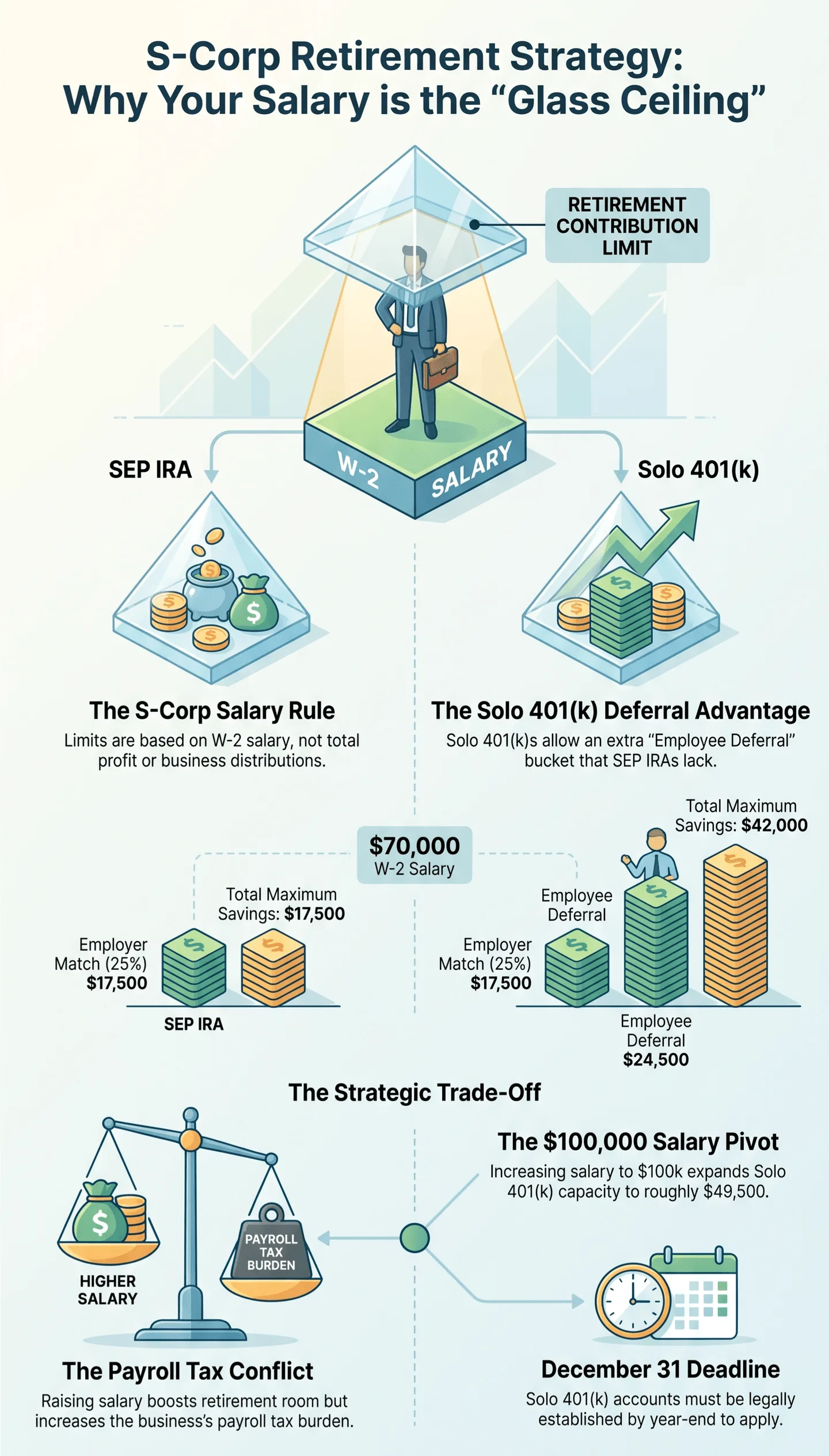
When she went looking for a retirement account, she assumed her contribution limit would somehow reflect her business's actual profitability. It doesn't. For S-Corp owners specifically, retirement contribution room is based entirely on W-2 salary — not total profit, not distributions, not anything else on the business's books.
Why S-Corp Owners Calculate Differently Than Sole Proprietors
For a sole proprietor, retirement contribution limits are based on net self-employment income, run through a formula that nets out roughly 20% after adjusting for self-employment tax. For an S-Corp owner like Priya, the calculation is more direct: contribution room is based on W-2 salary, using a straightforward 25% employer contribution rate — no self-employment tax adjustment needed, since S-Corp salary isn't subject to self-employment tax the way sole proprietor income is.
This means two business owners with identical total profit can have very different retirement contribution room, depending entirely on how much of that profit they've assigned to salary versus distributions.
What Priya's SEP IRA Allows at Her Current Salary
$70,000 salary × 25% = $17,500 maximum SEP IRA contribution
This is Priya's ceiling under a SEP IRA, regardless of how much her business actually profits in a given year — the SEP formula only sees the $70,000 salary line, not the rest of her business's performance.
What a Solo 401(k) Adds at the Same Salary
- Employee deferral: $24,500 (2026 limit) — available regardless of her business's total profit, as long as her salary supports it
- Employer contribution: The same 25% formula applied to her $70,000 salary: $17,500
Total: $24,500 + $17,500 = $42,000
The Gap
| SEP IRA | Solo 401(k) | |
|---|---|---|
| Employer contribution (25% of salary) | $17,500 | $17,500 |
| Employee deferral | Not available | $24,500 |
| Total | $17,500 | $42,000 |
Difference: $24,500 — and notice where this entire gap comes from: it's exactly equal to the employee deferral, since the employer-side math is identical between the two account types for an S-Corp owner. The SEP IRA simply has no equivalent to the employee deferral bucket at all.
The Reasonable Compensation Trade-Off Priya Actually Faces
Here's where Priya's situation gets more interesting than a simple account-type comparison. Because her retirement room is tied directly to her salary, she has a genuine lever most sole proprietors don't: increasing her salary increases her retirement contribution room — but it also increases the payroll taxes she and her business pay on that higher salary, which is the exact opposite of why she elected S-Corp status in the first place.
If Priya raised her salary to $100,000, her Solo 401(k) room would grow to roughly $49,500 (employee deferral plus 25% of the higher salary) — a real increase in savings capacity, purchased at the cost of higher payroll tax on the additional $30,000 in wages. This is a genuine trade-off, not a free upgrade, and it's worth modeling against her specific payroll tax rate rather than assuming more salary is automatically better.
Why This Catches S-Corp Owners Off Guard
Many S-Corp owners, like Priya, structure their compensation specifically to minimize salary (and therefore payroll tax) while maximizing distributions — sound, standard tax planning. The unintended side effect is that this same salary-minimizing strategy also caps their retirement contribution room, since that room is calculated off the same number they've been trying to keep low. There's no way around this tension entirely — it's a real trade-off between current-year payroll tax savings and retirement contribution capacity, and the right balance depends on how much Priya values one against the other at this stage of her career.
What Doesn't Change: The December 31 Deadline
Regardless of which account Priya chooses, a Solo 401(k) needs to be legally established by December 31 for that year's contributions to apply — the same deadline that applies to sole proprietors applies to S-Corp owners using this account structure.
Run Your Own Numbers
If you're an S-Corp owner, your retirement contribution math depends on a number you're actively choosing every year — your salary — which makes this worth revisiting periodically rather than assuming your setup from three years ago is still optimal. See your specific numbers with our Solo 401(k) vs SEP IRA Calculator, and if you're unsure whether your current salary level makes sense at all, our S-Corp Readiness Assessment is a good starting point.