Most home equity line of credit guides walk through the same territory: credit score requirements, loan-to-value limits, which lenders offer the best rates. Almost none of them spend much time on what actually happens to your payment once you're a few years into the loan — and that's the part that determines whether a HELOC works out the way you expected.
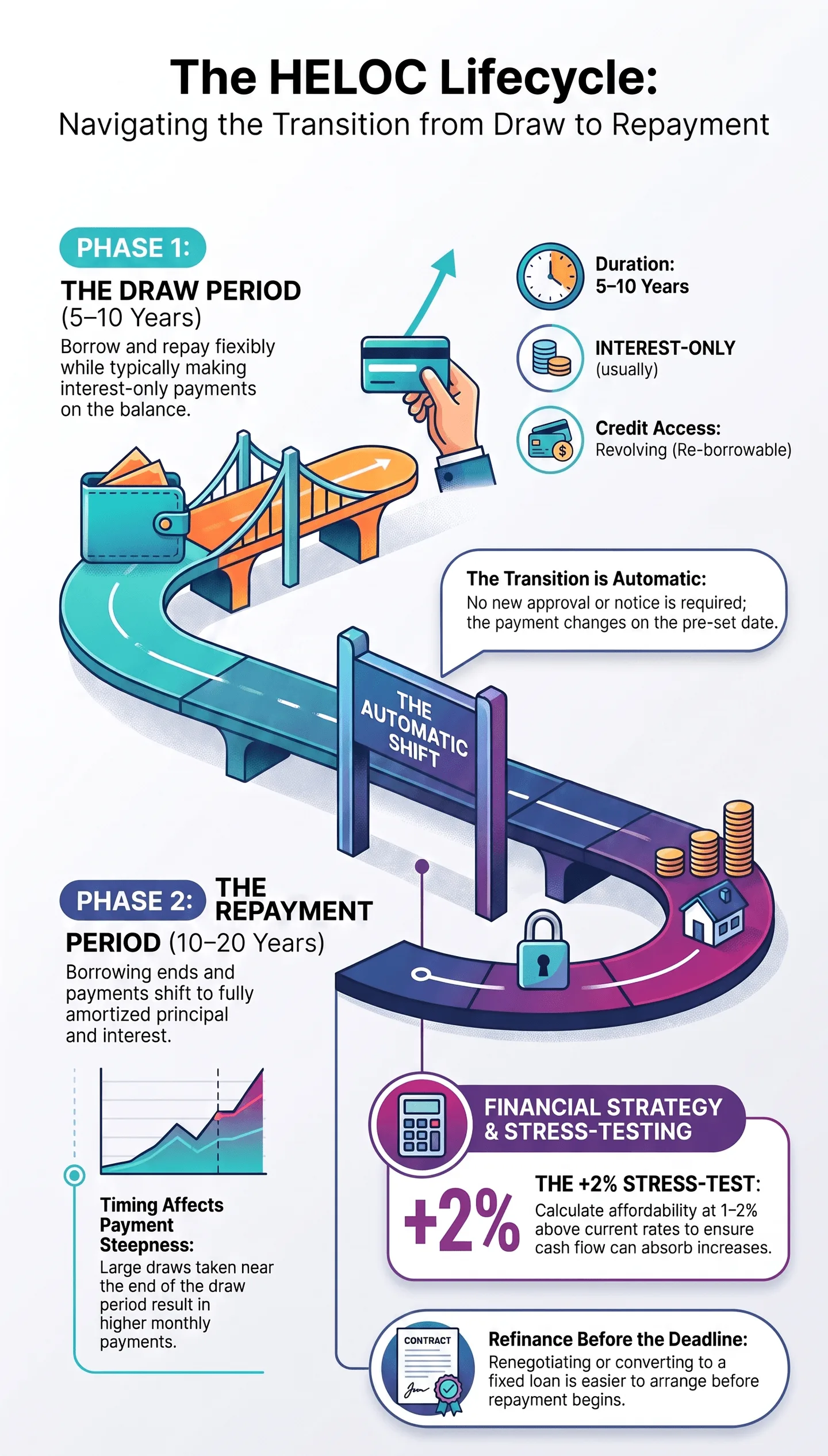
The Two-Phase Structure
A HELOC is structured in two distinct phases from the moment it's originated, and the terms don't change based on how you use the funds.
The draw period typically runs 5 to 10 years. During this window, you can borrow against your available credit line, repay some or all of it, and borrow again — similar to a credit card, but secured against your home's equity. Most lenders only require interest payments on the outstanding balance during this phase, which is why early payments are low relative to the amount borrowed.
The repayment period typically runs 10 to 20 years after the draw period ends. You can no longer draw new funds, and your required payment shifts to fully amortizing — principal and interest together, calculated to pay off whatever balance remains by the end of the total loan term.
The Transition Isn't Optional or Negotiated in the Moment
The shift from draw period to repayment period happens automatically on the date set at origination. There's no renewal application, no new approval process, and no additional notice requirement beyond what's already disclosed in your original loan documents. If you haven't specifically calculated what your payment will be once that date arrives, the first time you'll see the real number is on the statement after the transition.
This is also why the timing of a draw matters. A large draw taken early in the draw period has more time to be paid down once repayment begins; the same draw taken in the final year or two of the draw period compresses into a shorter repayment window, producing a steeper monthly payment.
Why the Interest-Only Payment Isn't the Number to Plan Around
The core planning principle is straightforward: the interest-only payment is temporary by design, so it's the wrong figure to use when evaluating whether you can actually afford what you're borrowing. A more reliable approach is to calculate the fully amortizing payment at the outset — what you'd owe monthly once the repayment period begins — and, since most HELOCs carry variable rates tied to the prime rate, stress-test that figure at a rate 1 to 2 percentage points above today's.
If your income, or a rental property's cash flow, can't comfortably absorb that higher, stress-tested figure, the draw carries more real risk than the current interest-only statement suggests.
Options Before the Repayment Period Begins
Borrowers aren't necessarily locked into the repayment-period payment once the draw period ends. Many lenders allow refinancing into a new HELOC, converting the balance into a fixed-rate home equity loan, or in some cases negotiating an extended draw period — though these options typically require re-qualifying based on current credit and income, and are far easier to arrange proactively than after a higher payment has already started.
Sources: Consumer Financial Protection Bureau, HELOC guidance; standard draw/repayment period disclosures from major HELOC lenders, 2026.
Frequently Asked Questions
How long is a typical HELOC draw period? Most HELOCs have a draw period of 5 to 10 years, though this varies by lender. Payments during this window are usually interest-only on the outstanding balance.
Does my payment increase immediately when the draw period ends? Yes, typically with no grace period. The payment recalculates to a fully amortizing figure starting the month after the draw period ends.
Are HELOC rates fixed or variable? Most HELOCs carry a variable rate tied to an index like the prime rate, meaning the rate — and therefore the payment — can change over the life of the loan, independent of the draw-to-repayment transition.
Can I pay down principal during the draw period even though it's not required? Yes, and doing so reduces the balance that will be amortized once the repayment period begins, which lowers the eventual repayment-period payment.
What happens if I can't afford the repayment-period payment when it arrives? Options generally include refinancing into a new credit line, converting to a fixed home equity loan, or in some cases negotiating a modification with your lender — all of which are easier to arrange before the transition than after a missed or strained payment.