David is 45 and drew $80,000 against his home's equity to invest in the market, expecting his investment returns to comfortably outpace the HELOC's interest rate. For the first few years, the math worked in his favor. Then, in the same year his draw period ended and his payment shifted to fully amortizing, the market had a down year — and David found himself covering a higher loan payment with a portfolio that had temporarily shrunk, rather than grown, right when he needed it to do the opposite.
The Plan on Paper
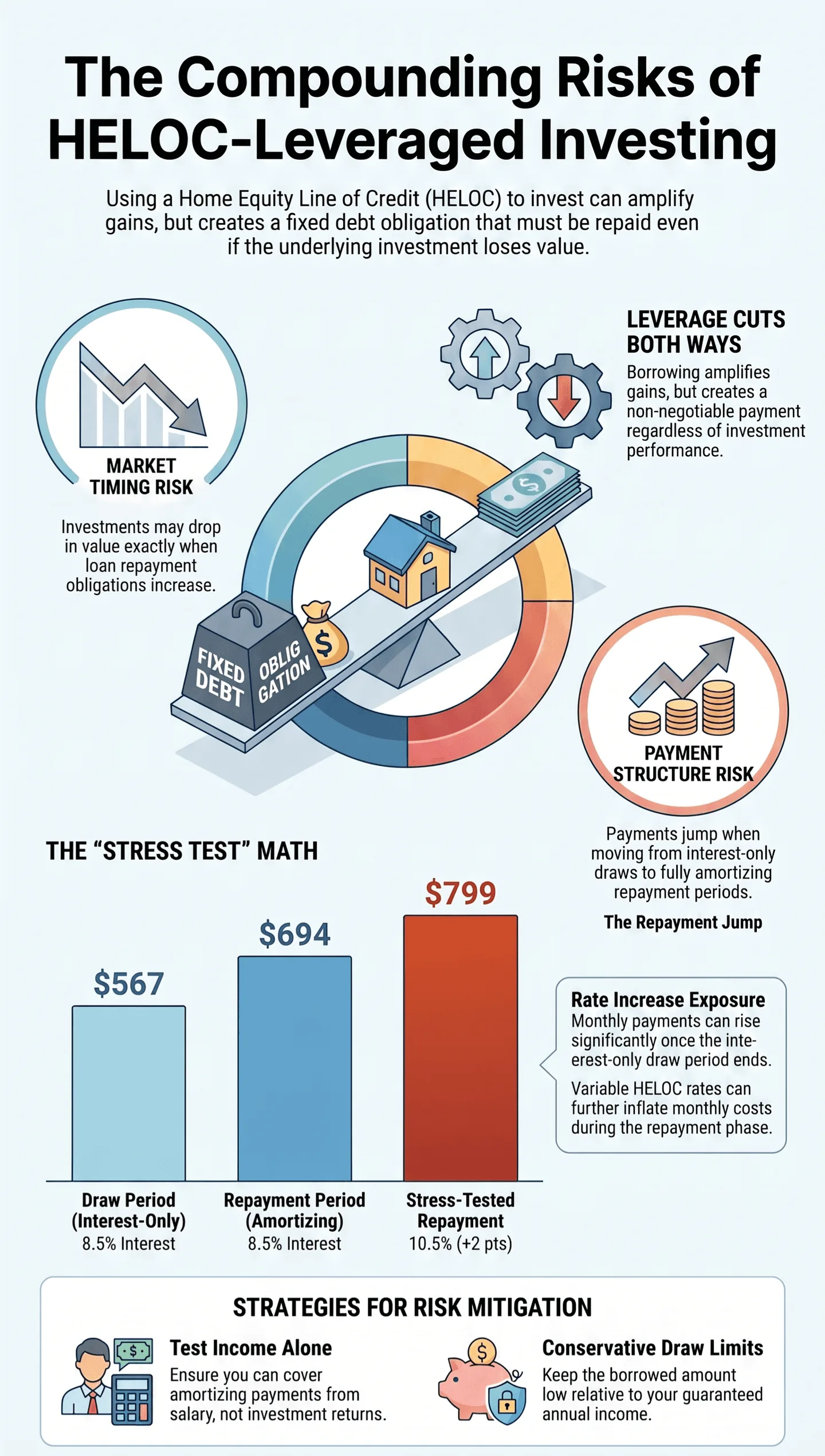
David's HELOC carried a variable rate around 8.5%. His reasoning was straightforward: historically, market returns have outpaced that rate over long periods, so borrowing at 8.5% to invest for a higher expected return looked like a reasonable trade, especially since the draw period's interest-only payment — about $567 a month on the $80,000 balance — was easy to absorb alongside his regular expenses.
What He Hadn't Stress-Tested
What David's plan didn't account for was two risks landing in the same window: market timing risk and payment structure risk, compounding rather than staying independent of each other.
When his draw period ended, his payment shifted to a fully amortizing $694 a month — manageable on its own. But that same year, his invested portfolio was down, meaning the asset he'd borrowed against expecting growth was temporarily worth less than what he'd put in, at the exact moment his required payment increased. Stress-tested at a 2-point rate increase, that repayment payment would climb further, to roughly $799 a month.
The Full Math
- HELOC draw amount: $80,000
- Draw period payment (interest-only): $567/month
- Repayment period payment (fully amortizing): $694/month
- Stress-tested payment (+2 points): approximately $799/month
- Portfolio value the year the draw period ended: down from the original $80,000 invested, due to market conditions that year
Why Leverage Cuts Both Ways
Borrowing to invest amplifies outcomes in both directions — when returns outpace the borrowing cost, the strategy works better than not borrowing at all; when they don't, the borrower is exposed to a fixed, non-negotiable repayment obligation regardless of how the investment performed. Unlike an unleveraged investment, where a down year simply means paper losses to ride out, a HELOC-funded investment carries a required monthly payment that doesn't pause or shrink just because the underlying investment did.
The repayment-period payment obligation and market performance are independent risks — nothing links them together to move in the same, favorable direction. Planning around this strategy means being able to cover the fully amortizing, stress-tested payment from income alone, without depending on the investment being up at that specific moment.
What This Isn't
This isn't an argument that borrowing to invest is always a mistake — plenty of investors use leverage deliberately and successfully, and David's portfolio may well recover over time. The issue is narrower: the repayment-period payment needs to be affordable on its own, from income, independent of what the invested funds are doing at that moment. Treating the investment's expected returns as the source of the repayment funds — rather than as a separate, hoped-for bonus — is where the plan carries more risk than it appears to on paper.
Check Your Own Number
If you're considering — or already carrying — a HELOC used to invest, the repayment-period payment needs to work on its own, without relying on investment performance to cover it. Run your draw amount, rate, and income through our HELOC Risk Stress Test to see that number clearly.
Frequently Asked Questions
Is it common to use a HELOC to invest in the market? It's a known strategy sometimes called "leveraged investing" or "portfolio margin via home equity," but it carries meaningfully more risk than investing with cash you already have, since the loan payment is a fixed obligation regardless of investment performance.
What happens if my portfolio is down when the repayment period starts? Your required HELOC payment doesn't change based on your portfolio's value — you'd need to cover the fully amortizing payment from income or other savings, independent of whether the investment has recovered.
Is HELOC interest used for investing tax-deductible? Interest on a HELOC used for investment purposes may be deductible as investment interest expense, subject to IRS limitations tied to your net investment income — this is different from the rules for HELOC funds used on the home itself. Consult a CPA for your specific situation.
How can I reduce this risk if I still want to invest with a HELOC? Options include stress-testing the repayment-period payment against your income alone (not counting on investment gains), keeping the draw amount conservative relative to your income, and having a plan to pay down principal before the repayment period begins rather than only after it starts.