If you researched bonus depreciation any time before mid-2025, you probably came away with the impression that it was fading out — scheduled to drop to 20% in 2026 and disappear entirely by 2027. That plan no longer exists. The One Big Beautiful Bill Act (OBBBA), signed July 4, 2025, permanently restored 100% bonus depreciation, and the IRS has since issued detailed guidance (Notice 2026-11) confirming exactly how it works.
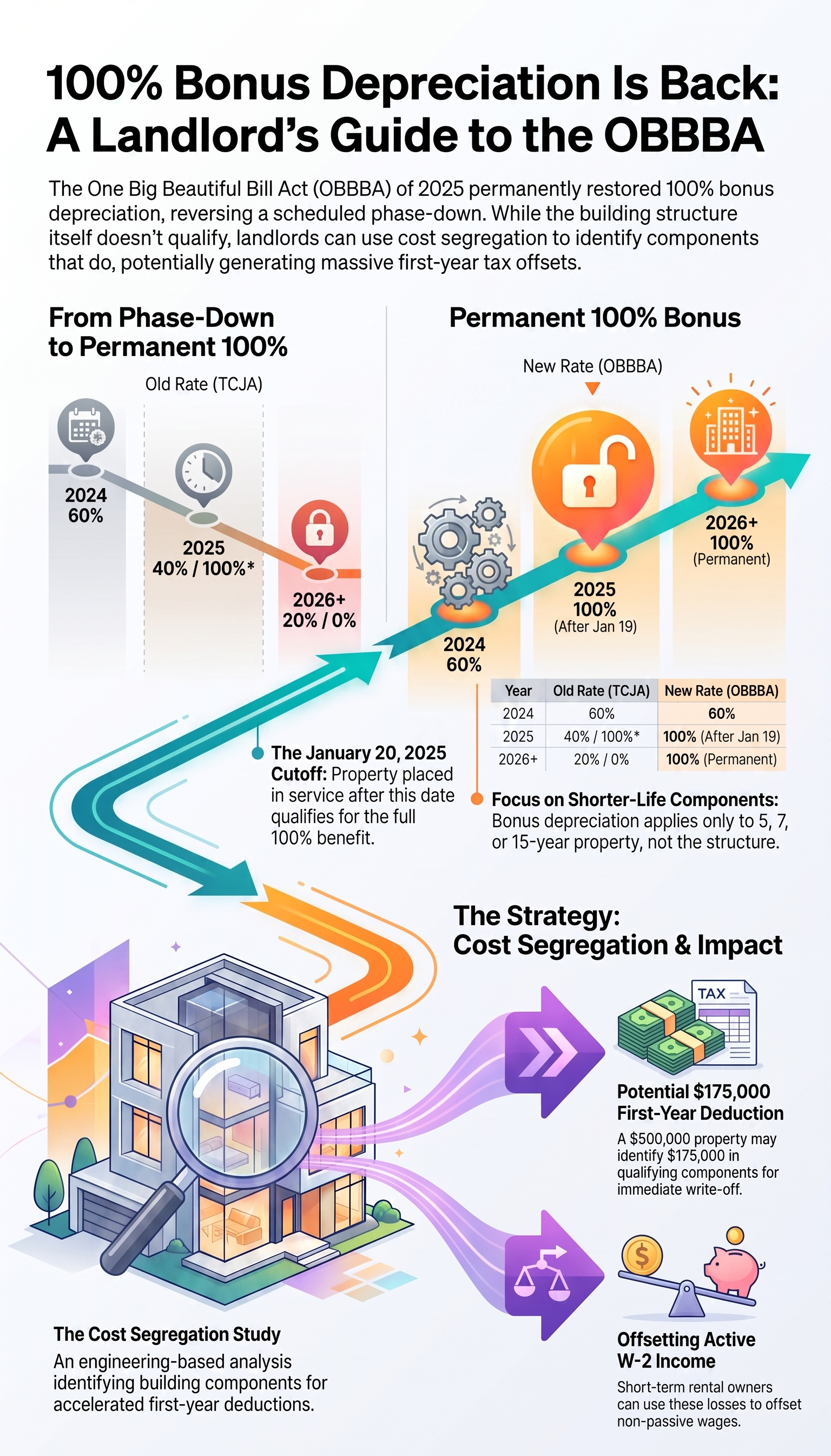
What Actually Changed
Under the prior law (Tax Cuts and Jobs Act), 100% bonus depreciation was phasing down on a fixed schedule: 80% in 2023, 60% in 2024, 40% for the first part of 2025, with a drop to 20% in 2026 and full elimination in 2027. The OBBBA reversed this entirely. Property acquired and placed in service after January 19, 2025 now qualifies for 100% bonus depreciation — permanently, with no scheduled phase-down.
There's a precise dividing line worth knowing if you placed anything in service in early 2025: property placed in service between January 1 and January 19, 2025 still falls under the old 40% rate. Anything placed in service January 20, 2025 or later gets the full 100%. For 2026 acquisitions specifically, the rate is uniformly 100% — the timing complexity only matters if you're looking back at early-2025 transactions.
Why This Matters More for Landlords Than the Headlines Suggest
Bonus depreciation itself doesn't apply to the building structure of your rental — that's still depreciated over 27.5 years using straight-line MACRS, unaffected by this change. Where bonus depreciation becomes powerful for landlords is in combination with cost segregation.
A cost segregation study is an engineering-based analysis that identifies components of your rental property that qualify for much shorter depreciation periods than the building itself — carpeting, cabinetry, certain electrical and plumbing components, fencing, landscaping, and similar items, which the IRS classifies as 5-year, 7-year, or 15-year property rather than 27.5-year real property. Those shorter-life components are exactly the category that bonus depreciation applies to.
With 100% bonus depreciation restored and made permanent, any component identified through a cost segregation study as 20-year-or-shorter property can be fully deducted in the first year, rather than spread across its normal depreciation schedule.
What This Looks Like in Practice
On a $500,000 rental property, a cost segregation study might identify $125,000 to $175,000 worth of components — flooring, cabinetry, certain fixtures, land improvements — that qualify for accelerated 5, 7, or 15-year treatment instead of the standard 27.5-year building depreciation. Before OBBBA, with bonus depreciation phasing down toward 20%, only a fraction of that reclassified amount could be deducted immediately. With 100% bonus depreciation now permanent, the entire reclassified amount can potentially be deducted in the year the study is completed and the components are placed in service.
This is the mechanism behind what's often called the "short-term rental loophole" for landlords who materially participate in managing an STR with an average guest stay of 7 days or less — the accelerated depreciation from a cost segregation study can generate a substantial first-year paper loss, and because STR income under those conditions isn't classified as passive under IRC 469, that loss can offset active income, including W-2 wages, without the usual $25,000 passive loss cap.
This Isn't a DIY Project
A cost segregation study is a specialized engineering and tax analysis, not something to attempt from a spreadsheet. It typically requires a qualified cost segregation firm or engineering-credentialed tax professional to properly document and defend the component classifications — this is an area the IRS scrutinizes closely, and misclassification carries real audit risk. The study itself has a cost, typically ranging from a few thousand dollars for a smaller residential property to significantly more for larger or more complex properties, which is worth weighing against the projected tax benefit before committing.
Who This Makes the Most Sense For
Cost segregation combined with 100% bonus depreciation delivers the most value for landlords who:
- Have meaningful active income to offset (W-2 wages or business income), which is only usable against rental losses if the STR loophole or real estate professional status applies
- Plan to hold the property for a while, since accelerating depreciation now means less depreciation available in later years, and increases the depreciation recapture exposure at eventual sale
- Recently acquired or renovated a property, since cost segregation studies are typically most cost-effective when performed close to acquisition or after a major renovation, though "look-back" studies on older properties are also possible
The Trade-Off Worth Understanding Before You Commit
Accelerating depreciation isn't free — it's a timing choice, not a permanent tax reduction. Every dollar of bonus depreciation you claim now reduces your future depreciation deductions in later years (since you've already used them up front), and increases the depreciation recapture liability you'll face when you eventually sell (see our related article on the depreciation recapture trap). For landlords planning to hold long-term or eventually do a 1031 exchange, this trade-off often still favors acceleration — but it's a decision worth modeling with a CPA rather than assuming bigger deductions now are automatically better. Start by seeing your standard depreciation numbers in our Landlord Tax Estimator before deciding whether a cost segregation study is worth the added expense.
Frequently Asked Questions
Does bonus depreciation apply to the rental building itself? No — the building structure remains on the standard 27.5-year straight-line depreciation schedule for residential rental property, unaffected by bonus depreciation rules. Bonus depreciation applies to shorter-life components (typically 20 years or less) identified through a cost segregation study, or to certain personal property and land improvements associated with the rental.
Do I need a cost segregation study to benefit from 100% bonus depreciation at all? For most landlords, yes — without a cost segregation study, there's little in a typical residential rental that falls into the 20-year-or-shorter property categories bonus depreciation applies to. Appliances and certain land improvements can sometimes be identified without a formal study, but a full cost segregation study is what unlocks the larger deductions from building components.
Is 100% bonus depreciation actually permanent, or could it change again? The OBBBA restored it without a scheduled sunset date, unlike the prior TCJA version which always had a built-in phase-down. That said, "permanent" in tax law means "until Congress changes it again" — the same OBBBA that restored this rate could theoretically be modified by future legislation. As of the IRS's Notice 2026-11 guidance, there's no scheduled expiration, but tax law is never guaranteed to stay fixed indefinitely.
How does this interact with the passive loss rules I already deal with as a landlord? Bonus depreciation and cost segregation don't change the passive activity rules themselves — a large first-year loss from accelerated depreciation is still subject to the same $25,000 allowance and MAGI phase-out (or full passive treatment) that applies to your rental losses generally, unless you qualify for real estate professional status or the short-term rental exception. The size of the deduction changes; which rules apply to using that deduction does not.